
The best safety razor depends on your experience level, beard type, and shaving goals. This guide compares the top safety razors across all major categories so you can choose the right one. These are the top safety razors we’ve tested, including beginner-friendly, adjustable, and high-efficiency options for different shaving needs.
If you are trying to decide which safety razor to buy, start with models that consistently balance efficiency, comfort, and control. The best safety razor is not necessarily the most aggressive or the most talked about. It’s the one that delivers a predictable, comfortable shave for your specific needs.
If you’re thinking about switching to a safety razor from a cartridge razor, be sure to read our comparison guide first. If you’re confused about all the different options and what they mean, take a look at our single blade razor explainer.
Not sure which safety razor guide you need?
This is the main Sharpologist safety razor guide across experience levels and razor types. If you are buying your first safety razor, start with the beginner safety razor guide. If your main problem is shaving tight areas, see the guide to safety razors for under the nose. If you specifically want adjustability, see the adjustable safety razor guide. If irritation is your main concern, see the sensitive-skin safety razor guide.
Quick Answer
The best safety razor is the one that matches your skin sensitivity, beard type, and shaving goals while still removing stubble efficiently. For most shavers, the Merkur 34C is a long-established best overall starting point, but beginners, sensitive-skin shavers, coarse-beard shavers, and adjustable-razor users may need different designs.
Top Safety Razor Picks (Quick Summary)
These are the best safety razors based on real-world performance, grouped by where they work best. The categories below reflect the most common shaving needs and use cases.
- Best Overall Safety Razor: Merkur 34C – balanced efficiency and comfort for most shavers
- Best Safety Razor For Beginners: Supply SE, OneBlade (single edge); Weishi Nolstalgic (double edge) – mild, forgiving, easy to learn
- Best Budget Option: Baili BD179 – strong performance at a lower price point
- Best Safety Razor For Sensitive Skin: Rockwell 6S – smooth feel with reduced irritation risk
- Best Butterfly Safety Razor: Rockwell T2 Adjustable Razor – easy blade changes
- Best Open-Comb Safety Razor: Parker 26C – classic open-comb design with efficient cutting
- Best Mild Safety Razor: Henson AL13, Feather AS-D2 – low blade exposure and highly forgiving
- Best for Coarse Beards: RazoRock Lupo Open Comb 95 – higher efficiency with controlled blade feel
- Best Adjustable Safety Razor: Rockwell T2 Adjustable Razor In Stainless Steel – versatile adjustment across multiple settings
- Best Slant Bar Safety Razor: RazoRock SuperSlant – angled head design for efficient cutting
- Best for Precision Areas: Parker Adjustable Injector razor – compact head for tight spots
[NOTE: Amazon, OneBlade, PAA, Rockwell, and Supply links are affiliate. Geni.us links may be affiliate. However Sharpologist was not directly paid by any manufacturer for these recommendations.]
How We Evaluated These Safety Razors
Choosing the best safety razor requires more than comparing blade gaps or reading manufacturer claims. Performance depends on how a razor balances efficiency, comfort, and control in real-world use.
Each razor considered here was evaluated across several factors:
Efficiency and Blade Feel
How easily the razor removes stubble and how much blade presence it communicates to the skin. A razor can be efficient without feeling harsh, and overly mild razors can sometimes cause irritation through repeated passes.
Forgiveness and Margin for Error
How the razor behaves when angle or pressure is slightly imperfect. This is especially important for beginners and for daily shaving.
Head Geometry and Maneuverability
The shape and profile of the head affect how easily the razor shaves under the nose, around the jawline, and along tight contours.
Weight, Balance, and Grip
A well-balanced razor encourages proper technique. Excess weight or poor balance can lead to unconscious pressure and increased irritation.
Consistency Across Different Beard Types
Razors were assessed on light, medium, and coarse growth to determine how broadly applicable they are.
Value Relative to Performance
Price alone does not determine quality. Some razors justify a higher cost through machining precision, materials, and long-term durability. Others offer excellent performance at a lower price point. Each recommendation reflects how well the razor performs for its intended use relative to its cost.
These recommendations reflect practical, repeatable performance across different use cases, not just initial impressions or popularity. Some razors excel in a narrow category. Others perform reliably for most shavers. The distinctions below are based on where each design performs best.
Detailed Safety Razor Reviews And Honorable Mentions
Searching for the best safety razor in 2026? This guide offers a simple but complete look at different razor types for various needs, helping you make an informed choice to help get the best shave, whether you’re a beginner or an old-hand. This is an update to a continuing series on Sharpologist!
This guide covers the best safety razors overall, across experience levels and shaving styles. Generally-speaking, cutting facial hair is the primary objective.
Criteria For The Top Safety Razor
Why trust this article? Because Sharpologist specializes in getting the best, most enjoyable shave possible.
Basic Criteria:
- The experience of Sharpologist editors, contributors, and readers who have actually purchased and use the razor as well as research over 10 years of research on various specialty internet forums, review sites, and blogs.
- Reputation of the manufacturer and the general quality control of the razor’s production;
- Length of time on the market;
- Razor’s general availability, stability of design, and popularity;
- Razor’s over-all value (quality vs. price).
Remember the old adage, “Your Mileage May Vary!”
These are not the only products of course–there are many truly excellent premium, artisan-made razors! If you know of a good razor not listed here be sure to mention it in a comment! All the prices in this article are in U.S. dollars and approximate.
Safety Razor Category Analysis and Honorable Mentions
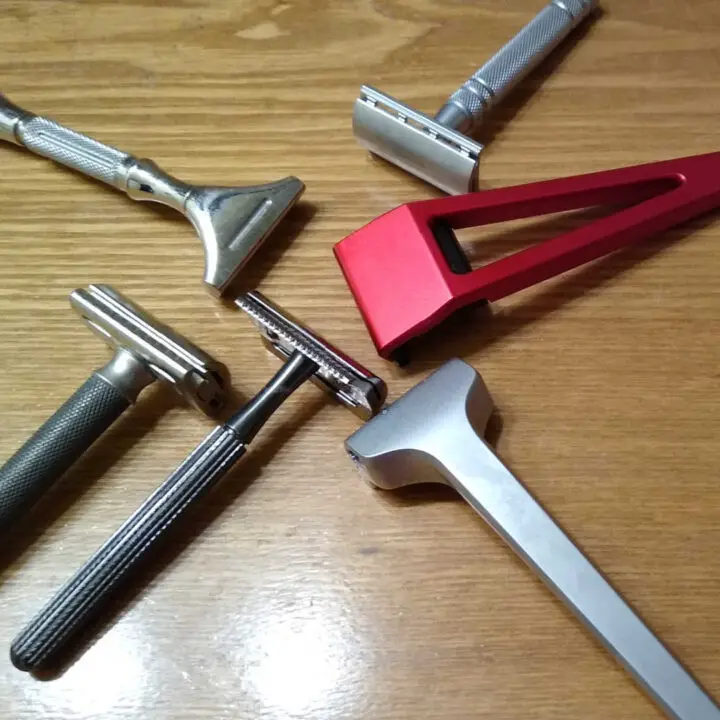
There is some disagreement about just what is a “safety razor.” On one side of the spectrum are those who say it is any razor with a blade (or blades, in a cartridge) and some kind of design to protect the blade from exposing too much of its edge to the skin: anything from long-defunct vintage designs from 100+ years ago to the latest multi-blade, pivoted razor.
At the other end of the spectrum others will argue the term refers only to the classic double edge (“DE”) razor and designs.
For the purposes of this article the term “safety razor” will refer to a razor with a single, non-proprietary blade (where patents have expired) and some kind of design that prevents excessive blade edge exposure to the skin’s surface. For a detailed look at the different design types, see our article on single blade razors.
Skip To:
- Merkur 34C
- OneBlade
- Supply SE
- = Beginner Looking For A Classic Double Edge Style Razor
- RazoRock Quick Change (plus Baili BD179)
- Rockwell 6S
- Rockwell T2 Adjustable Razor
- Parker 26C
- = A Variation On The OC Razor: The Self-Lubricating Or Double Open Comb
- Henson AL13
- Feather AS-D2
- RazoRock Lupo Open Comb 95
- Rockwell T2 Adjustable Razor in Stainless Steel
- RazoRock Superslant
Merkur 34C – Best Overall Safety Razor
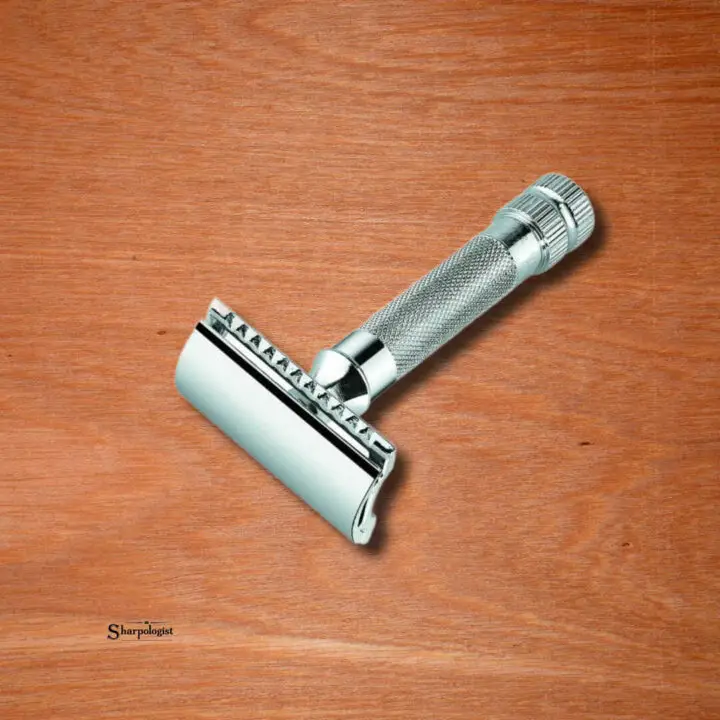
The Merkur 34C all metal safety razor (also known as the Merkur HD, Merkur Heavy Duty, Merkur Heavy Classic, Merkur Model 178) is the closest thing to a “standard” safety razor for modern times: it is widely available, very popular, and there are many reviews found with a simple search engine query. It is an all metal razor designed and manufactured in Germany that features a scalloped closed comb, and a short handle with a diamond knurled grip, making it easy to hold and maneuver. The razor’s weight is about 2.7 oz. (77 grams) and the handle is 3 inches long.
Why is the Merkur 34C so popular? The company’s time in the market and this razor’s general reputation and reliability have made it a major name in the industry. This razor is known for its good weight and balance, and solid build quality (though durability has been called into question according to some recent reviews), making it a great choice for both beginners and experienced wet shavers alike. The “C” in the model number denotes a chrome plated finish. A gold-tone finish version, the 34G, may also be available. Note: the Merkur 38C razor has the same razor head on a longer handle.
Advantages
- “Middle of the road” shave, suitable for most shavers.
- Good handle texturing and grip.
- Good engineering design.
- Simple, two piece design (razor blades easier to replace).
- Affordable.
- Widely available.
Disadvantages
- Short handle compared to some other razors (offset by the 38C).
- Durability may have declined recently.
- Some non-visible parts are not polished (but this does not affect the performance of the razor).
What Others Say
Amazon score of 4.5 with sentiment 86% positive ~7500 ratings. Fakespot grade: B with under 20% of reviews suspect.
“Coming from that butterfly design of safety razor sold under multiple names (Mine was Van Der Hagen), the quality of shave is night a day. Steaming hot shower, sensative shave gel, and this handle paired with a good blade is all you need.” – Trent
“All-in-all, the Merkur 34C is the ideal razor for anyone beginning with DE shaving, but it also is a classic and should be included in any veteran’s shaving cabinet. The quality will last, and the design will teach. It’s the perfect combination of form and function.” – Tailor And Barber
“The 34c is a great starter razor, good shave. Its neither too mild or too aggressive. Easy to get, good price, solidly made. You can buy any razor you want after starting which guys usually do. When I was in the shaving hobby years ago I bought mostly all the Merkur models, there was very little difference between them but the 34c seemed the best of the lot.” – Tight_Lime6479
Honorable Mentions: Muhle R89, Edwin Jagger DE89, Rockwell 6S.
OneBlade Razor Pivoted Single Edge Safety Razor, Supply SE Single Edge Safety Razor – TIE – Best Safety Razor For Beginners
The OneBlade razor (not to be confused with the Phillips OneBlade trimmer) and the Supply SE razor are produced for those new to wet shaving in mind, aiming squarely at the wider consumer razor market, and might be best for those who are unhappy with mass-market, multi-blade razors but also a little reluctant to dive head-first into classic double edge razors for their first safety razor. Both razors are designed in USA and manufactured in China.
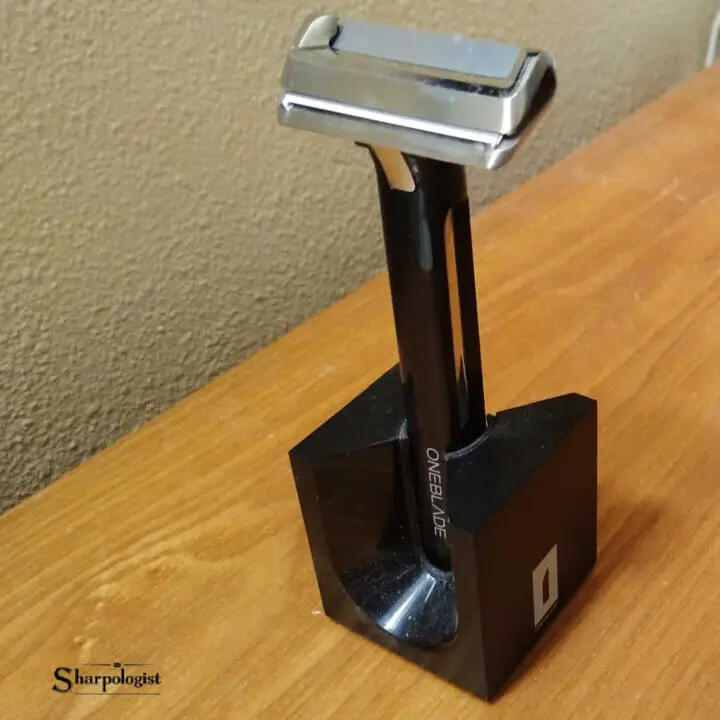
OneBlade razors, available in several different models/prices, combine the best of both worlds: a single blade razor with a pivoting head that follows skin contours. OneBlade razors use a blade that is not very common but is non-proprietary.
Advantages
- Pivoting head.
- Several models and price points.
Disadvantages
- Limited blade choice.
- May be too mild for some.
What Others Say
“I’ve been using the OneBlade Core for a year, and recently decided to upgrade to the OneBlade Element. I’m really impressed with this razor – it feels perfectly balanced with just the right weight. The new Hi Carbon Blades are a significant improvement over the Feather blades, providing me with a much closer shave.” – dmiller622
“I own 12 DE and a handful of SE razors, ranging in price from 50-300 dollars. This is by far the one that does it all. It shaves as close as my most dangerous double edge (that requires major technique and patience)….all the while, being as forgiving as a cheap cartridge razor.” – Tedzone
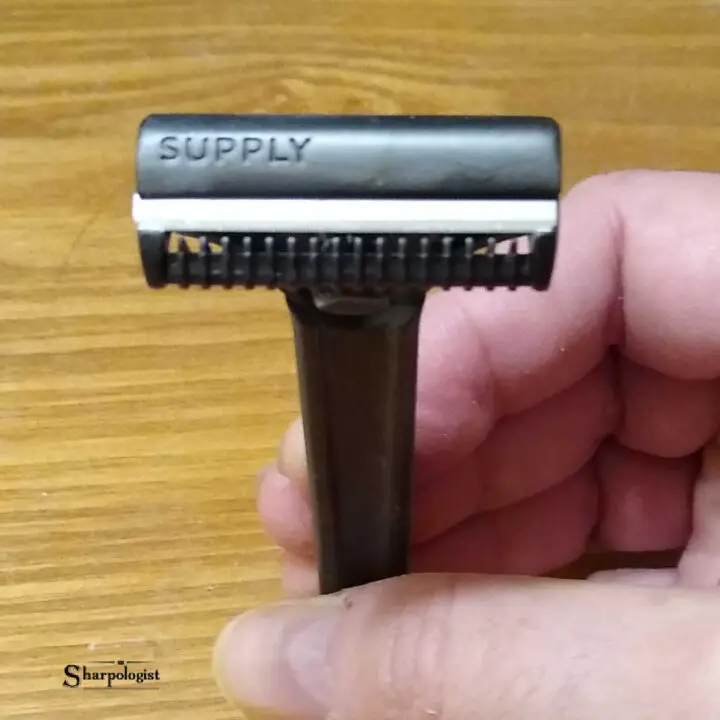
Supply SE razors use “Injector” style razor blades, a non-proprietary blade originally meant for use with razors that were popular up to about 1970 or so, fading with the introduction of multi-blade razor cartridges. However these blades are still available from several sources. The Supply SE is well-built and well-balanced. It also has a very wide range of angles that it may be held at with successfully, making very beginner-friendly. The razor is about 110mm long and weighs about 90 grams.
Advantages
- Comfortable on the skin.
- Generous blade angle “window.”
- Offered with several colors including Classic Matte, Black Matte, Rose Gold, and Polished Gold.
Disadvantages
- Limited blade source variety/selection
What Others Say
“Very clean and sharp shave. No issues at all. I have very sensitive skin on my upper lip and previous razors would always pull the hair and cause irritation; the SE didn’t pull or irritate at all. It was a single pass and took the hair right out. Best razor I’ve ever had.” – Aaron
“[T]he Supply razor consistently gives me the best home shave I’ve ever accomplished.” – Gordon Meyer
If You Are A Beginner Looking For A Classic Double Edge Style Razor
If you are a beginner who simply must have a classic DE razor, the Merkur 34C (above) can be a good choice for beginners. Also consider the Rockwell 6C for its versatility and price point, the Weishi Nostalgic for its value, or the Henson razor (see below) for its milder shave.
Related Post: Click/tap here to read Sharpologist’s extensive article about safety razors for the beginner.
Related Post: Click/tap here to read Sharpologist’s article about low cost razors
Rockwell 6S Best Safety Razor For Sensitive Skin
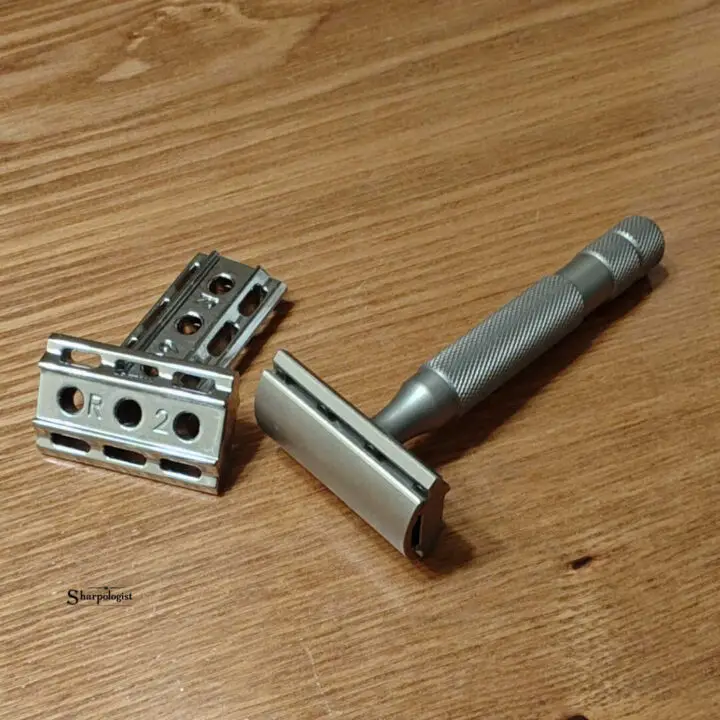
The Rockwell 6S razor, is made with biocompatible stainless steel and is comes with a set of unique “flippable” base plates that can make the shave milder or more aggressive. Designed in Canada and manufactured in USA, it is widely regarded as an excellent razor, not just for those with sensitive skin.
Advantages
- Manufactured with biocompatible stainless steel.
- Comes standard with a set of base plates for different shave settings.
Disadvantages
- Somewhat expensive.
- Depending on blade, some minor “tea staining” may result.
- Difficult to change base plates mid-shave.
What Others Say
Score of 4.7 with sentiment 90% positive on Amazon with ~650 ratings. Fakespot grade: B with under 20% of reviews suspect.
“I started shaving nearly 5 decades ago and in that time I have gone back and forth between shaving wet with various types of blades and shaving with an equally varied number of electric razors. Multi blade razors nicked and cut my face while electrics were never close enough but still irritated my skin and left me with razor burn. Shaving wet with soap and brush and a safety razor proved to be the answer. I had a decent brush and Merkur razor but once I had proven that was the right choice for me, I was ready to trade up for better equipment. I read the reviews and identified the Rockwell 6S as the gold standard for a comfortable shave and was attracted to the feature that allowed changing the angle of the blade to make it more or less aggressive. I have sensitive skin and my beard is on the light side so 4 was the one that worked best for me. Once I determined that I have experienced the most comfortable shaves of my life with no nicks or irritation yet still close. Being able to achieve a close yet comfortable shave without cutting my face has justified the $100 price tag.” – 4rthunter
“The one thing I love is the quality of this razor. The one thing I don’t like is if you need to add just it during a shave, you have to break it down and change base plates. Not for me.” – RJ
“I know there are differing sides on shaving. Cartridge, safety, straight edge and electric. In my teen years I started with an adjustable safety razor. I always had nicks each week for many years. Just couldn’t get the knack or the razors weren’t great back in the 70’s. So I went electric for many years. Got tired of not getting a close shave and switched to cartridges. Then the cost became a burden and back I went to electric, foil and rotary. But they just don’t shave closely and I would end up doing touch ups with a cartridge blade. How dumb is that. So finally after extensive research I decided on this Rockwell safety razor. Time to shave is not bad at all. I actually am enjoying the ritual. My shave is finally close, nothing left to feel on my face. Using a good shaving cream has left me with zero nicks, and the scent is great and lasts all day. All told with the razor, extra blades, brush, cream and balm it was under 150. Well worth it. My skin is healthier and my face is much smoother than ever before. This is an excellent razor, solid build, feels good in the hand, six adjustment plate settings for mild to aggressive shaving and simply a precision shaver that will last decades. Well worth the cost and I wish I had done this sooner. This is what proper shaving really is and thus is an excellent shaver.” – Edward L.
Related Post: Click/tap here for a Sharpologist article specifically about razors for sensitive skin.
Rockwell T2 Adjustable Razor – Best Butterfly Safety Razor
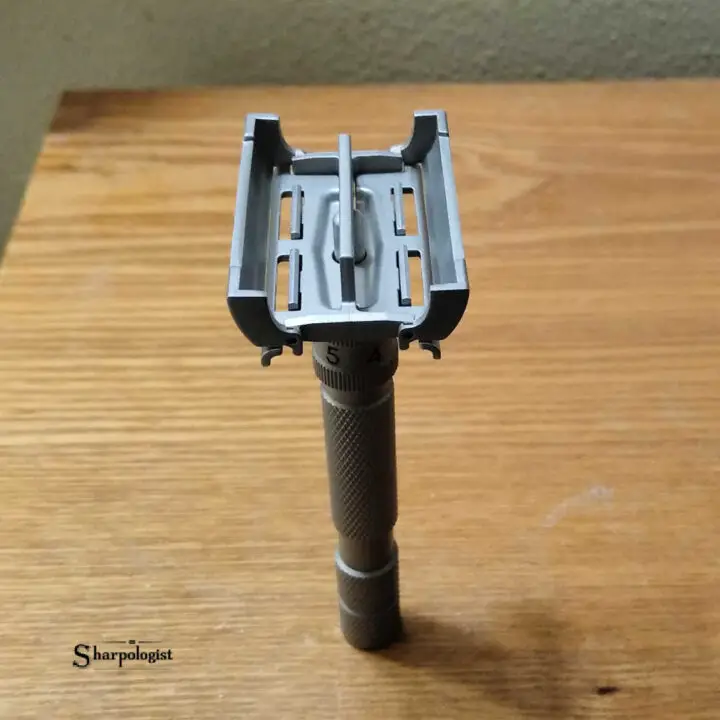
The Rockwell T2 safety razor is a pretty amazing razor for several reasons.
Twist-to-open (TTO) “butterfly” DE razors are not only convenient to use but they also have a place in cultural history: ask a random person on the street to describe an “old fashioned safety razor” and the odds are they’ll say something like ‘oh, that razor where the top doors opened up to change a blade with.’
Most twist-to-open razor mechanics need perhaps an additional quarter-turn on the open/close dial to “cinch down” after closing over a blade. The T2 cinches down much more securely, taking almost two full turns to clamp the blade completely. The T2’s dial action is very smooth and fluid-like. It is designed in Canada and manufactured in China.
Plus, the T2 is adjustable (see also below), with a dial to change the blade gap from a mild shave to a more aggressive shave. There is also a version made of stainless steel (below).
- Razor Weight: 103 grams
- Razor Length: 95mm (3.74 inches)
- Handle Length: 89mm (3.5 inches)
- Available finish: Gunmetal chrome
- Adjustability: Fluidly adjustable
Advantages
- Well-built.
- Fluid butterfly mechanics.
- Fully adjustable aggressiveness setting.
Disadvantages
- Relatively large and heavy.
- Somewhat expensive.
What Others Say
Amazon score of 4.6 with sentiment 90% positive ~150 ratings. Fakespot grade: A with under 10% of reviews suspect.
“I recently got into wet shaving due to my go to razor blades from dollar shave club were discontinued. I bought this razor and another right away after doing some research. Out of the 2, this one is my favorite hands down. Damn good looking and a better, smoother shave than my other. I will definitely be buying Rockwells other razors and shaving products!” – Ryan
“This is admittedly my first safety razor, I’m never going back to cartridge shaving ever. I’ve always struggled to get a clean shave without irritating my face, this makes it easy and I can adjust the blade to catch the indent in my cheeks and I have a rather angular jaw and chin so cutting on that edge and with the varied cheek surface has always been problematic and left me breaking out etc. I’m at the end of my second week, less mess, less time, learning was a breeze, and I really do like the luxurious feeling of the ritual itself. I get it now.” – Dr. Banner
Honorable Mention: Parker 87R
Parker 26C – Open-Comb Safety Razor
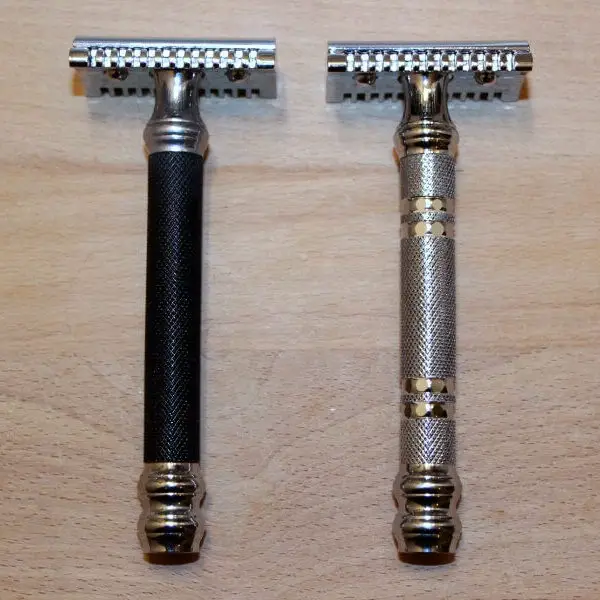
Parker offers two open comb (“OC”) razors, the 26C and the 24C, differing only in the style of the handle (the 24C has a chrome handle and the 26C has a coated handle. The heads are the same). They’re both fairly heavy, with the 24C weighing in at about 3.5 oz. and the 26C at about 3 oz, and both handles are longer than average at 4 inches. It is designed and manufactured in India.
Advantages
- Many users also find that shaves with the Parker OC razors are exceptionally “smooth” for this type.
- With the right blade there probably won’t be any trouble with an against-the-grain pass, unlike many other OC razors.
Disadvantages
- This razor is more aggressive than most of the closed comb safety-bar Parker razors but less than many other OC razors.
What Others Say
Amazon score of 4.5 with sentiment 87% positive ~500 ratings. Fakespot grade: A with under 10% of reviews suspect.
“I really like this razor. I was concerned it was going to be too aggressive, this being my first open comb style, but it’s easy to use and I’ve had no issues. Gives me a nice close shave, easy to handle. I shave because I have to but I choose to enjoy it.” – Scott In Vegas
“Yes a very nice razor. Well made and finished. Solid feeling. Very smooth feeling shave, but that is due to it not really being very aggressive for being an “open comb”. My Parker 82R TTO is definitely more aggressive even though it is supposedly not. You can get a close shave with many passes, but the TTO will shave cleaner on the 1st pass. You can see it. I Like the feel of this and will use it. Makes a good 1st pass razor followed by another razor. Otherwise you are looking at a 3 pass minimum. That’s my experience doing A B comparison with Sharps, Chrystals etc. Just one tool of many, but I do not think this would be my main one if I had to get just one. Who does that? It’s a guy thing.” – Drummer
Honorable mentions: Merkur 25C, Parker Variant adjustable OC razor.
Related Post: Click/tap here to read Sharpologist’s article on open comb razors
A Variation On The OC Razor: The Self-Lubricating Or Double Open Comb
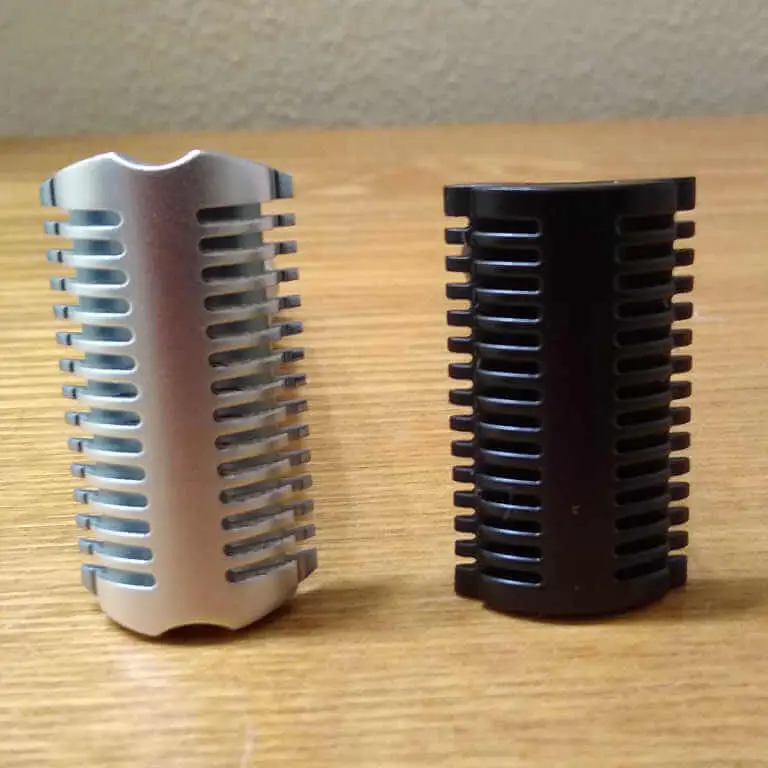
The OC razor was one of the original safety razor head designs. While the evolution of the DE razor generally moved to a closed comb safety bar, the OC concept did take a branch of its own which has been recently re-discovered: the double open comb (DOC) or self lubricating open comb (SLOC) razor.
These razors are characterized by having a slotted top cap with an OC base plate (the slots may or may not line up with the teeth of the base plate). The purpose of the slots was to serve as a sort of reservoir for water and lather.
Consider the Phoenix Artisan Accoutrements (PAA) Nickel-Plated DOC razor or the RazoRock SLOC razor if you are interested in trying this type of razor.
Related Post: Self-Lubricating Razors
Henson AL13 Long Handle Razor, Feather AS-D2 Double Edge Safety Razor – TIE Best Mild Razor
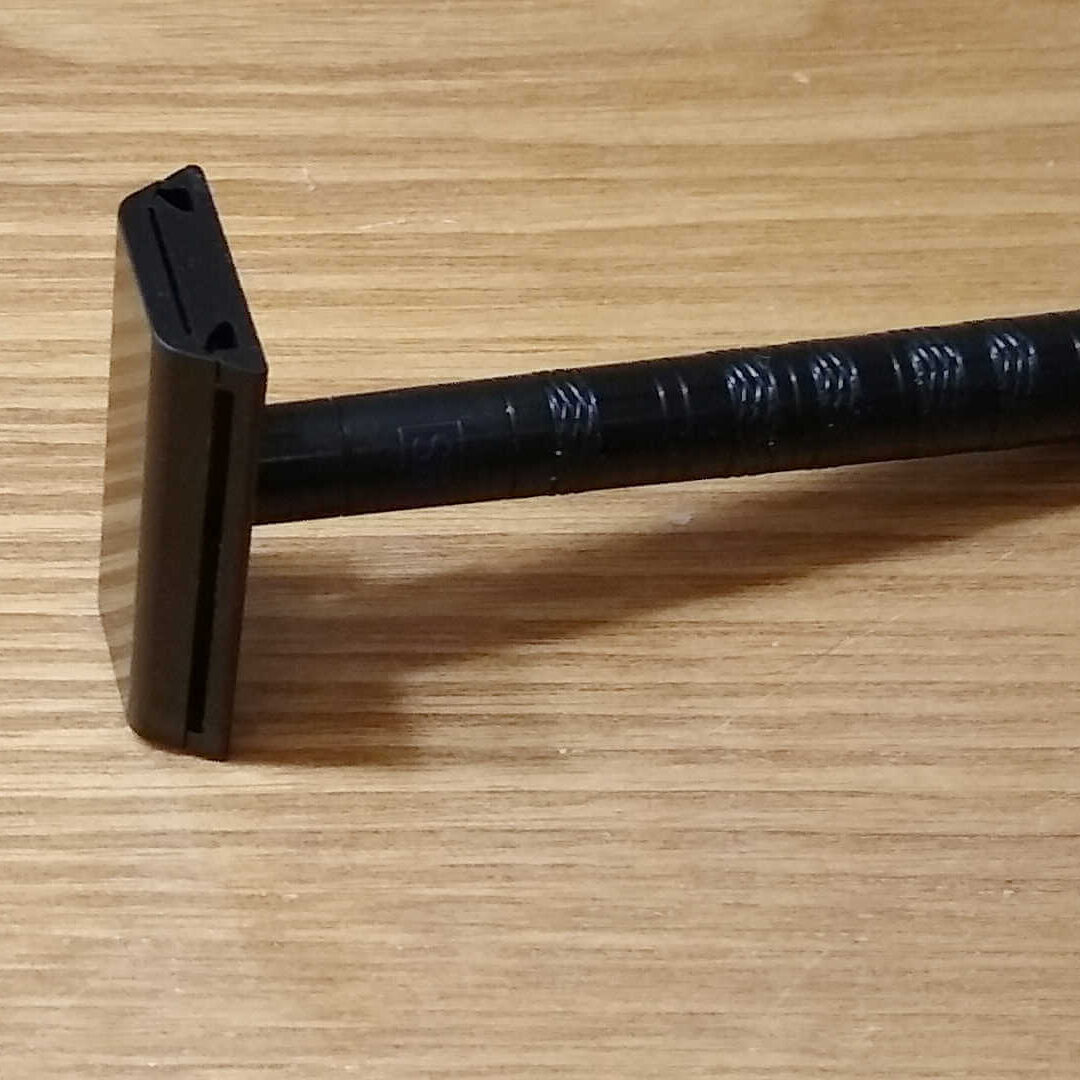
The Henson AL13 aluminum DE razor has been making waves in the shaving world for its engineering design and its mild shave. It has become very popular in a very short time. It is designed and manufactured in Canada by Henson Shaving.
The design and engineering of the AL13 is exceptional. The head design is quite interesting: the angle that the razor is held at might be a little odd for the shaver who has used other DE razors. But once that angle is “locked in” most find the performance excellent.
The AL13’s weight is a mere 37 grams (~1.3oz). The handle is 95mm (~3.75″) not counting the head.
The standard AL13 is very mild; other versions are also available for those who want a little more aggressiveness.
Advantages
- Long handle.
- Exceptional engineering tolerances.
- Very mild, with less mild options available.
Disadvantages
- “Hold angle” may take some getting used to.
- Light weight
What Others Say
Amazon score of 4.6 with sentiment 87% positive ~600 ratings. Fakespot grade: B with under 20% of reviews suspect.
“This is the most comfortable and closest shave I have ever experienced! I used Gillette and Harry’s cartridges for years. It took me about three shaves to adjust to this new experience. I used this razor even after a week’s worth of beard growth and it worked wonderfully. I am convinced I will never go back to the costly replacement cartridges. I loved it so much I bought two more in different colors and plan to purchase more to give to my son and son-in-law. I would recommend this razor to anyone who is looking for a comfortable and close shave! I wish I had known about this years earlier…. – Pleased with Purchase
“I’ve had the AL13 mild now for over two years, and it is my first and only safety razor. I would recommend it. There’s a bit of a learning curve at first. It will not cut unless you hold it at the right angle, but once you get the technique down it is in my opinion superior to cartridge razors. I can get BBS shaves with no irritation, consistently. I enjoy shaving now far more than I did before the Henson.” – doodoopeepeecacka
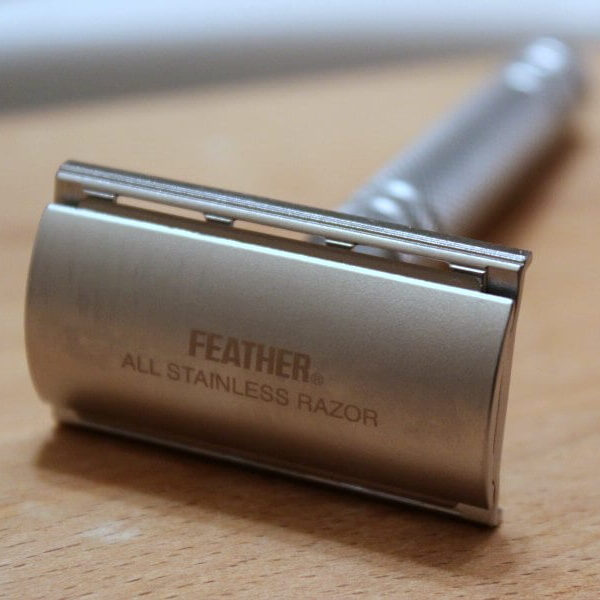
The Feather AS-D2 all stainless steel long handle double edge safety razor was considered the high-end DE not too many years ago. Now it’s practically “bargain basement” in its class: the past couple of years have seen an explosion of artisan-made, luxury-priced razors with premium materials.
- Razor Length: 98mm/3.9″
- Razor Head Length: 43mm/1.7″
- Razor Head Width: 25mm/1″
- Weight about 90 grams/3.2 oz.
The AS-D2, designed and manufactured in Japan, is well-designed and well-built but has a reputation as being very mild, prioritizing a comfortable shave rather than achieving a close shave. You will want to use a high performance blade for best results.
Advantages
- All stainless steel double edge razor.
- Excellent build quality and quality control.
Disadvantages
- Might be too mild for some.
- Seems to be optimized for use with a high performance blade like the Feather Hi-Stainless double edge razor blade.
What Others Say
Amazon score of 4.6 with sentiment 89% positive ~1200 ratings. Fakespot grade: A with under 10% of reviews suspect.
“I like this product and don’t regret the purchase. It’s been great for my face and good for my head. The head seems a little large for head shaving though. I still use it for my entire face and head. Very mild so I think it would be good for beginners. I have a medium beard. My beard isn’t too tough or thick and I get a great shave from the AS-D2. It really seems more like a surgical instrument then a safety razor. You can tell the roots of the company by the design and quality. It’s awesome.” – Den
“After using this razor every day for a month I am more impressed with it than I was two weeks ago, or a month ago. Is it an aggressive shaver? No. It is mild razor. That means it has a smallish gap, and conservative blade exposure. it also means you are less likely to take off a layer of skin. The razor requires more passes than an aggressive razor, but, with proper angle and NO PRESSURE, several passes are no problem. It is a very comfortable shaver. The angle must be fairly shallow (you ride the razor’s head). The weight of the razor does the work.” – Historian/Physician
Related Post: Click/tap here to read Sharpologist’s extensive article on mild razors.
RazoRock Lupo Open Comb 95 – Best Aggressive Razor
The RazoRock Lupo Open Comb 95 may be less well-known than the “poster boy” for aggressive razors, the Muhle R41, but the Lupo is regarded as smoother and could conceivably be used daily for those with thick, coarse hair stubble (though it shines for multi-day growth). The Lupo is designed and manufactured in Canada. Available with a number of handles and base plates so weight and length specifications vary somewhat; see the sales page for specs. Note that a Lupo “127” has just been announced (February, 2025) that may be even more aggressive!
Advantages
- Manufactured with marine-grade stainless steel.
- Several alternate base plates available for those who would like something slightly less aggressive.
Disadvantages
- Very, very aggressive shave: a gentle touch, good technique, and distraction-free focus are required to use the Lupo successfully.
What Others Say
“The shave was blissfully exquisite and gave me exactly what the RR Lupo .95 OC was meant to do. What is that you say? Well, the tiniest amount of blade feel over its SB brother, an uptick in razor/blade cutting feedback and an almost equal feel in glide & smoothness to its SB counterpart. No harshness nor an aggressive or overly aggressive shave action in my first shave experience…. I see no weakness nor do I think there are negatives that could place this razor in a negative light or in the shade of a storm cloud.” – GlazedBoker
“I have several razors but I am not a collector. If I had bought one of these sooner I would have fewer razors. This thing is smooth. Like driving a new Cadillac on fresh pavement smooth. Smoothness should not be confused with mildness. This razor gives the same close shave as my Muhle R41 but much more comfortably. I like the sharpness of Feather brand blades but they always felt like sandpaper on my face. Not so with the SS Lupo 95 OC. Everything about this item is quality, from performance to appearance and time will tell about durability. Being made of high grade stainless steel, this thing should outlive me.” – Tim
Rockwell T2 Adjustable Razor in Stainless Steel – Best Adjustable Safety Razor
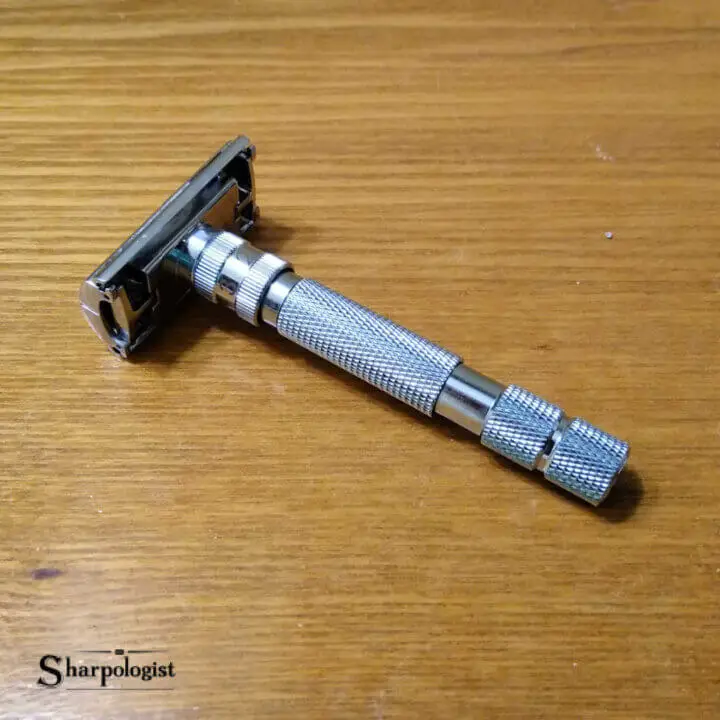
The stainless steel version of the Rockwell T2 (mentioned earlier), the “T2SS,” is a premium tier but exceptionally capable razor. The T2SS is designed in Canada and manufactured in USA.
The T2SS is 3 grams heavier than the stock T2 (other dimensions like handle length are the same) and the balance of the T2SS seems to be just a bit higher on the handle (toward the head) compared to the regular T2. The T2SS feels more “dense” in the hand.
- Razor Weight: 106 grams
- Razor Length: 95mm (3.74 inches)
- Handle Length: 89mm (3.5 inches)
- Available finish: Matte
- Adjustability: Fluidly adjustable
The handle is long and well-knurled handle for an excellent grip. The weight and balance likewise excellent: the “heft” is there without getting too cumbersome.
The T2SS’s adjustment “window” is biased a bit milder than the regular T2. Realistically this shouldn’t make any difference for the vast majority of wet shavers. Those who enjoy turning this type of razor “up to 11” should be aware of it, though.
Advantages
- Outstanding performance.
Disadvantages
- A little on the heavy side for some.
- Expensive.
What Others Say
“Overall, I give the Rockwell T2 SS 5 stars. As Ferris Bueller says “It is so choice. If you have the means, I highly recommend picking one up.” – oldmonker81
“The entire T2SS razor has a nice, firm, durable feel. The adjustment knob is smooth yet solid. Quite firm and sure. The same can be said for the knob that opens and closes the TTO doors. Again, I love the fact that I can close and lock down the doors after a blade is installed. The razor head is locked, safe, and secure with no chance of the blade coming loose. I also like that the razor blade end tabs are enclosed in the razor head. I also find the razor head to be nicely maneuverable. It performed well in tight areas under the nose and by the ears.” – Mark S.
Honorable mentions: The Parker Variant (now also available with an OC version!) is an excellent razor for the price! The Rex Supply Ambassador, another premium-tier adjustable, has the widest adjustment window of all the units tested.
Related Post: Click/tap here for Sharpologist’s detailed article about adjustable razors.
Italian Barber RazoRock Superslant – Best Slant Bar Razor
The Italian Barber RazoRock SuperSlant rises to the top of this category simply by the sheer number of options it offers. While most slant bar razors are generally considered aggressive, SuperSlant options range from “moderate” to “very aggressive” depending on configuration. The SuperSlant is manufactured in Canada.
Advantages
- Multiple build options.
- Especially popular with men who have tough, coarse, wiry stubble, which makes the improved ease of cutting quite noticeable.
Disadvantages
- Expensive.
- Not for those who have fine stubble.
What Others Say
It feels more like a regular razor than does the Stealth, and it has all the efficiency of the Wunderbar. I would rate the Superslant as extremely efficient, even among slants (which tend to be more efficient than conventional, “chop-action” razors because of the slant’s slicing action)…. AND the Superslant is extremely comfortable. It feels good on my face (and also in my hand: I like this handle a lot — It has crisp knurling, which provides a good grip and excellent control). The shave was, in a word, superb…. – Leisureguy
Honorable Mention: Parker Semi-Slant is a “kinder, gentler” slant bar razor, and value-priced too. It’s definitely milder than other slants, with less torque and blade exposure.
Is It Better To Shave With A Safety Razor?
A lot of people think so. Although some use safety razors for the nostalgia factor, there are some quantifiable advantages to shaving with a single blade:
Benefits Of Using A Safety Razor
A safety razor provides reduced chance of razor burn, skin irritation, and ingrown hairs (razor bumps).
- Since single-blade safety razors don’t follow the “lift and cut” model of shaving, there is less of a chance of over-shaving an area.
Less expensive in the long-term.
- While this is a modest additional “up front” cost to a safety razor, the long term costs are much lower due to the difference in blade cost vs. cartridge price. The return-on-investment generally comes after a year or two of use.
More environmentally friendly.
- Razors and blades are generally entirely metal, with little-or-no plastic content to clog landfills.
Great shave!
- Done properly, switching from cartridge razors to safety razors can be just as close.
While most safety razor users believe the advantages far outweigh the disadvantages, there are a few inconveniences:
Drawbacks Of The Classic Safety Razor
While most safety razor users believe the advantages far outweigh the disadvantages, there are a few inconveniences:
Technique reset.
- Shaving with a safety razor generally involves “unlearning” some bad habits developed with shaving with a cartridge razor (though there are some razors on the list below that can mitigate that somewhat). There is a learning curve.
Travel with a safety razor can be problematic.
- In the US the Transport Safety Administration (TSA) may not permit safety razors in carry-on luggage on passenger airlines. You can pack a safety razor and blades in checked luggage or you can purchase safety razor blades at your destination. Or take cartridge or disposable razors in your wet shaving kit.
It can take a little more time.
Shaving with a safety razor may require a bit more time to shave properly and get good results. However, done efficiently, the extra time to use a safety razor can be minimal.
Key Considerations for Safety Razors
Price Range
- Budget options are typically under $20, mid-range from $30-$60, and premium razors over $200.
New, Used, or Vintage
- New: Widely available but can be pricier.
- Used: A more affordable option.
- Vintage: Quality varies; often found online or in antique stores.
Construction Types
- Open Comb vs. Safety Bar (Closed Comb): Open-comb razors are good for heavy stubble; closed-comb safety razors offer more protection.
- Piece Construction (1, 2, or 3 Pieces): 3-piece razors may allow customization with other razor parts.
- Adjustable vs. Set Gap: Adjustable razors offer versatility in aggressiveness. Adjustables allow the shaver to vary the blade gap to some degree for a more enjoyable shaving experience.
Slant Razors
- Slant razors offer an angled blade for efficient cutting. Best for those seeking a closer shave with fewer strokes.
What About The Best Safety Razor Blades – A Further Caution To The Beginner
Safety razor blade refills are cheap! No discussion about the best razor would be complete without mentioning blades. Many beginners think “a blade is a blade” and while double-edge safety razor blades may all look similar there can actually be fairly significant differences in the way a blade is made. Metallurgy (the metal or combination of metals used to make the blade), coatings, and grinding specifications (the blade’s “sharpness”) can all play a part in the razor blade production process.
So take the time to try a number of different blade brands to find the one(s) that work best for the razor you’re using (your skin, the mineral content of the water you’re using, and the shave lather you’re using play parts too).
Some shaving vendors sell “sample packs” or “blade samplers” to make the process easier: you get a few replacement blades of many different types. After you decide which one(s) work best you can then buy your favorites in bulk, saving a ton of money!
Enjoy this article? Please comment and share!

I am surprised the Rex Envoy did not make your list of Best Razors. Please can you do a review of this remarkable bulldog razor?
“Best” is such a vague term, and absolutely wrong term to use, as it is up to the individual, isn’t it!? There are so many factors, depending on your type of beard, preparation, skin sensitivity, technique, you simply CAN’T call out what’s “BEST”, because it’s different for everyone!!!
I moved to wet shaving some 10 years ago, when I finally realized that mowing my face with a Norelco just wasn’t doing the job.
After a few years of multi-blade mediocrity, I found Supply. I have a 2.0, and a Pro, both of which I like very much (especially with Supply’s new Platinum blades). I’ve tried OneBlade, but just don’t get on with the Feather blades – someone else commented that they feel like sandpaper, and that’s my experience also.
Then my son bought me a Henson – the mild version. I am addicted to this thing. It gives me such a comfortable shave in no time at all, and I’ve never had so much as a single nick. I now also have the medium version, which comes in handy when I go more than 2 days between shaves – it’s equally comfortable.
I’m still settling in on blades for it, but Astra Platinum, and (surprisingly) Feather Platinum are the front runners right now, with Henson’s own RK brand being cheap, but merely adequate.
My Supplys are feeling neglected, so I have the Pro next up in the rotation – but I have a strong suspicion I’ll be back to the Henson soon.
I like the RazoRock Superslant a lot, but in my experience the Phoenix Artisan Double Slant (available in various colors) gives it a run for the money, and “money” is the operative word: a Double Slant costs $27 and is every bit as comfortable and efficient as the Superslant. I recommend at least including that in any future update.
Great, now I’ll have to try that one too, LOL.
I agree with the 34C popularity. Every time I use this razor (slant or classic), paired with a Gillette Silver Blue and a premium shave soap, I think – “Why don’t I use this every time?” For me, it’s the standard to beat.
Gotta wonder why Rockwell is not included. They are so wonderful, especially the 6S. I have yet to find a blade that does not work well in it. Very hard to cut oneself. And the craftsmanship and build quality are top notch.
The Rockwell 6S is listed under “Best Multi Base Plate Razor”
thanks for the great article! i need an article with the top 5 or top 10 aggressive razors like the yaqi helmet and etc. do you have these recommendations? thanks
I’m in the process of taking notes after each shave, noting the razor, blade, comfort, and closeness so I can better contemplate the shaves. It’s too soon for me to make any meaningful comparis0ns, but the Razorock Superslant and the Muhler R41 are up there, along with the Razorock German 37 slat.
Calling something like razors for “The Best”, is pretty stupid, as it is up to the individual on how their technique is… You can take the cheapest razor and make good use of it, or take the most expensive one and make the worst with it, so there definitely isn’t such a thing as “The Best”, it’s like calling a “Perfume” for the best, or an instrument, nonsense
I still recon you can’t beat the Rockwell S6, for what it offers & delivers shaving wise from mild to wild it unbeatable. It would be great if Rockwell made an S6 type single blade Razor later on sometime.
After getting back to shaving with a DE safety razor these are my choices. After trying and using several DE safety razors my favorite is the Yates 921-M. My preferred blades are Parker….Derby Premium…..Gillette Wilkinson Sword. The Parker blade is my all around favorite.
Yates is definitely on the radar for inclusion in a future update.
Of course, I believe, philosophically, that the best razor is the one you enjoy using at the moment. Still, with 50 years shaving experience here, I’m now convinced the Gillette Old Type is the absolute perfect razor as far as shaving performance. The manufacturing (the handle) was less than good in the long run, but nowadays a replica handle fixes that for a user.
Can’t say I agree with the selection of the 34C over the DE89. I could not, for the life of me, get a good shave from my 34C and usually left me with razor burn; I sold it. My DE89, while milder than I like, delivers consistently decent shaves.
As for the Henson… the medium was my first DE and still gets regular use even with my now 60+ collection. They also make a so-called “aggressive” +++ in aluminum, but they don’t sell the aluminum +++ on their site – you have to buy it through specialty stores like Razor Emporium or The Razor Company. I have the V1 version and really like it!
Thanks for your comments. I wasn’t aware of the Henson +++ availability, I need to add that to Sharpologist’s Henson review.
My vote goes to the Henson razor. I have used several high end razors, Cobra classic, Weber, One Blade, Leaf, Merkur Slant,etc.. The Henson mild gives me the smoothest 3 pass shave I have experienced.
I’m a recent cartridge convert and am extremely happy with Hensen’s AL13 in both Mild and Medium (+ and ++). These are very easy to learn to use, and at least for me there has been no penalty for poor technique except uncut whiskers.
Great article. I purchased a Timeless .95 about 2 ½-3 years ago. I had a rotation with about 4 razors. For the past year, I’ve only used the Timeless. It’a a remarkable razor in every way. Construction, quality of shave, soooo smooth, aesthetics. I’ve often thought of other razors as “this is the one” only to change my mind. Not with the Timeless. It’s name is fitting!
I was interested to see that the Merkur 34C is the most popular razor. In my experience, the Mühle/Edwin Jagger head design is noticeably better (and certainly that head design is widely copied). Perhaps the use of the Mühle/EJ head on many different models results in no single model having the market presence of the older 34C.
Full disclosure: I did initially use the 34C — in part because it was the standard recommendation. However, when EJ made the switch to from the Merkur head design to the new design jointly developed with Mühle, I found that new design to be more comfortable and efficient than the 34C. That’s not surprising, of course since obviously EJ would want to design a razor head better than the one they had been using. Otherwise, what’s the point?
As I note in the article ‘popular’ does not necessarily equal ‘better.’ I did take the different EJ/Muchle handles into account while I was gathering the data.
Having picked up Timeless in stainless, titanium, and bronze, they have easily become my favorite modern DE razor
I would like to know, is it ok to shine or polish your DE razor with toothpaste?
No such thing as “The Best”, it’s all a matter of technique and preperation…
Prep and technique are important but you can’t ignore razor design and construction.
Why is Wolfman not on this list?
Wolfman was an excellent razor but new inventory has been…sporadic. I don’t want to list a razor you can never buy.
It was a great article. Although you nentioned the Mühle R41, as the best aggressive razor, you neglected to mention the variants of the R41, namely the R101 and R102. The R101 and R102 have different handles, but the same R41 head.
I have a Parker 91R. Parker does not seem to get mentioned a lot on this website, or at least when it comes to these “best” lists. I started with a Van Der Hagen, and then graduated to the Parker. Great razor, with great balance, not too aggressive, and I’m using the German made Wilkinson Sword blades, which are very comfortable, paired with this razor, giving me 7-10 “DFS” close shaves, with minor buffing toward the higher #. So, how about some Parker love on this site! I tbink it is fesefved. Take a poll, and see who uses a Parker. Not everyone is going to spend $150, or even $75-80 on a razor…
I agree that the Parker 91R should be on this list. I own, or have owned multiple double edge razors & the Parker is absolutely the best shaver of the bunch, no matter which blade I use. It has great weight & balance, gives close shaves without irritation or nicks. I could have saved a lot of money if I had bought this razor first.
Mark As always nice work. Gillette made Super Speed razors, I am thinking from 1940s until 1980s. You say the best Super Speed is 1955. I was wondering why that year?
Thanks Fred
Respectfully differ. My 56 red tip and 53 President are better IMO