

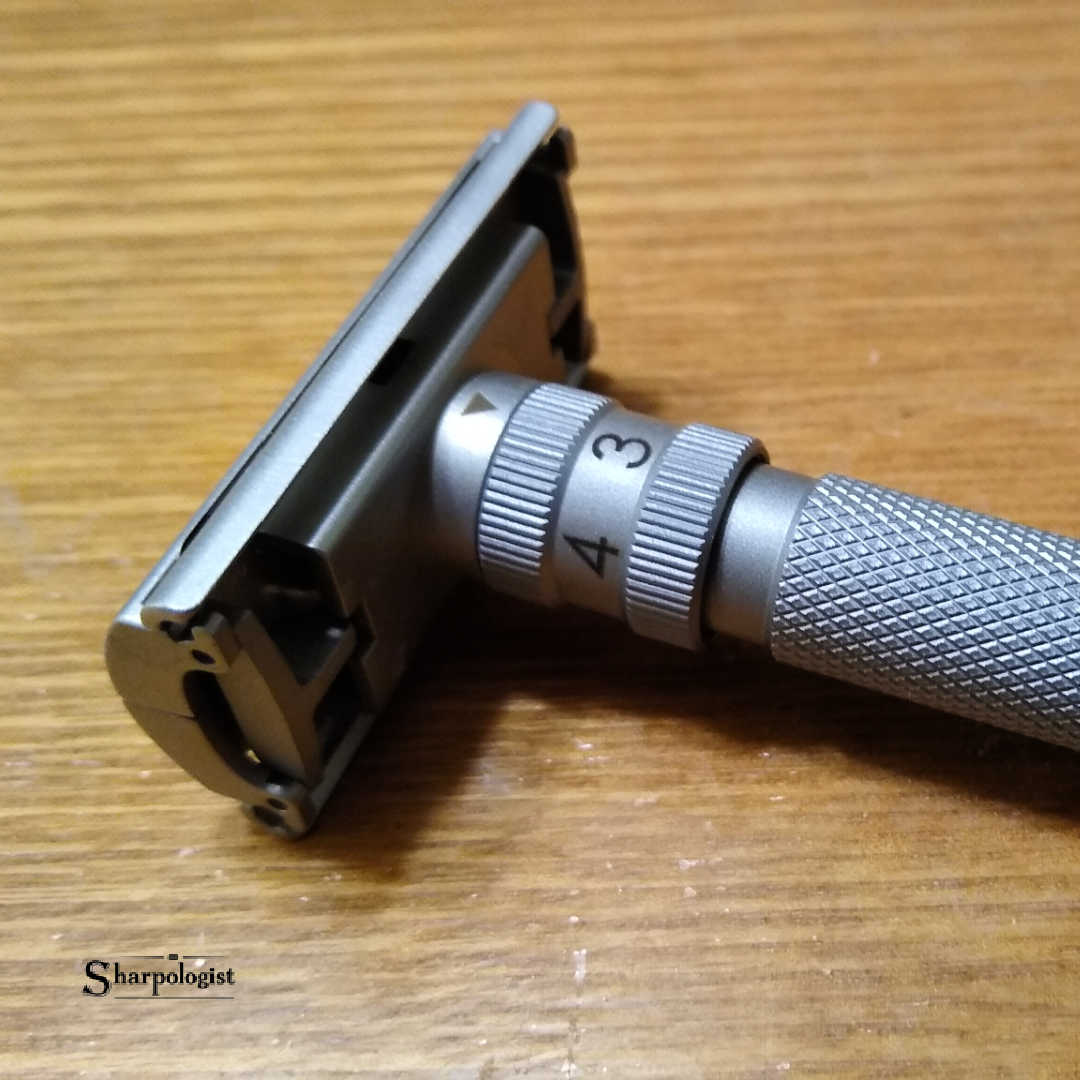
Adjustable razors create a particular kind of hope. When a fixed safety razor gives inconsistent results, the dial starts to look like the missing control.
Too much irritation? Turn it down.
Not close enough? Turn it up.
Different blade? Different setting.
That sounds reasonable because adjustability really does change the shave. It changes how the razor presents the blade to the beard and skin. What it doesn’t do is change the hand using it. Pressure, angle, lather, repeated strokes, and the urge to chase perfect closeness all remain part of the shave.
This article is about what adjustability changes in the shave. For specific model recommendations, Sharpologist’s adjustable razor roundup covers current options, and the under-$50 adjustable razor guide covers budget experiments.
Quick Answer
An adjustable razor changes how much blade access the razor gives to the beard and skin, usually by changing blade gap, blade exposure, or the way the razor head presents the blade. In a continuously adjustable razor, that change usually happens through a dial or mechanism that moves through a range of settings. Higher settings usually increase efficiency and blade feel. Lower settings usually reduce efficiency and blade feel.
An adjustable razor does not fix pressure, angle control, poor lather, excessive buffing, or an unrealistic closeness goal. It gives the shaver another variable to control. That can be useful when settings are tested deliberately. It can also make diagnosis harder when the dial gets changed every time the shave feels a little off.
The useful question is not whether an adjustable razor changes the shave. It does. The useful question is whether the part it changes is the part causing your problem.
What Counts As An Adjustable Razor?
The term “adjustable razor” gets used in more than one way.
The most familiar version is the continuously adjustable razor. This is the style with a dial or similar mechanism that lets the shaver move through a range of settings. The setting can usually be changed between passes, between shaving areas, or from one shave to the next without changing parts.
There are also plate-based systems, such as Rockwell-style razors, where the shaver changes efficiency by swapping base plates. These are adjustable in a broader sense, but they behave differently. The change is more deliberate because the shaver has to change parts rather than turn a dial.
Both types teach the same broad lesson. Changing the razor’s geometry can change efficiency and blade feel. It does not automatically correct pressure, angle, lather, or pass strategy.
This article mainly focuses on the continuous style because the temptation to adjust constantly is part of both its appeal and its risk.
What An Adjustable Razor Actually Changes
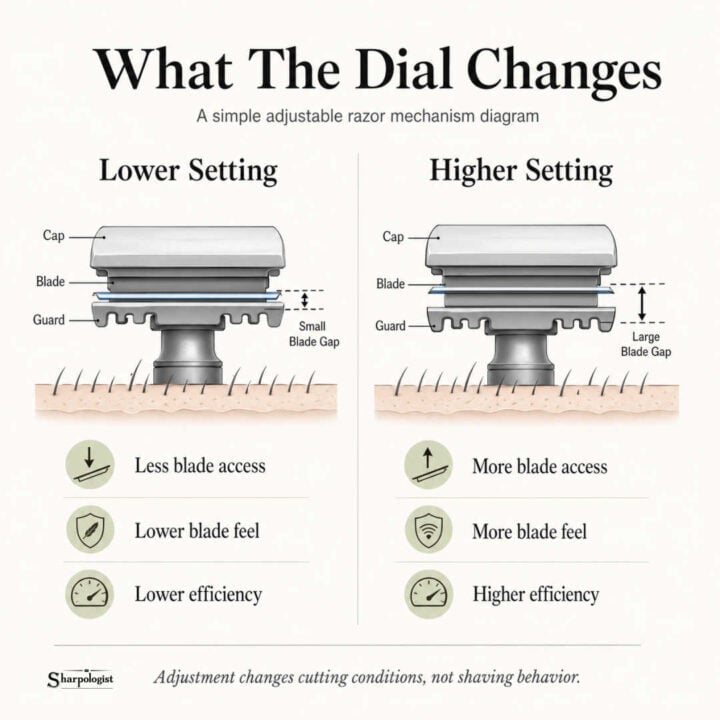
An adjustable razor changes the razor’s cutting conditions. It doesn’t change the shaver’s behavior.
In most continuously adjustable razors, the most obvious change is blade gap. Blade gap is the space between the blade edge and the safety bar or guard. Increasing that gap can allow more beard and skin to reach the blade edge. Reducing it can make the razor feel milder and less direct.
Blade exposure is related, but it’s not the same thing. Exposure describes where the blade edge sits in relation to the cap and guard. A razor can have a modest blade gap and still feel direct because of exposure, head shape, or the way the cap encourages a particular angle.
That’s why two razors with similar numbers on paper may not feel alike. Head geometry, cap shape, guard design, blade rigidity, and handle balance all influence how the blade meets the beard. The dial matters, but it’s not the whole story.
In practical terms, adjustment usually changes two things the shaver notices: efficiency and blade feel.
Efficiency is how readily the razor cuts stubble when used correctly. A more efficient setting removes more beard per stroke. Blade feel is how directly the edge is felt on the skin. A setting can feel more present, more lively, or more demanding before it ever causes irritation.
The distinction matters because closeness, efficiency, and comfort are not the same thing. A higher setting may make the razor more efficient, but that does not automatically make the shave better. It simply gives the blade more opportunity to cut.
The dial is not a closeness control by itself. It is an efficiency and blade-feel control. Closeness still depends on beard reduction, pass strategy, angle, pressure, lather, and knowing when to stop.
For the product-category view of current adjustable razors, Sharpologist’s adjustable razor roundup covers specific models and how they compare.
What An Adjustable Razor Does Not Change
The first limitation is pressure.
A lower setting may make the razor feel safer, but the same hand can still press too hard. A higher setting may cut more easily, but the same pressure becomes less forgiving. The dial changes the razor. It does not lighten your hand.
Angle remains its own variable too. Some settings may feel more forgiving than others, but the blade still has to meet the beard at a workable angle. If the angle keeps drifting, the dial may only change how obvious the drift feels.
Stroke count is where many shavers get into trouble. A lower setting can encourage extra work because each stroke feels less risky. A higher setting can encourage overconfidence because each stroke feels more productive. Either way, the skin may receive more total exposure than it can tolerate.
Lather quality stays in the equation. A dry, thin, pasty, or unstable lather can make any setting feel harsher. Turning the razor down may reduce blade feel, but it can’t replace hydration and glide.
Beard growth pattern doesn’t change either. A difficult neck, swirl, jawline, or under-nose area remains difficult. Adjustment can help match efficiency to the area, but it doesn’t remove the need to understand direction of growth and pass structure.
And then there’s the goal the shaver brings to the mirror. If the goal is always “closer, no matter what,” the dial can become another way to keep shaving after the skin has already had enough.
Why Higher Settings Can Feel Like Progress At First
Higher settings often feel rewarding right away. The razor cuts more beard per stroke. The first pass feels more productive. Dense growth seems easier to reduce. The shaver may feel less tempted to keep going over the same area.
That can be useful. A more efficient setting can reduce total work when the shaver responds with fewer strokes, lighter pressure, or a simpler pass structure.
The problem starts when the behavior does not change with the setting. The shaver turns the razor up but keeps the same pressure, the same number of passes, and the same touch-up habits. Now the skin gets more blade exposure without receiving less work.
The setting improved cutting efficiency. The shave did not become more controlled.
Higher settings can feel like progress during the shave and still produce irritation later. The immediate result is closer reduction. The delayed result may be heat, tenderness, or roughness that appears after the shave is over.
Why Lower Settings Do Not Always Prevent Irritation
Lower settings can be useful. They often reduce blade feel, calm the shave down, and make sensitive areas feel less risky. For many shavers, that is exactly what is needed.
But lower does not automatically mean safer across the whole shave.
A setting that is too mild for the beard may encourage compensation. The shaver presses a little more. Adds a few short strokes. Buffs the same patch. Touches up an area that was already close enough.
The razor felt mild. The skin still got too much work.
The better question is not “what is the mildest setting?” It is “what is the lowest setting that removes enough beard without making me add pressure or extra strokes?”
Mildness helps when it reduces total exposure. It does not help when it turns the shave into a longer effort on the same skin.
The Right Use Case For A Continuously Adjustable Razor
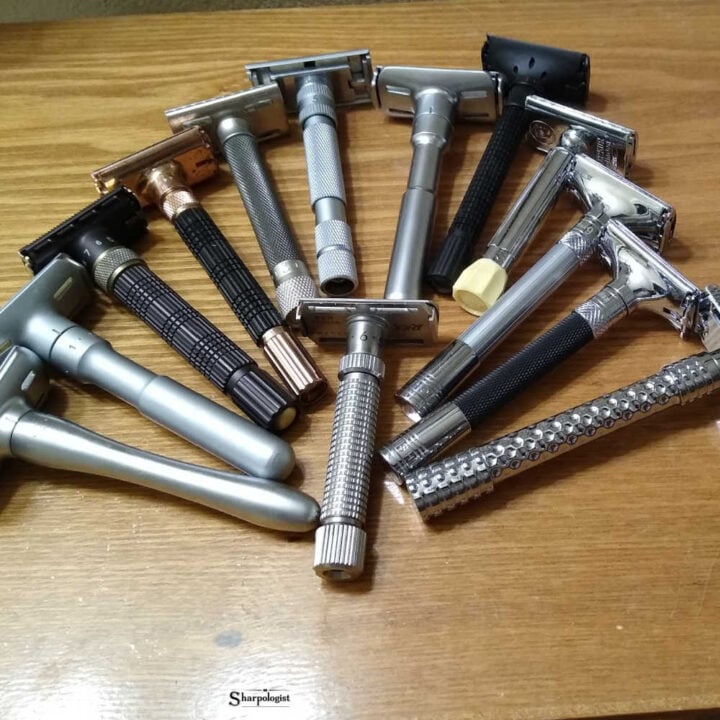
A continuously adjustable razor works best when the shaver has a clear reason for changing the setting.
One good use case is learning the razor at a mild or mild-middle setting. This gives the shaver time to understand the head shape, angle, balance, and blade feel before increasing exposure.
Another good use case is area-based adjustment. A shaver may use a slightly more efficient setting on flatter, denser growth and a milder setting on the neck or other irritation-prone areas. That can make sense when the shaver already knows which areas tolerate more blade contact and which do not.
Adjustability can also help with different shave intervals. Daily shaving may call for less efficiency than shaving after two or three days of growth. Beard length changes. Skin tolerance may not change by the same amount.
It can help with blade testing too, but only when used carefully. Keeping the same razor while changing only the blade can make blade behavior easier to interpret. That advantage disappears when the shaver changes the blade, setting, lather, and pass structure all at once.
Different settings for different passes can also work. It is usually better to wait until the baseline shave is already consistent. If the first pass, second pass, and touch-up all use different settings before the shaver understands the razor, the dial becomes noise.
There is nothing wrong with enjoying control, as long as the setting changes are tied to a reason rather than to every small variation in the shave.
The Wrong Use Case For An Adjustable Razor
An adjustable razor tends to make things worse when the dial becomes a substitute for diagnosis.
Starting at the highest setting just to “see what the razor can do” is a common mistake. It may produce an impressive first stroke, but it creates a poor baseline. The shaver learns the razor from its least forgiving end.
High settings should not be used to overcome poor lather or a bad angle. If the blade is skipping, dragging, or scraping because the setup is wrong, more exposure may only make the problem more obvious.
Low settings can be misused too. A shaver may turn the razor down, feel safer, and then keep shaving the same area until irritation appears anyway. The lower setting reduced blade feel. It did not reduce total exposure.
Another mistake is changing the setting every shave without a reason. One day the razor is too mild. The next day it’s too harsh. The blade changes. The lather changes. The pass order changes. After a week, there is plenty of experience but not much useful information.
Adjustment works best when it answers a specific question. It works poorly when every shave becomes a new experiment.
How To Test Adjustable Razor Settings Without Guesswork
Start at the mild or mild-middle setting, not the highest setting.
That starting point gives you room to learn the razor without making the first shave a stress test. It also makes the feedback easier to interpret. If the shave is comfortable but not quite efficient enough, you can move upward deliberately. If the shave is already irritating at a mild setting, the problem is probably not that the razor needs more exposure.
Use the same blade type for several shaves. A new razor setting and a new blade can both change the feel of the shave. Change them together and you may not know which variable mattered.
Keep the same pass structure. Don’t test one setting with a single pass and another setting with three passes plus touch-ups. The setting is only one part of total exposure.
Change one setting variable at a time. Move in small steps. Give each setting enough repetition to judge comfort, not just immediate closeness.
Do not judge the setting only by how smooth the skin feels immediately after rinsing. Irritation often shows itself later. The neck may feel warm after an hour. A rough patch may become tender by evening. A setting that feels impressive during the shave may not be the setting your skin tolerates best.
Use the lowest setting that gives the beard reduction you need without extra strokes. The goal is not to find the most dramatic setting, but to find the least exposure that still cuts efficiently enough for the shave you actually want.
For plate-based razors, the same testing logic applies, but the “setting” is the plate choice. Do not change the blade, plate, lather, and pass structure all at once.
Adjustable Razors And Blade Choice
Blade choice still matters in an adjustable razor.
A sharper blade can make a higher setting feel more efficient, but also more immediate. A smoother-feeling blade may make the same setting feel calmer. A blade that works well in a mild fixed razor may feel different when an adjustable razor gives it more exposure.
This does not mean every blade needs its own complicated setting map. It means the blade and setting should not both be treated as random variables.
If you are testing blades, keep the setting stable. If you are testing settings, keep the blade stable. Otherwise the shave becomes difficult to interpret.
This is especially important for experienced shavers who already have strong blade opinions. A blade that feels harsh in one setting may be acceptable at another. A blade that feels too mild in one razor may become useful when the razor gives it more cutting access. The only way to know is to test one variable at a time.
Adjustable Razors Versus Fixed Razors
A fixed razor is not inferior because it lacks a dial. In many cases, fewer variables are an advantage.
A fixed razor gives the shaver one geometry to learn. That can make pressure, angle, blade choice, and pass structure easier to isolate. For newer safety razor users, or for experienced shavers trying to rebuild consistency, that simplicity can be useful.
A continuously adjustable razor adds a controllable variable. That can help when the shaver already has enough consistency to understand what the variable is doing. It can distract when the shaver is still changing too many things at once.
Plate-based systems sit between the two. They offer multiple efficiency levels, but the change is more deliberate. Because the user has to swap plates, there is less temptation to change settings constantly during the shave.
Choose a fixed razor when you want fewer variables and more repeatability.
Choose a continuously adjustable razor when you already understand your pressure, angle, and pass structure and want more control across areas, blades, or shave intervals.
Choose a plate-based system when you want multiple efficiency levels but prefer a more deliberate setup and less temptation to adjust constantly.
Practical Decision: Do You Need An Adjustable Razor?
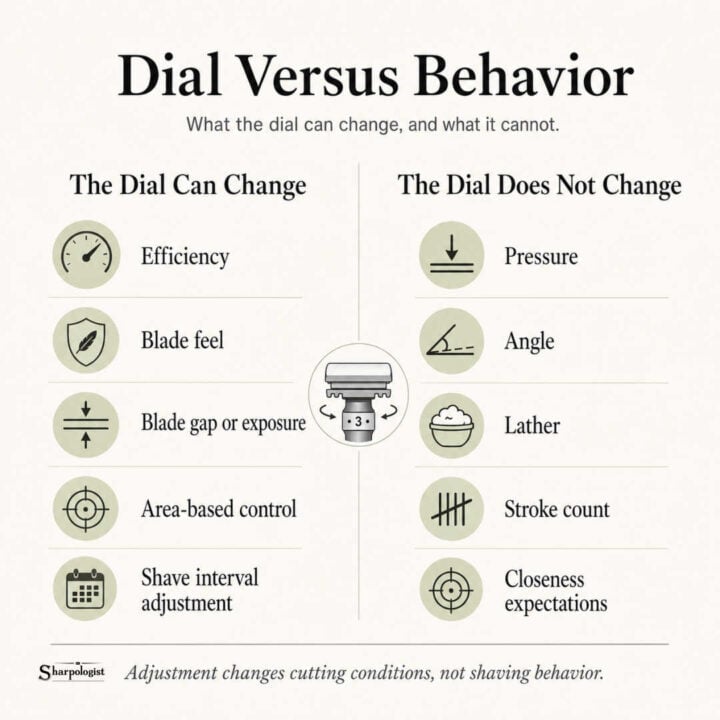
An adjustable razor may help if your shaves are already fairly consistent but you want to fine-tune efficiency by area, blade, or shave interval.
It may help if your cheeks can tolerate more efficiency but your neck cannot. It may help if daily shaves and two-day growth need different levels of cutting power. It may also help if you want to test blades while keeping the razor itself constant.
An adjustable razor is less likely to help if your main problems are pressure, inconsistent angle, poor lather, or repeated strokes on irritated areas. In those cases, the dial may only give you more ways to repeat the same pattern.
A continuously adjustable razor may be worth trying if you can commit to testing settings deliberately rather than chasing each shave with the dial. A plate-based system may be a better fit if you want controlled variation without constant adjustment available during the shave.
Once adjustability fits the problem, model choice becomes the next question. Readers who already know they want an adjustable razor should go to the adjustable razor roundup. Readers who want to experiment without committing to a premium razor should use the under-$50 adjustable razor guide.
Readers who still get irritation regardless of razor should start with pressure, angle, pass strategy, and razor efficiency before buying another tool.
Conclusion: Adjustment Is Control, Not Correction
An adjustable razor gives the shaver more control over efficiency and blade feel. That control can be useful. It can make the razor more adaptable across shaving areas, blades, and beard length. It can help an experienced shaver fine-tune a shave without owning several fixed razors.
But adjustment is not correction.
The dial does not lighten pressure. It does not stabilize angle. It does not hydrate lather. It does not stop the shaver from touching up the same irritated area one more time.
The best use of an adjustable razor is deliberate. Start mild. Change one variable at a time. Watch comfort after the shave, not just closeness during the shave. Use the lowest setting that gives enough beard reduction without extra work.
The dial is useful when it supports diagnosis. It becomes noise when it replaces it.

I have been using a Muhle R-41, a Rex Ambassador, and a Gillette Fatboy and deciding which to keep as my daily razor. My beard is somewhere in the middle range and my skin is neither sensitive nor tough. The shaving experience is highly individualistic, but for me, after extensive comparison, the R-41 is the clear winner. I get the closest, most comfortable shave with two passes with the R-41. I wanted the Rex to work, but the dial changes only the gap and it was always close with discomfort or comfort without closeness, and always it requires 3 passes. I think the Fatboy adjusts the blade angle as well as the gap and it comes closer, again with 3 passes, but the Muhle, which I’ve fitted with a more beefy Alpha stainless handle, gets the job done in 2 passes with no irritation. I just have to use almost no pressure and let the weight of the razor glide across my face. An adjustable can be helpful if finding the right setting for you without trying a lot of razors, but if you find just the right uncomplicated razor you’re fortunate indeed.