
Introduction
Shaving angle is one of the most commonly discussed aspects of traditional wet shaving. It’s also one of the least clearly understood.
Most advice focuses on how to “find the right angle.” That framing suggests the problem is solved once the razor is positioned correctly. In practice, it is not what experienced shavers actually struggle with.
The real difficulty is not finding the angle. It’s maintaining it as the shave progresses.
Quick Answer
Shaving angle is the relationship between the blade edge and the skin during the movement of the razor. It is difficult to maintain because the surface of the face constantly changes, requiring continuous adjustment rather than holding a fixed position.
The Core Principle
Shaving angle is not a position you find once, but a relationship you must continuously maintain as the razor moves across changing surfaces. With experience, these adjustments become automatic rather than deliberate.
How Shaving Angle Actually Works
Shaving angle is best understood as an interaction, not a position.
At any moment in the shave, the blade meets the skin at a specific orientation within a changing interaction. That relationship is shaped by three factors working together: the geometry of the razor, the way the razor is held, and the movement of the stroke.
A small change in that relationship changes how the blade engages the hair. A slightly steeper angle increases direct contact between the blade edge and the skin. A slightly shallower angle reduces engagement and can cause the blade to skim over the surface instead of cutting cleanly.
Angle feels sensitive not because there is a single correct position, but because the interaction between blade and skin changes quickly with small adjustments.
The Threshold Model Of Shaving Angle
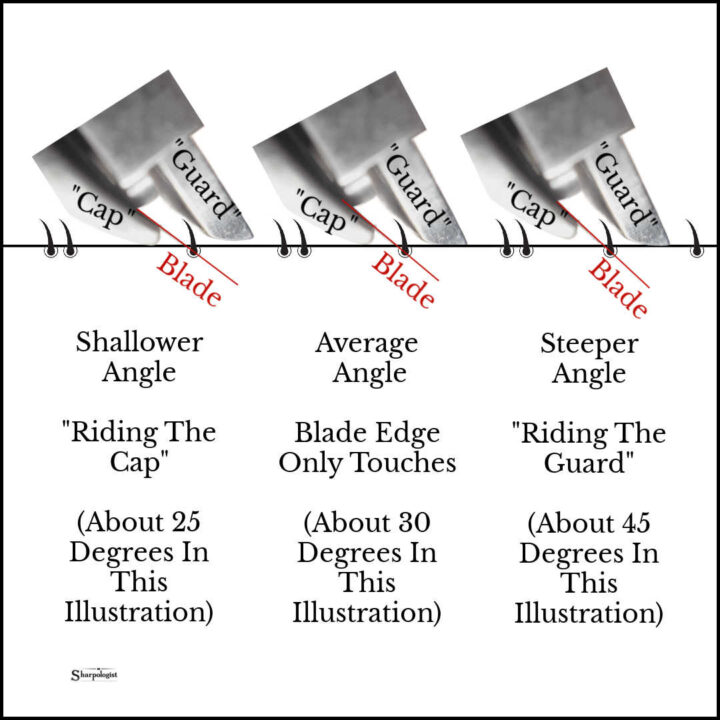
Angle operates within a functional range, not a single correct position.
Within that range, the blade cuts effectively without excessive irritation. Outside that range, performance degrades in predictable ways.
On one side of the range, the angle becomes too shallow. The blade does not engage the hair consistently. The result is tugging, skipping, or incomplete reduction.
On the other side, the angle becomes too steep. The blade begins to scrape rather than cut. That increases friction and the likelihood of irritation.
Between these extremes is a usable window where the shave feels smooth and controlled. Maintaining the shave inside that window is the real task.
Why Angle Is Difficult To Maintain
The difficulty comes from the fact that the conditions of the shave are not stable.
The face is not a flat surface. It is a series of curves, transitions, and irregularities. Moving from the cheek to the jawline, or from the jaw to the neck, changes the geometry the razor must follow.
Hair direction also shifts. Even small changes in growth direction alter how the blade needs to meet the hair to cut effectively.
Hand movement introduces variation as well. Subtle changes in wrist position or stroke direction can shift the angle without being obvious.
Pressure adds another layer. As explained in Why Excess Pressure Causes Shaving Problems, increasing pressure changes how the razor sits on the skin, which in turn alters the effective angle.
Lather condition also matters. As the shave progresses, lather can break down or thin out. Reduced glide increases resistance, making it harder to keep the blade moving within the intended range.
These factors combine to create constant drift. Even if the angle is correct at the start of a stroke, it can shift by the end of that same stroke.
These variables do not act independently. Each one alters the blade-to-skin relationship, which is why angle drift is so common even when the shave feels controlled. This variability is inherent to the shave, not a sign that something is going wrong.
How Pivoting Single-Blade Razors Change Angle Control
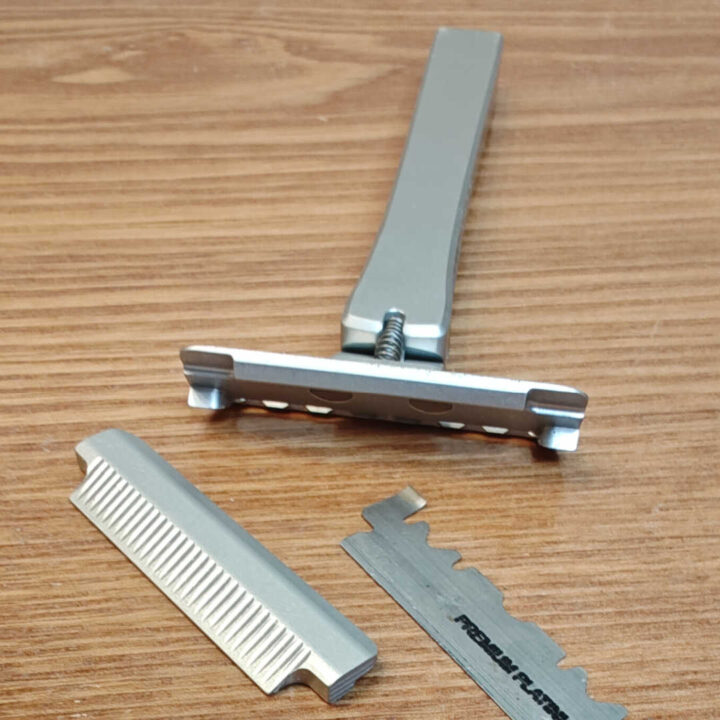
Pivoting single-blade razors change how angle is managed, but they do not eliminate it.
In designs like the Proof, Natu, or OneBlade, the head can adjust slightly as it moves across the skin. This reduces how much the user must actively manage the angle during the stroke.
The underlying interaction remains the same. The blade still operates within a functional range. The pivot shifts how that range is maintained, from direct control to partial mechanical assistance.
This makes the shave feel more consistent, especially across curves. It can also reduce the sensitivity to small hand movements.
At the same time, it limits how precisely the angle can be adjusted. The user has less direct control over how the blade engages the hair.
The core principle still applies. Angle is a relationship that must remain within a functional range. Pivot designs change how that relationship is maintained, not whether it exists.
Common Misinterpretations
One of the most persistent misunderstandings is the idea that angle can be “locked in.”
Advice such as “find the angle and hold it” implies a static condition. That doesn’t reflect what actually happens during a shave.
Heuristics like “ride the cap” or “ride the bar” can be useful starting points. They describe a general orientation, not a complete explanation, and they do not account for changes in surface shape, pressure, or stroke direction.
Another common assumption is that angle exists independently of other variables. In reality, angle interacts with pressure, razor design, and pass strategy. As discussed in Why Technique Determines Shaving Results More Than Tools, these variables are not isolated. They work together during the shave.
Observed Behavior

Across forums and user discussions, several patterns appear repeatedly.
Shavers often report that the first pass feels smooth, but later passes become less consistent. Others notice that certain areas, such as the jawline or neck, remain difficult even when the rest of the shave improves.
There are also frequent reports of inconsistent results despite using the same razor, blade, and routine.
These patterns align with angle drift. The initial conditions are controlled, but as the shave progresses and variables shift, maintaining the same functional angle becomes more difficult.
Experience Progression
Early in the learning process, most shavers focus on identifying the correct angle. This stage is often characterized by experimentation and uncertainty.
As experience increases, the focus shifts. The issue becomes less about finding the angle and more about maintaining it across different areas and passes.
With further experience, angle control becomes more intuitive. Adjustments are made continuously, with less conscious effort over time. The shave feels more stable, even though the underlying conditions are still changing.
Symptom Mapping
Certain outcomes are strongly associated with angle drifting outside its functional range.
Irritation is often linked to angles that are too steep or that fluctuate during the stroke. Increased contact between blade and skin raises friction and sensitivity.
Tugging is more common when the angle is too shallow or inconsistent. The blade fails to engage the hair cleanly, leading to resistance.
Patchy results often reflect variation across the face. Some areas remain within the functional range, while others fall outside it.
These symptoms are frequently attributed to other causes, but angle is often a contributing factor.
Practical Correction
Improving angle control is less about adopting a rigid technique and more about developing awareness.
Feedback during the shave provides useful signals. Sound, tactile feel, and resistance all indicate how the blade is interacting with the hair and skin, reflecting changes in shaving angle in real time.
Instead of trying to hold a fixed position, the goal is to make small, continuous adjustments. This allows the razor to stay within the functional range as conditions change.
This approach also explains why tool changes do not always solve problems. As explored in When A Tool Change Helps And When It Does Not, the underlying issue may be how the razor is being used, rather than the razor itself.
Conclusion
Shaving angle is often treated as a simple instruction. In practice, it is a dynamic relationship that must be managed throughout the shave.
The challenge is not locating the correct angle once. It is maintaining a functional range as the surface, direction, and conditions change. This is the same mechanism behind many common shaving problems, even when those problems appear to have different causes.
Understanding angle in this way helps explain why shaves can become inconsistent, even when nothing obvious has changed. It also connects directly to other variables that shape the outcome of the shave.

Good post. It explains one reason why i drifted away from DE razors to open razor shaving with straight razors and barber’s razors. It wasn’t that maintaining the correct angle with a DE was too difficult, it was the realisation that open razor shaving meant that the blade, and what it was doing, was always visible, and that for me, resulted in a greater level of consistency.
Really excellent article, especially the diagram that illustrates riding the cap vs. riding the guard.
I have heard from those shaving with DE razors that they more often get nicks from the XTG pass, while the WTG and ATG passes are generally trouble-free. They mention this as though the problem is somehow in the physics of the horizontally held razor, but in fact the problem is almost certainly the result of a failure to maintain a good blade angle in the XTG pass (and admittedly, keeping a good angle in that pass does require close attention and some practice).
As a committed cartridge shaver, I feel that a pivoting cartridge eliminates much of these problems. The frame of the cartridge holds the blade(s) at a consistent 30 degree angle. The pivot adjusts to the topography of the face. I achieve baby-bottom-smoothness with zero cuts.