
Introduction
Most experienced wet shavers already know that too much pressure causes problems.
It leads to irritation, razor burn, and inconsistent results. It’s one of the first things people learn to correct. And yet, even after that awareness, it continues to show up in the shave.
That creates confusion. Pressure is treated as a simple mistake, but it behaves more like something that reappears under certain conditions. You can remove it for a time, then find it creeping back in without realizing it.
Understanding why that happens requires looking at pressure not as a habit, but as part of how the shave works.
Quick Answer
Excess pressure increases blade engagement beyond what the skin can tolerate, leading to irritation and damage. It persists because it often develops as a response to poor feedback during the shave, not as a deliberate choice.
Core Principle
Excess pressure causes shaving problems because it increases blade engagement past the skin’s tolerance threshold, and it persists because it’s reinforced by immediate feedback during the shave.
The Mechanism: What Pressure Actually Does
Pressure changes how the blade interacts with both hair and skin.
When additional force is applied, the blade engages more deeply. This increases cutting efficiency in the short term, but it also increases friction and the amount of skin being affected by the blade. The result is a higher total load on the skin during each stroke, even when the stroke feels controlled.
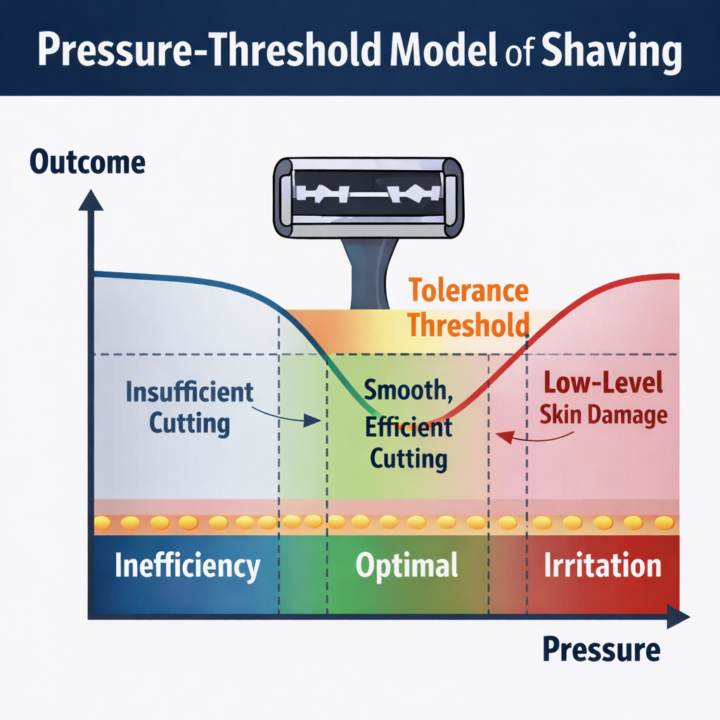
This can be understood through a simple threshold model of the shave. Each stroke operates within a tolerance range. Below it, the blade cuts cleanly. Above it, the skin begins to accumulate damage.
At lower levels of pressure, the blade removes hair with minimal disruption to the skin. As pressure increases, the shave becomes more efficient up to a point. That point represents the skin’s tolerance threshold. Beyond it, the blade is no longer just removing hair. It is also creating low-level skin damage.
The important detail is that this threshold is not fixed. It shifts based on angle, lather quality, razor efficiency, and the condition of the skin.
Pressure is not just an input. It is a multiplier on everything else happening during the shave.
Why Pressure “Works” In The Moment
Pressure may sometimes feel like it improves the shave.
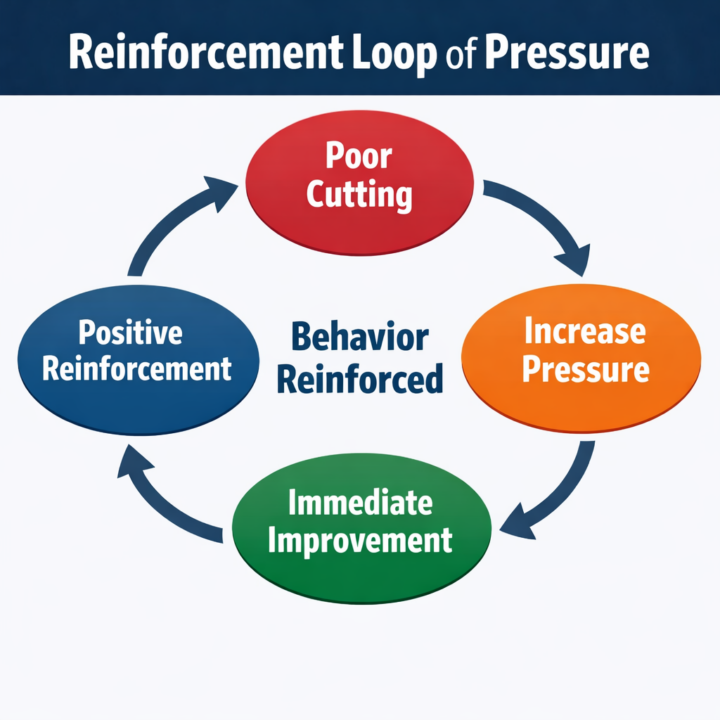
When hair is not being removed cleanly, adding a little more pressure can make the blade cut more effectively. Strokes may feel smoother. Areas that previously resisted begin to clear. The shave appears to improve.
But it also creates a strong feedback loop. The brain registers that pressing slightly harder produces a better result, so it repeats the behavior. The improvement may be real but incomplete. It feels like progress, and that feeling is enough to reinforce the behavior.
What is not immediately visible is the cumulative effect on the skin. The shave may feel efficient during the pass, but the cost appears later as irritation, sensitivity, or uneven results.
Pressure can become self-reinforcing. It solves a short-term problem while quietly creating a longer-term one. This is what makes pressure difficult to eliminate. The same force that improves cutting in the moment is also what pushes the shave past the skin’s tolerance.
Why Pressure Persists
Pressure is rarely the root cause of a problem–it is usually a response. When the shave becomes less predictable, adding pressure is a natural way to try to regain control.
When the shave isn’t working as expected, pressure fills the gap, compensating for other variables that are not aligned:
A slightly off angle can reduce cutting efficiency, so pressure restores it. A dull blade can struggle to cut cleanly, so pressure forces the cut. Weak or unstable lather reduces glide, so pressure pushes through it. Incomplete beard reduction leaves too much work for later passes, so pressure attempts to finish it.
In each case, pressure may appear to fix the problem. That’s why it persists.
The shave is providing unclear or insufficient feedback, and pressure becomes the default way to restore progress. The behavior is not random. It is adaptive.
This is also why simply telling yourself to “use less pressure” sometimes fails. The underlying conditions that created the need for pressure are still present. In that sense, pressure is not a primary variable. It is a compensating variable.
Observed Behavior
Several patterns show up repeatedly in real-world shaving discussions:
- Pressure seems fixed, then returns without warning
- Shaves start clean but degrade in later passes
- Certain areas consistently trigger more pressure than others
These patterns are not random mistakes. They reflect moments where the shave crosses from stable to unstable conditions.
As feedback becomes less reliable, pressure increases automatically. The user may not even notice it happening. By the time it appears, it often feels like part of the stroke rather than a separate action, or something that “comes back” rather than something consciously applied.
Experience Progression
Pressure changes as experience increases, but it doesn’t disappear.
Beginners tend to use obvious, sustained pressure, usually from lack of familiarity with angle and reduction. The results are immediate and noticeable.
Intermediate shavers often believe they have solved the problem. In reality, pressure becomes more subtle. It appears in specific areas, later passes, or difficult spots. It’s less visible, perhaps inconsistent, but still present.
Experienced shavers learn to recognize when pressure is being introduced and why. They may still apply it in controlled ways, but it’s no longer a default response.
The key difference is not elimination: it’s awareness and control. Pressure also increases the total exposure the skin experiences over the entire shave, not just within a single stroke.
Symptom Mapping
Different shaving problems can often be traced back to how pressure interacts with the threshold and reflect different ways the shave exceeds the skin’s tolerance. These are often the first signs that pressure has moved past the skin’s tolerance:
- Razor burn typically reflects sustained pressure above the tolerance threshold across multiple strokes.
- Nicks and cuts often result from localized spikes in pressure, especially when combined with unstable angle or skin tension.
- Inconsistent results usually indicate fluctuating pressure, where the shave moves in and out of stable conditions.
These outcomes are not separate issues. They are different expressions of the same underlying mechanism.
Interaction Model: Pressure Is Not Isolated
Pressure does not act alone. It interacts with every other variable in the shave.
- Angle determines how the blade meets the hair. If the angle is inefficient, pressure often increases to compensate.
- Razor efficiency affects how easily hair is cut. Less efficient razors can encourage more pressure if the user expects the same immediate result.
- Lather quality affects glide and protection. When lather breaks down, pressure increases friction and amplifies the problem.
The important point is that pressure becomes more damaging when other variables are unstable.
Changing tools does not reliably solve pressure-related issues. The underlying interaction between variables remains the same. As the shave becomes less stable, pressure becomes more active as a compensating behavior.
For a broader view of how these interactions shape results, see Why Technique Determines Shaving Results More Than Tools and Why Some Shaves Fail Even When Nothing Changed.
Practical Correction
Because pressure is a response, it does not disappear through intention alone. Correcting it requires changing the conditions that produce it. Lasting improvement does not come from suppressing pressure. It comes from removing the need for it.
When angle is clear and consistent, the blade cuts without force. When lather provides stable glide, there is no need to push through resistance. When beard reduction is handled progressively, later passes require less effort.
Pressure tends to disappear when the shave provides clean, reliable feedback.
Some shavers find that more efficient razors reduce irritation rather than increase it. When the blade cuts more easily, there is less incentive to add force. This dynamic is explored further in Why Mild Razors Can Produce More Irritation Than Efficient Ones.
Similarly, understanding when a tool change actually helps depends on whether it removes the need for compensation. See When A Tool Change Helps And When It Does Not for how that distinction plays out.
Conceptual Completeness Check
Pressure is not just a mistake. It is a response generated by the shave.
It increases blade engagement and pushes the shave beyond the skin’s tolerance threshold. It persists because it is reinforced by immediate feedback and compensates for other variables that are not aligned.
Understanding pressure in this way places it within a broader pattern. Many shaving problems are not isolated issues. They are outcomes of how the variables interact.
Conclusion
Excess pressure is easy to recognize, but harder to eliminate.
That is because it is not simply something you choose to do. It is something the shave encourages under certain conditions. When feedback becomes unclear, pressure fills the gap.
Improving the shave is not about resisting that impulse directly. It is about changing the conditions that create it.
Once the shave becomes clear, stable, and predictable, pressure no longer has a role to play.
