
Introduction
“Efficient” is one of the most commonly used terms in wet shaving. It’s also one of the least clearly defined.
Most experienced shavers have a sense of what it means: a razor feels efficient, or it doesn’t. But when results become inconsistent, that intuition often breaks down. A more “efficient” razor may produce worse shaves. A “milder” razor may require more work than expected.
The problem is not the term itself but how loosely it is used to describe multiple different things at once.
Until razor efficiency is defined clearly, it’s difficult to predict how a razor will behave or why a shave improves or degrades when something changes.
Razor efficiency is one of the core variables in how the shave works, and it interacts directly with angle and pressure.
Quick Answer
Razor efficiency describes how much hair a razor removes per pass at a given angle and pressure. A more efficient razor removes more hair with each stroke, which can reduce the number of passes required but may increase the margin for irritation if not controlled.
The Core Principle
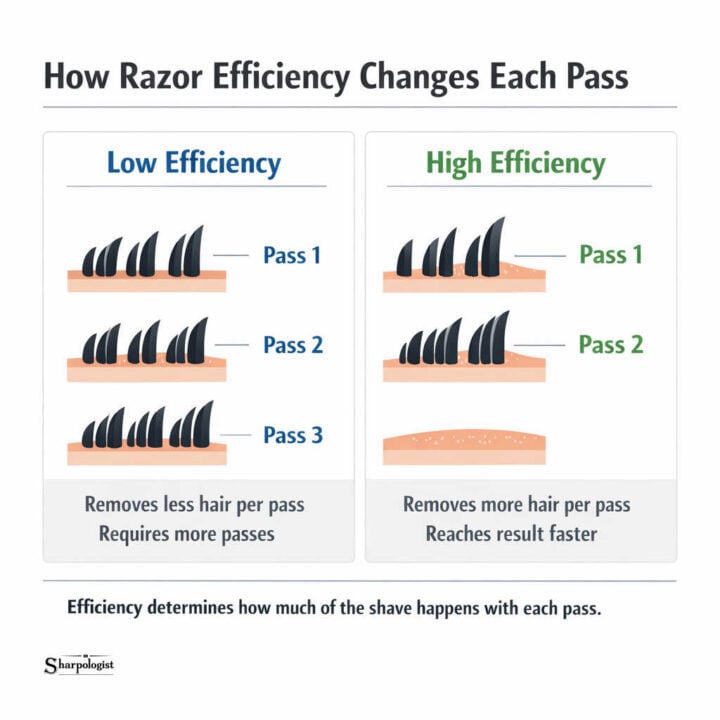
Razor efficiency is the rate at which a razor removes hair relative to its impact on the skin during each pass.
It’s not just about closeness. It’s about how quickly the shave progresses. In practical terms, it determines how much of the shave happens with each pass.
A highly efficient razor removes more stubble in a single pass. A less efficient razor removes less, requiring additional work to reach the same result. The tradeoff is that increased efficiency also increases how much of the shave happens at once, including both hair removal and skin interaction.
How Razor Efficiency Actually Works
That rate is determined by how the blade meets the hair and the skin at the same time.
Blade exposure, blade angle, and head geometry determine how directly the edge engages the stubble. When that engagement is stronger, more hair is cut with each stroke.
But the blade does not only contact hair. It also interacts with skin. As efficiency increases, both interactions increase together.
This creates a consistent relationship:
Higher efficiency increases the rate of hair removal per pass, while also increasing the intensity of each pass.
Lower efficiency reduces the impact of each pass, but requires more total exposure over the course of the shave to achieve the same result.
This is why efficiency is better understood as a rate, not a result.
The Threshold Model
Efficiency changes how quickly you reach the point where the shave begins to break down.
With a low-efficiency razor, each pass contributes a small amount of hair removal. The shave builds gradually. This leaves more room for variations in angle and pressure, but it also increases total exposure from repeated passes.
With a high-efficiency razor, each pass removes more hair immediately. The shave reaches its endpoint faster, but the margin for error is smaller.
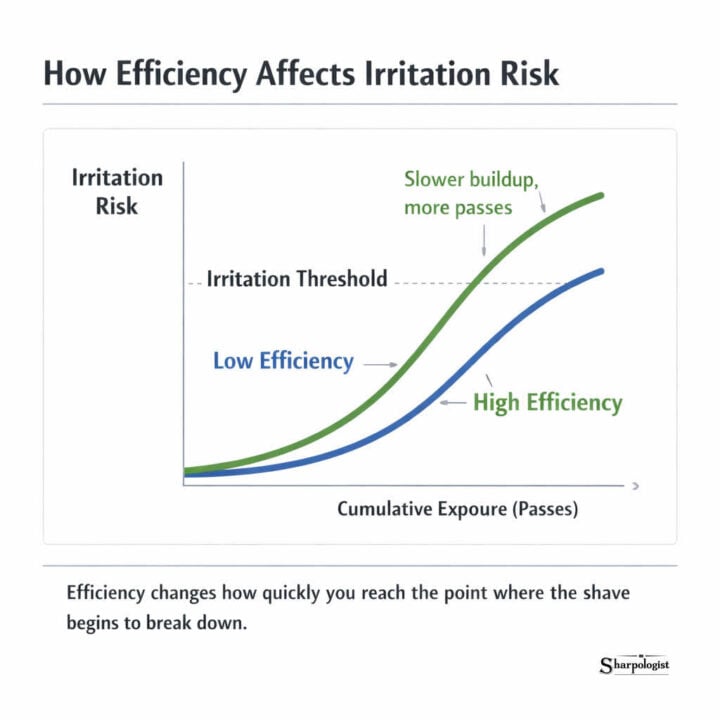
There is a practical threshold in every shave where additional exposure begins to produce irritation instead of improvement:
- Lower efficiency approaches the threshold slowly through accumulation
- Higher efficiency approaches the threshold quickly through intensity
This threshold is what ultimately determines whether a shave improves or begins to break down.
Why Efficiency Is Often Confused With Aggression
Efficiency and aggression are related, but aren’t the same.
Aggression describes how the razor feels on the skin. It reflects blade feel, feedback, and perceived harshness.
Efficiency describes how much of the shave happens per pass.
A razor can feel smooth and still be highly efficient. It can also feel harsh without removing much hair effectively.
The confusion comes from the fact that many razors increase both at the same time. When that happens, it becomes easy to assume they are the same concept.
Efficiency is about performance. Aggression is about sensation.
Observed Behavior
Across forums and user reports, the same patterns appear repeatedly:
Shavers describe a new razor as “too aggressive” when the actual issue is that it removes more hair per pass than their technique is calibrated for.
Others describe a razor as “mild but ineffective” when the real issue is low efficiency requiring more passes than expected.
In both cases, the underlying mechanism is being misinterpreted.
How Efficiency Changes With Experience
Efficiency is not experienced the same way across different stages of shaving.
Less experienced shavers tend to benefit from lower efficiency. The slower rate of hair removal allows for more variation in angle and pressure without immediate consequences. The shave is more forgiving, even if it requires additional passes.
As experience increases, many shavers begin to prefer higher efficiency. The ability to remove more hair with fewer passes becomes an advantage, especially when angle control and pressure are more consistent. But that preference is situational, not a progression toward a better outcome.
Higher efficiency increases the need for more precision. It reduces the margin for error. For some shavers, especially those prioritizing comfort over closeness, lower efficiency remains preferable even with experience.
Efficiency is a control variable, not a skill level marker.
Symptom Mapping
Many common shave outcomes can be traced back to how efficiency is interacting with technique.
Needing multiple passes to get close often indicates lower efficiency. The razor is removing hair gradually, requiring repeated exposure.
Irritation after a single pass often indicates higher efficiency interacting poorly with angle or pressure. Too much of the shave is happening at once.
Inconsistent results with different razors often reflect a mismatch between efficiency and technique. The same approach does not produce the same outcome when the rate of hair removal changes.
These patterns are directional, not definitive. Efficiency is one variable in how the shave behaves, not the only one.
Practical Interpretation
Efficiency does not change the goal of the shave. It changes how much of that goal is achieved with each pass.
A more efficient razor reduces the number of passes required, but increases the importance of maintaining a stable angle and controlled pressure. A less efficient razor distributes the shave across more passes, increasing total exposure but reducing the impact of each individual stroke.
This is why the same technique can produce different results when the razor changes.
Changing razors often produces unexpected results, even when everything else remains the same.
The shaving process is not only about the tool but also about how the variables interact.
If efficiency changes, the rest of the shave must adjust with it.
For a deeper look at how technique influences outcomes regardless of the tool, see Why Technique Beats Razor Choice Every Time. For how multiple variables combine to affect results, see Why One Change Rarely Fixes A Bad Shave. For the role of angle in controlling blade engagement, see What Shaving Angle Means (And Why It Is Difficult To Maintain). For a broader explanation of why problems rarely have a single cause, see Why Shaving Problems Are Almost Never Caused By One Thing.
Conceptual Summary
Razor efficiency is often used as a shorthand for several different ideas. Clarifying what it is not helps stabilize the concept.
Efficiency is not closeness. Closeness is the outcome of the shave. Efficiency determines how quickly that outcome is reached.
Efficiency is not aggression. Aggression describes how the razor feels. Efficiency describes what it does.
Efficiency is not comfort. Comfort reflects how the shave interacts with the skin over time.
Keeping these distinctions clear makes the rest of the shaving process easier to interpret.
The goal is not to find the “most efficient” razor. The goal is to understand how efficiency shapes the shave, so that the result is intentional rather than accidental.
