
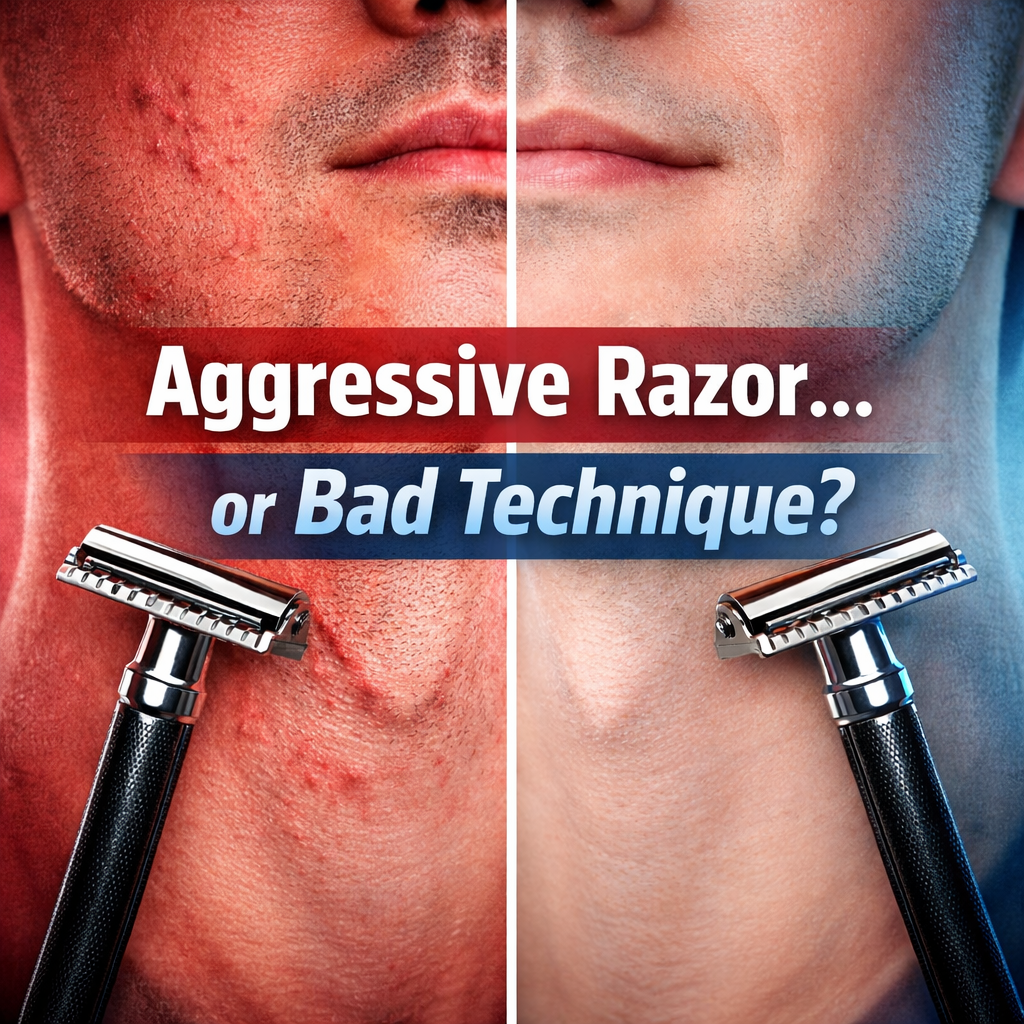
Spend enough time reading wet shaving forums and you will see the word aggressive everywhere. Razors are described as aggressive or mild, as if those labels describe a single measurable trait. Blades are said to make a razor more aggressive. Irritation is often blamed on too much aggression.
Introduction: Why “Aggression” Is a Confusing Word
The problem is not that shavers are careless or inexperienced. The problem is that aggression has become a catchall term for several different things. It started as a useful shorthand, but over time it began doing too much work.
As a result, many shavers correctly sense that something is off during a shave, yet misidentify the cause. That confusion often leads to unnecessary product changes instead of meaningful improvement.
Quick Answer
Most shavers misdiagnose razor aggression because they treat it as a fixed design property of the razor. In practice, what feels aggressive depends on angle, pressure, blade choice, and the number of passes. The same razor can feel harsh or smooth depending on how it is used.
The Same Razor, Two Completely Different Experiences
One user says a razor is aggressive. Another says the same razor is smooth and comfortable. This pattern appears often in shaving forums and reviews. Both users can be correct.
The disagreement doesn’t resolve over time. It repeats across different razors and different users.
This is the first clue that something is being misunderstood.
Most shavers think they are describing the razor. In reality, they are describing the result of an interaction they can’t fully see.
Why Shavers Can Disagree About The Same Razor
If aggression were a fixed property, opinions would be consistent. They aren’t.
The same razor produces different results between different users, for the same user on different days, and even within the same shave. This suggests that “aggression” is not a stable design characteristic like weight or handle length. It’s a conditional experience that depends on how the razor is used.
What You Are Actually Feeling When a Razor Feels “Aggressive”
When a razor feels aggressive, several things are usually happening at the same time:
- The blade is more noticeable on the skin: this often feels like harshness, but it is usually just increased feedback from the blade edge.
- Hair is removed more quickly per stroke: this creates a stronger immediate effect, which many users interpret as the razor being more aggressive rather than more efficient.
- Small mistakes produce immediate feedback: slight errors in angle or pressure show up right away instead of being masked.
- The margin for error is smaller: there is less tolerance for inconsistency, so the shave feels less forgiving overall.
Most users interpret these signals as harshness. In many cases, they are simply noticing the blade more clearly. The sensation is real. The interpretation is often incorrect.
Why Efficient Razors Get Labeled “Aggressive”
Razors that remove more hair per pass often get called aggressive.
This happens because efficient razors do two things at once:
- They reduce the number of passes needed
- They increase the consequences of small mistakes
If the angle is slightly off or pressure increases, the result becomes noticeable immediately. The user experiences this as harshness.
The user feels the outcome, not the cause. Because the razor is the most visible variable, it becomes the default explanation.
The razor did not become aggressive. It became less forgiving.
Efficiency is often misread as aggression because it exposes errors faster.
Why Efficient Razors Get Blamed Unfairly
How Technique Changes the Feel of Any Razor
The same razor can feel completely different depending on how it is used. Most of these changes happen without conscious awareness during a shave.
Angle
Small changes in angle change how much of the blade engages the skin. Riding the cap produces a different result than riding the guard. Many users shift between these without realizing it, especially when adjusting mid-stroke or trying to pick up missed areas.
Pressure
Pressure is often subtle. It increases when chasing a closer result, when attention fades, or when confidence drops. Even slight pressure can turn a comfortable shave into an irritating one, particularly with more efficient razors.
Stroke Length and Speed
Long strokes increase cumulative contact with the skin. Faster strokes reduce control. Together, they make small mistakes harder to detect and correct in real time.
Pass Count
Each pass removes a small amount of skin along with hair. Additional passes increase irritation. Many users attribute this irritation to the razor, even though it is the total accumulation that causes the problem. If the feel of the razor changes without changing the razor, technique is part of the cause. Efficient razors provide immediate feedback. That feedback can feel intense, especially at first.
What they often do not do is cause delayed irritation. By removing stubble quickly and clearly, they reduce repeated contact and help the user adjust sooner.
Many experienced shavers eventually prefer efficiency not because it is harsher, but because it is more honest.
When a Razor Is Actually Aggressive and When It Only Feels That Way
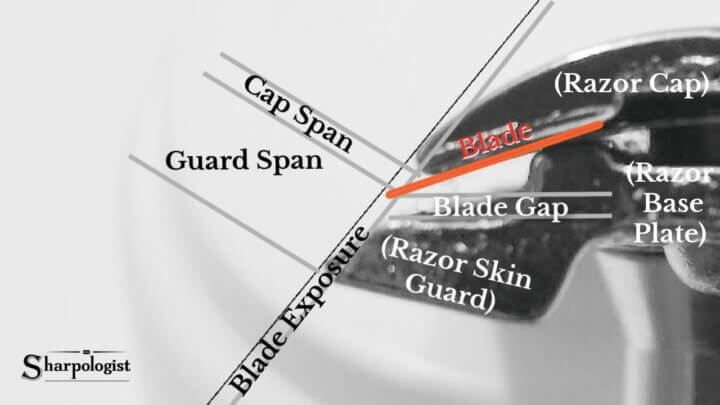
Some razors do have design characteristics that increase blade engagement. These include:
- positive blade exposure
- larger blade gaps
- head geometry that presents the blade more directly
These design factors affect how the blade meets the skin, but they don’t determine the outcome on their own.
Most impressions that feel aggressive come from other sources:
- excess pressure
- inconsistent angle
- too many passes
- poor blade pairing
Most users don’t separate these factors. They assign the result to the razor because it is the most visible variable.ny one of those and the experience changes. Treating aggression as a fixed trait hides that flexibility.
How to Tell If the Problem Is the Razor or the Technique
By this point, the distinction should be clearer. Instead of guessing, you can look for patterns in the outcome.
- Irritation appears immediately: angle or pressure is likely the cause
- Irritation builds over multiple passes: cumulative damage is likely the cause
- Only certain areas have problems: angle inconsistency is likely
- A different blade changes the result: pairing is likely the issue
- Results vary from day to day: technique is not stable yet
These patterns matter because they show whether the problem happens instantly or builds over time. That distinction usually points to the underlying cause.
If the result changes without changing the razor, the razor is not the only variable.
These patterns don’t require changing razors to test. They require changing how the razor is used.
Observed Behavior: What Shavers Say vs What Is Happening

These patterns appear consistently across long-term discussions and user reports. They repeat across different razors, blades, and experience levels. They are not isolated cases.
A common pattern is that a razor gets labeled aggressive when the technique does not match the razor’s tolerance. The razor exposes inconsistencies that were previously hidden.
Another pattern appears when a razor is described as “biting.” This is usually tied to a steeper angle or a small increase in pressure. The blade engages more directly with the skin, creating a sharp, localized response that feels like the razor is at fault.
It is also common for a razor to be described as unforgiving. In most cases, the razor is revealing small variations in angle and pressure that milder razors allow to pass without consequence.
In some cases irritation appears after the second or third pass, but the razor is blamed. Irritation is cumulative: each pass adds a small amount of skin damage, and the final result is attributed to the tool instead of the total number of passes.
Another recurring pattern occurs when switching to a sharper blade. The razor is then described as aggressive, even though the razor hasn’t changed. The blade has altered how the edge interacts with the skin, increasing the sensation of directness.
It’s also common for a razor to feel aggressive in one area of the face but not another. This usually points to angle inconsistency or differences in skin contour, not a change in the razor itself.
These statements describe real experiences. The outcomes are accurate. The interpretation of the cause is often not.Across these patterns, the same theme appears: the label “aggressive” is applied to the outcome, not the cause.
Why Experience Changes How “Aggression” Is Perceived
Experience changes how feedback is interpreted.
Less experienced shavers often interpret blade feel as a warning. They prefer a muted sensation because it feels safer and more controlled.
More experienced shavers interpret blade feel as information. They use it to guide angle and pressure more precisely during the shave.
The same razor can feel aggressive at one stage and controlled at another. The razor did not change. The interpretation did.
Why Mild Razors Can Hide Problems
Mild razors tolerate imperfect technique. They allow:
- slightly incorrect angles
- small amounts of pressure
- extra passes
This can produce acceptable results while masking underlying issues.
Over time, these habits become normal. When a user switches to a more efficient razor, those habits no longer work.
The new razor gets blamed for problems that were already present but hidden. This is why a change in razor often appears to “create” a problem that was already there.
The Role of Blade Choice In Perceived Aggression
Blade choice can change how a razor feels more than expected.
- Sharper blades increase blade presence and make the shave feel more direct
- Smoother coatings reduce friction and soften the overall feel
- Different blades change how the razor interacts with both hair and skin
It is common for a razor labeled aggressive to feel smooth with a different blade.
This is another sign that aggression isn’t a fixed property.
Why the Idea of “Aggressive Razors” Persists
The term remains popular because it simplifies a complex interaction.
Manufacturers use it to describe product differences. Forums use it as shorthand to communicate quickly. It is easier to say a razor is aggressive than to describe angle, pressure, and efficiency in detail.
There is also a tendency to blame tools first. Technique is harder to observe and harder to adjust.
The concept persists because it’s convenient, not because it’s precise.
What “Aggressive” Really Describes
In most cases, “aggressive” describes a razor that:
- increases blade engagement
- reduces tolerance for error
- makes technique more visible
A more useful way to think about aggression is this:
It reflects how sensitive the shave is to how you use the razor.
This shifts the focus from the tool itself to the interaction between the tool and the user.
What Changes as You Gain Experience
As technique improves:
- angle becomes more consistent
- pressure decreases without conscious effort
- fewer passes are needed to reach the same result
- blade feel becomes easier to interpret and use
Razors that once felt aggressive often become predictable and comfortable.
The tool remains the same but the interaction improves.
Key Takeaways
- Aggression is not a fixed property of a razor
- Efficient razors often feel aggressive because they expose mistakes
- Technique has a larger effect than most users expect
- Mild razors can hide underlying problems
- Perception of aggression changes with experience
These patterns all point to the same idea: the shave is an interaction, not a fixed outcome from a tool.
Conclusion
Most shavers misdiagnose aggression because they try to assign a simple label to a complex interaction. Once you understand how angle, pressure, blade choice, and pass count work together, the term “aggressive” becomes less about the razor and more about how the shave is performed.
FAQ
What makes a razor feel aggressive?
Usually a combination of blade exposure, angle, pressure, and efficiency. The razor contributes, but technique determines how those factors are experienced.
Is an aggressive razor bad?
Not necessarily. Razors that feel aggressive often provide efficient shaves when used with controlled technique.
Why does my razor feel aggressive some days but not others?
Small changes in angle, pressure, skin condition, and pass count can change how the shave feels.Should I switch razors if mine feels aggressive?
Only after evaluating technique and blade choice. Many cases improve without changing the razor.

Good article, which I fully agree with. The article explains why instead of getting an efficient razor, I chose a barber’s razor (shavette) instead because blade angle and pressure are easier to see and achieve and overall “feel” is greater than that of a DE razor, and that does make a difference to the shave.
Great article. I started with a Merkur 34c 10 months ago. I enjoy the lack of blade feel.How do I know when it is time to try a more efficient razor? I tried a ROCCA about six months ago but sold it because I did not like the blade feel and having to concentrate so hard on technique. But I might be willing in the future to try something more efficient again.