
Introduction
Most experienced wet shavers have gone through the same cycle.
A new razor promises better results. A different blade is supposed to be smoother. A new soap is meant to fix irritation. And, for a few shaves, something does feel different. Then the results drift back to where they were before.
At that point, it starts to feel inconsistent. Not bad enough to diagnose clearly, but not good enough to trust.
The natural conclusion is that something in the tools still isn’t right.
In most cases, that conclusion is the mistake.
Quick Answer
Technique determines how the blade interacts with the skin and hair during the shave. Tools can change the range of possible outcomes, but they do not control what actually happens at the point of contact. The consistency, comfort, and closeness of a shave are primarily determined by angle, pressure, and how the passes are structured.
The Core Principle
Shaving results are determined primarily by how the blade is used, not by the tool holding it.
The Mechanism: How Technique Actually Determines Results
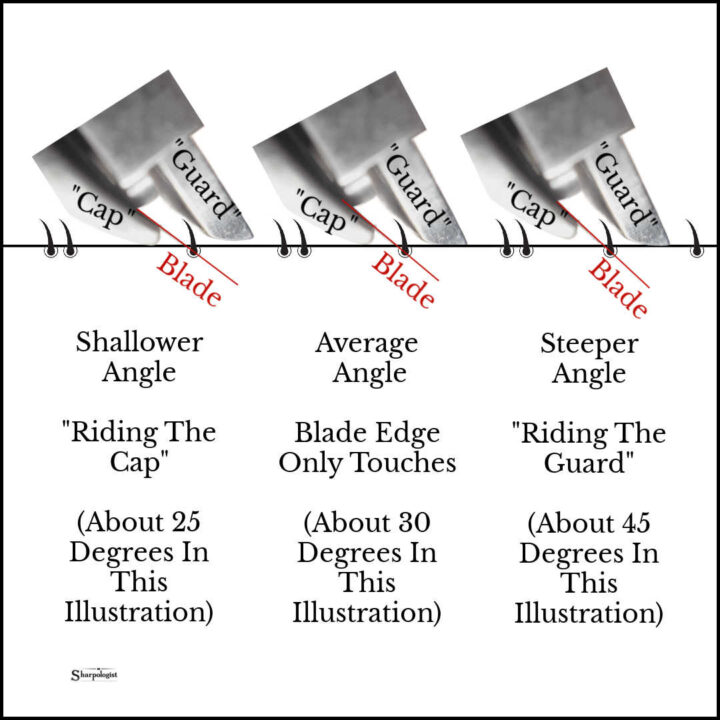
Every shave comes down to a simple interaction: a blade moving across hair that is attached to skin.
What matters is not the tool itself, but how that interaction is managed. The blade does not decide how it cuts: the way it is applied determines the result.
This is not about doing something “wrong.” It’s about how small differences in how the blade is used change the result.
Angle determines whether the blade engages the hair cleanly or skims across the surface. When the angle is correct, the blade cuts efficiently. When it is off, the blade either misses hair or drags against the skin.
Pressure determines how much of the blade’s force is directed into the skin. Light pressure keeps the interaction controlled. Increased pressure pushes the blade into the skin, which increases both cutting force and the likelihood of irritation.
Pass structure determines how the hair is reduced over time. Hair isn’t removed all at once: it’s shortened in stages (“passes”). When passes are structured properly, each pass removes a manageable amount. When they are not, the blade is asked to do too much at once.
These variables are always present. The razor only holds the blade at a certain exposure and angle range. The outcome depends on how those variables are used during the shave.
This is why two people can use the same razor and get completely different results.
Threshold Model: Where Results Actually Change
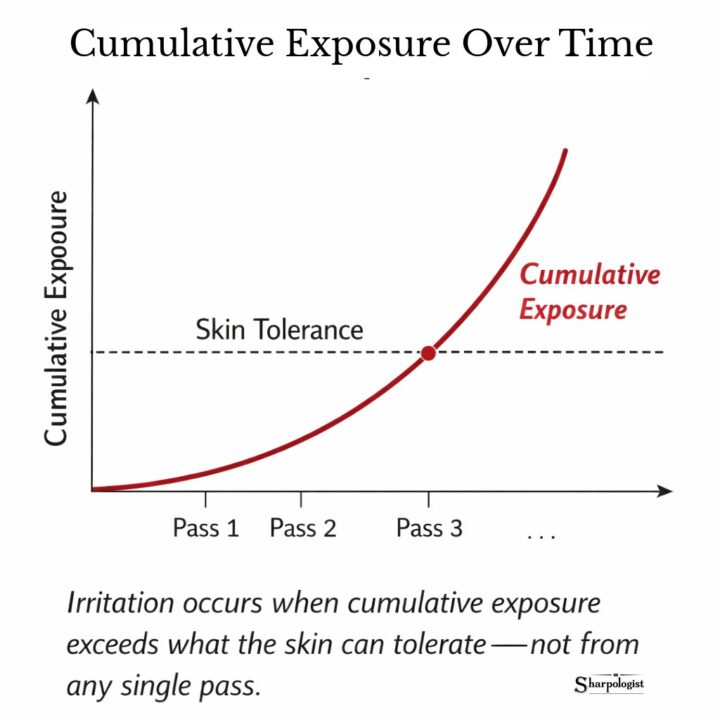
Shaving results tend to feel gradual, but that’s not necessarily so. There are thresholds.
There’s a point where a shave goes from comfortable to irritating. There’s also a point where hair is cut cleanly instead of being pulled. Additional passes stop improving closeness and start increasing irritation.
Technique determines whether those thresholds are crossed.
Angle, pressure, and repetition all move the shave toward or away from those points. Staying just below the irritation threshold produces a comfortable shave. Crossing it produces the same problems many shavers try to solve by changing tools.
Tools can shift where these thresholds sit. A more efficient razor may reach cutting thresholds more easily. A milder razor may delay irritation. But neither controls whether those thresholds are crossed. That is determined during the shave itself.
This is the same reason shaves can fail even when nothing in the setup has changed.
Why Tools Appear To Matter More Than They Do
If technique determines results, tools should not seem so influential. But they do. Tools still matter, but they shape the range of outcomes rather than determine them.
Part of this comes from how immediate the feedback is. A new razor changes the feel of the shave right away. That makes it easy to attribute any difference in outcome to the tool.
Another part comes from how tools can limit extremes. Some razors make it harder to apply too much pressure. Others make it easier to reach a cutting angle. This creates the impression that the tool is solving the problem, when it is often just limiting how far technique can drift.
There is also a simple attribution problem. When results improve, it is easier to credit the new razor than to notice that angle, pressure, or pacing changed at the same time.
This is why a new setup can seem to work well for a few shaves, then stop working as the underlying habits remain unchanged.
Common Misinterpretations
“This razor is too aggressive.”
This usually describes the outcome of the shave rather than the cause. What feels aggressive is often the result of angle and pressure combining in a way that increases how much of the blade engages the skin.
“This blade causes irritation.”
Blades can vary, but irritation is more often a result of how the blade is used. When pressure or repetition crosses a threshold, the blade becomes the visible source of the problem.
“I need a better razor for a closer shave.”
Closeness comes from how hair is reduced over multiple passes. When reduction is incomplete or inconsistent, the result is often attributed to the razor rather than to how the passes were executed.
These statements are understandable: they describe what the shave feels like. They do not reliably identify why it feels that way.
Observed Behavior
Across forums and shave logs, a consistent pattern shows up, regardless of the specific razor or blade being used.
Shavers rotate through multiple razors, blades, and soaps, looking for a combination that produces stable results. Some combinations seem to work temporarily, but the improvement rarely holds.
When results do stabilize, it’s often after something changes in how the shave is performed. The pace slows down. Pressure becomes lighter. Passes become more deliberate. The change is subtle, but the results become more consistent.
What stands out is not the specific tools being used, but the repeatability of how the shave is executed.
Experience Progression: How This Changes Over Time
Early on, tools feel like the main variable.
Each razor feels different. Each blade seems to behave in its own way. It’s natural to assume that the right combination will solve most problems.
As experience increases, a different pattern emerges.
Results start to improve, but not always consistently. Good shaves happen, but they are not fully repeatable. At this stage, tool changes become less reliable as a solution.
With enough repetition, technique stabilizes. Angle becomes more consistent. Pressure becomes controlled without deliberate effort. Pass structure becomes predictable.
At that point, different tools still feel different, but the results vary much less. The same technique produces similar outcomes across a range of razors and blades.
This is not a lack of experience. It’s how the mechanics of the shave reveal themselves over time.
Symptom Mapping: What Problems Actually Point To
Most shaving problems come from how the blade is interacting with the skin and hair during the shave.
Irritation usually indicates that angle, pressure, or repetition has crossed a threshold. The blade is interacting with the skin more than it needs to.
Incomplete closeness often points to how the hair is being reduced. If the angle is inconsistent or the passes are not removing hair progressively, the result will feel uneven.
Inconsistent results are usually a sign that one or more variables are changing from shave to shave. Small differences in angle, pressure, or pacing can produce noticeably different outcomes.
These symptoms are often attributed to tools because tools are visible and easy to change. The underlying causes are tied to how the shave is performed.
Practical Correction
Improvement rarely comes from adding more variables. It comes from reducing them.
Using the same razor, blade, and soap for a period of time removes external differences and makes the interaction easier to observe. Changes in results become easier to connect to changes in execution.
Focusing on repeatability matters more than chasing ideal conditions. A consistent angle, controlled pressure, and deliberate pass structure create stable results across different setups. This can feel slower at first, because the feedback is less immediate than switching tools. But the results are more stable once the pattern settles.
This is also why changing less often leads to better shaves. It allows technique to stabilize instead of constantly adapting to new conditions.
Once technique stabilizes, the shave becomes more predictable and requires less adjustment.
(See Why Changing Less Improves Your Shaves.)
Conclusion
Tools shape the boundaries of a shave, but they do not determine the outcome.
The outcome is created where the blade meets the skin and hair. That interaction is controlled by technique.
When results are inconsistent, the instinct is to look outward and change equipment. In most cases, the more useful approach is to look at how the shave is being performed and make it more repeatable.
Once technique stabilizes, tools still matter, but they matter differently. They refine the experience, but they no longer determine the outcome. That is why results become consistent only when the way the shave is performed becomes consistent.

Good article. The only downside I can see regarding double edge razors is that the blade is hidden, and without a head pivot, the user has to “guess” the correct angle largely based on the angle of the handle, which a user has to learn, but once mastered, the shave is excellent. As for efficiency/aggression in a DE razor, is too much blade exposure really too much?