
Blade Performance Is More Complicated Than Most Shavers Think
If you spend enough time on wet shaving forums, you’ll eventually see two experienced shavers make completely opposite claims about the same blade.
One person describes a blade as incredibly smooth. Another says it’s rough and irritating. One shaver buys a hundred-pack because the results are so good. Someone else can’t wait to finish the first tuck.
At first glance, those strong disagreements may seem strange. After all, everyone is using the same blade.
But blade discussions often get confusing because several different characteristics get lumped together and described like they were the same thing. Words like sharp, smooth, aggressive, and harsh are often used interchangeably even when they’re describing very different aspects of the shave.
The result is a lot of contradictory advice and a lot of unnecessary blade experimentation.
Most blades are not simply “good” or “bad.” They have characteristics that interact with the razor, the beard, the skin, and the way the shave is performed. Understanding those characteristics makes blade discussions much easier to interpret and often makes blade selection much less frustrating.
Quick Answer
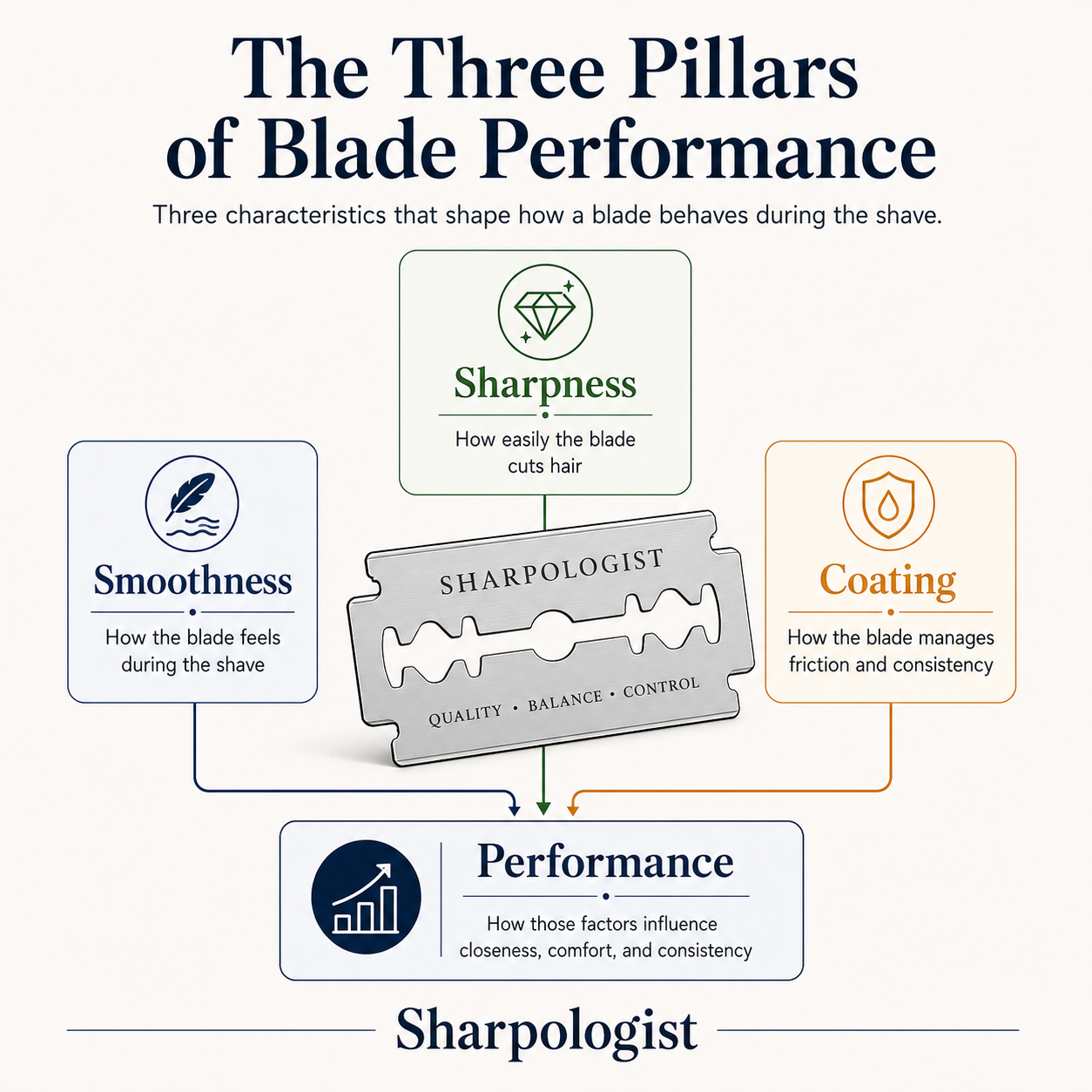
Blade sharpness affects how easily a blade cuts hair. Smoothness affects how the blade feels during the shave. Coatings influence friction, comfort, and consistency. Actual shaving performance comes from the interaction of all three characteristics, along with razor design and shaving technique.
That’s why a blade can feel exceptionally smooth without producing the closest shave, and why a blade that feels more noticeable on the skin can sometimes deliver excellent results. Sharpness, smoothness, and coating all matter, but none of them tells the whole story by itself.
The Core Principle
Blade performance is how blade sharpness, smoothness, and coating interact with razor design and shaving technique to influence closeness, comfort, and consistency.
This might be the most useful way to think about blades because it explains many of the contradictions that appear in blade reviews and shaving discussions.
Blades interact with a specific razor, a specific beard, and a specific set of shaving habits. The same blade can produce very different experiences depending on the razor holding it, the beard it’s cutting, and the person using it.
That’s also why finding the “best blade” is often more difficult than it sounds.
Many blade journeys begin with a simple assumption: if a blade cuts more easily, the shave should improve. Sometimes that’s true but it often isn’t. A sharper blade may improve results for one shaver while creating new problems for another. A smoother-feeling blade may feel more comfortable while removing less hair per pass. A coated blade may feel different without fundamentally changing how the blade edge cuts.
Those outcomes can seem contradictory until sharpness, smoothness, and coating are viewed as separate characteristics rather than different names for the same thing.
The rest of this article breaks those characteristics apart and explains how they combine to create the shaving experience most wet shavers simply refer to as “blade performance.”
What Blade Sharpness Actually Means
When wet shavers talk about blades, sharpness is usually the first characteristic that comes up.
That’s understandable. Sharpness is easy to notice. A blade that cuts through dense beard growth with very little resistance tends to stand out immediately. For shavers with coarse whiskers, the difference can be especially obvious.
Sharpness refers to how easily a blade cuts hair.
That sounds simple enough, but many discussions stop there and start to drift off course.
The assumption behind a lot of blade experimentation is straightforward: if a blade cuts more easily, the shave should improve. Sometimes it does. But sharpness alone doesn’t determine whether the shave will be comfortable.
Across wet shaving forums, it’s common to see a blade described as both incredibly sharp and surprisingly comfortable. It’s just as common to see a different blade described as sharp but unforgiving. Those aren’t necessarily contradictory observations.
A blade’s ability to cut hair and a shaver’s experience using that blade are related, but they aren’t the same thing.
This becomes easier to understand when viewed through the lens of cumulative exposure. A sharper blade may remove more hair with each pass, which can reduce the need for additional cleanup work. Fewer corrective strokes often means less total skin exposure.
That’s one reason some shavers actually experience less irritation after switching to a sharper blade.
At the same time, a sharper blade may make angle mistakes, excess pressure, or poor pass strategy more noticeable. The blade isn’t causing those problems on its own, but it may reveal weaknesses elsewhere in the shave.
The key point is that sharpness describes cutting ability, not overall performance.
Those two ideas overlap, but they are not interchangeable.
What Blade Smoothness Actually Means
If sharpness describes how a blade cuts hair, smoothness describes how the blade feels while doing it.
This is where blade discussions often become confusing.
Many shavers use the word smooth as though it automatically means better. Others use smooth as though it means less sharp. Neither assumption is particularly reliable.
A blade can feel remarkably smooth while removing less hair per pass than another blade. Likewise, a blade can produce excellent results while providing much more blade feedback throughout the shave.
Anyone who has spent time experimenting with blades has probably encountered this situation. You finish a shave and think, “That felt fantastic.” Then several hours later the closeness isn’t quite what you expected. Or the opposite happens: the blade felt somewhat noticeable during the shave, yet the final result turns out to be excellent.
That’s because smoothness is largely a sensory characteristic.
It reflects how the blade feels as it moves across the skin. Friction, feedback, and perceived comfort all influence that sensation. What smoothness does not reliably tell you is how much hair is being removed.
Many experienced shavers eventually discover that the blade they enjoy using most is not always the blade that removes the most hair. Others reach the opposite conclusion and willingly accept a little more blade feel because they prefer the final result.
Neither approach is wrong.
The important thing is recognizing that smoothness and effectiveness are separate characteristics.
Once those ideas are separated, many conflicting blade reviews suddenly make much more sense. Two shavers may agree completely on how a blade feels while reaching different conclusions about whether they actually like using it.
That distinction becomes even more important when coatings enter the discussion, because coatings often influence smoothness far more than they influence cutting ability.
What Blade Coatings Actually Do
At some point, most wet shavers encounter the coating discussion.
They read that one blade uses platinum, another uses PTFE, another uses multiple coatings, and before long it starts sounding as though coatings are the primary reason blades perform differently.
But that’s usually an overstatement.
Coatings matter, but probably not in the way many shavers assume.
The easiest way to think about coatings is that they influence how the blade behaves as it moves through the shave. They affect friction, feel, and consistency more than they affect the blade’s fundamental cutting ability.
A useful comparison is a sharp kitchen knife. The edge determines how easily it cuts. Changing the handle may alter how the knife feels in use, but it doesn’t fundamentally change the edge itself.
Blade coatings aren’t exactly the same thing, but the distinction is similar.
A coating can influence how smoothly a blade moves across the skin, how much resistance a shaver perceives, and how consistent that sensation remains over multiple shaves. What it typically does not do is transform a moderately sharp blade into an exceptionally sharp one.
This is one reason two blades can feel surprisingly different despite producing similar shaving results.
It also helps explain why discussions about coatings sometimes become exaggerated. A coating may influence the shaving experience in meaningful ways, but it remains only one contributor among several. Beard characteristics, razor design, angle, pressure, and the edge itself still play major roles.
The challenge for many shavers is that coatings influence one of the easiest things to notice: how the shave feels.
And what we feel during a shave isn’t always the same thing as what is actually happening.
Why Sharpness, Smoothness, And Coating Do Not Always Point In The Same Direction
Many blade discussions assume that sharpness, smoothness, and coating all move together.
They don’t.
A blade can be very sharp and still feel rough. A blade can feel exceptionally smooth while removing less hair per pass than another blade. A well-coated blade may feel comfortable on the skin without producing noticeably different cutting performance.
That’s why two blades can develop completely different reputations even when experienced shavers are describing them using similar language.
One way to make sense of this is to separate cutting performance from shaving feel.
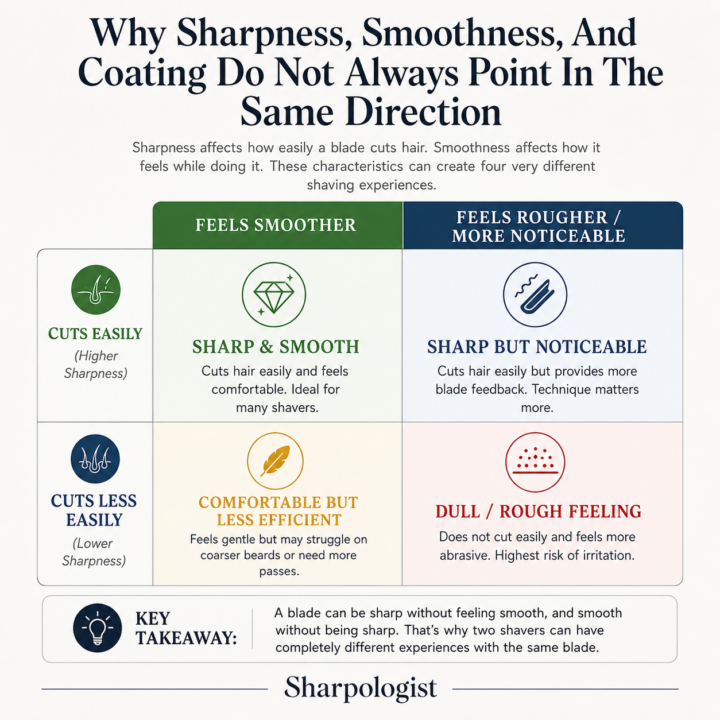
Most popular blades occupy the upper half of the chart. They remove hair reasonably well. The differences people notice most often come from how the blade feels while doing that work.
Consider a common forum exchange.
This is why a single blade review can be accurate but incomplete. The reviewer may be describing cutting ability, shaving feel, cleanup work, or how well that blade fits a particular razor and beard.
All four opinions may be describing different aspects of the same blade.
The first shaver may be responding primarily to feel. The second may be evaluating closeness. The third may have a beard that responds differently to the blade’s cutting characteristics. The fourth may have found a combination of razor, beard type, and technique that happens to work extremely well.
None of those observations automatically invalidate the others.
This is one reason blade reviews can be useful and misleading at the same time. They often describe real experiences. What they don’t always explain is which characteristic the reviewer is actually reacting to.
As shavers gain experience, many begin separating these characteristics almost unconsciously. They stop asking whether a blade is “good” and start asking more specific questions.
Does it cut efficiently?
How much blade feel does it produce?
How comfortable is it after three passes?
Does the result justify the experience?
Those questions tend to produce better answers than simply asking whether a blade is sharp or smooth.
Once sharpness, smoothness, and coating are viewed as separate variables rather than a single characteristic, many of the contradictions surrounding blades become much easier to understand.
Why Different Shavers Experience The Same Blade Differently
One of the most persistent questions in wet shaving is also one of the simplest.
How can two experienced shavers use the same blade and reach completely different conclusions about it?
The answer is that blades do not exist independently from the rest of the shave.
A blade interacts with a particular beard, a particular face, a particular razor, and a particular set of shaving habits. Change any of those variables and the experience can change as well.
This is why universal blade recommendations rarely work as well as people hope.
A blade that performs beautifully for someone with a dense, coarse beard may feel completely unnecessary to a shaver with lighter growth. A blade that feels smooth and forgiving in one razor may feel noticeably different in another. Even shaving frequency can influence how a blade is perceived. A blade that handles two days of growth effortlessly may feel less impressive during a daily shave.
This isn’t a flaw in blade reviews. It’s simply a consequence of how many variables are involved.
The most useful blade is not necessarily the sharpest, smoothest, or most heavily coated. It is the blade whose characteristics work well within the rest of the shave.
The further a shaver moves beyond beginner recommendations, the more obvious this becomes.
Instead of asking, “What is the best blade?” experienced shavers often start asking different questions.
Which blades work well with this razor?
Which blades handle my beard type effectively?
Which blades balance comfort and closeness the way I prefer?
Those questions acknowledge something important: blade performance is always contextual.
The blade matters. So does everything around it.
A Variable Stacking Model
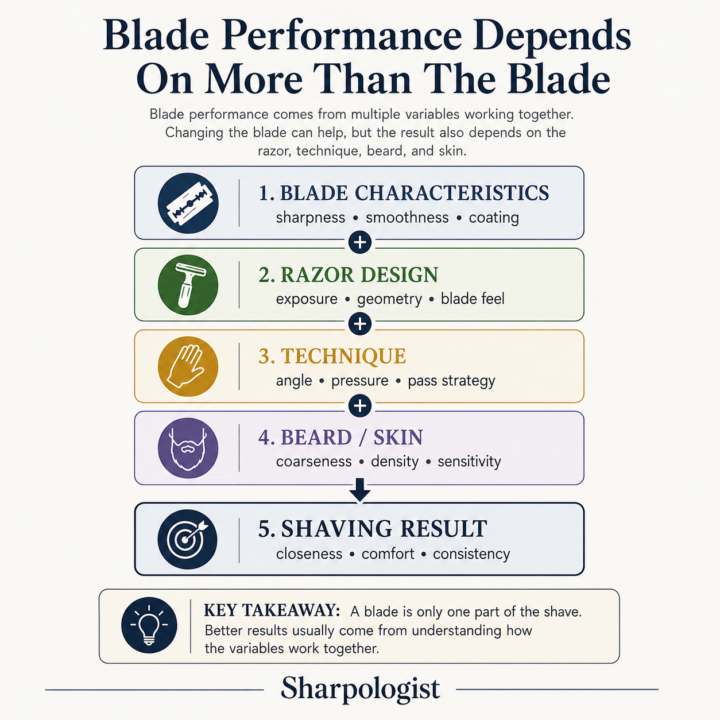
One useful way to think about blade performance is as a stack of interacting variables.
At a minimum, every shave includes:
- Blade characteristics
- Razor design
- Beard characteristics
- Skin characteristics
- Shaving angle
- Pressure
- Pass strategy
None of these variables operates alone. Each one influences the others.
That is why changing blades sometimes produces dramatic results and sometimes produces almost none at all. The blade is only one part of a much larger interaction.
Understanding this model makes it easier to interpret both recommendations and disappointments.
Why Blade Troubleshooting Often Goes Wrong
Most blade experimentation begins with good intentions.
A shave feels rough, inconsistent, or irritating, so the natural response is to look for a different blade.
Sometimes that works.
Other times the blade becomes a convenient explanation for a problem that originated somewhere else.
Many blade journeys begin with a search for something sharper. The logic seems reasonable: if the blade cuts more easily, the shave should improve.
Occasionally it does. Just as often the shaver discovers that the real issue was excess pressure, poor angle control, or an inefficient pass strategy. The sharper blade changes the experience without actually addressing the underlying cause.
Another common mistake is treating smoothness as the ultimate goal.
A blade that feels exceptionally smooth can be a pleasure to use. But comfort during the shave and effectiveness after the shave are not always the same thing. Some blades earn a reputation for smoothness while requiring additional cleanup work that ultimately increases total skin exposure.
The opposite mistake occurs as well.
Some shavers become so focused on closeness that they ignore what their skin is telling them. They chase increasingly sharp blades in search of a better result when the limiting factor is no longer cutting ability but skin tolerance.
Perhaps the most common mistake, however, is changing too many variables at once.
A new blade is introduced at the same time as a new razor, a different soap, a modified pass strategy, or an intentional technique adjustment. The resulting shave may improve or worsen, but it becomes difficult to determine what actually caused the change.
Across years of reader feedback and observation, one pattern appears repeatedly: many shaving problems that seem like blade problems turn out to be interaction problems. That does not mean blade characteristics are interchangeable. It means their effects are easiest to understand when the rest of the shave is reasonably stable.
The blade may contribute to the outcome, but the outcome usually reflects multiple variables working together.
That doesn’t mean blades are unimportant. It means blade selection works best when it is approached as one variable within the broader mechanics of the shave rather than as the single key to solving every problem.
How To Evaluate Blade Performance More Effectively
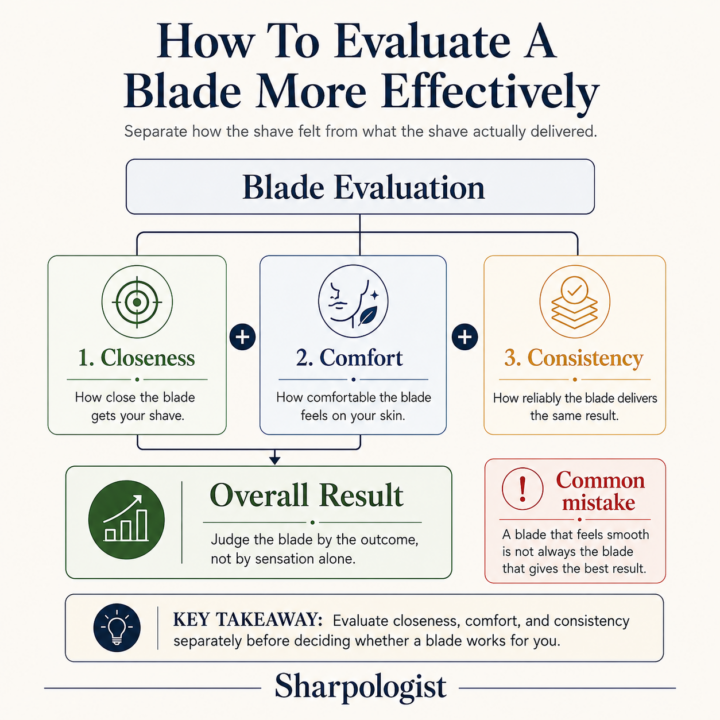
Once sharpness, smoothness, and coating are separated into distinct characteristics, blade evaluation becomes much easier.
The challenge is that most shavers experience all of those characteristics at the same time.
A blade feels smooth or rough. It seems sharp or dull. The shave feels comfortable or uncomfortable. Then, based on that single experience, a judgment is made.
The problem is that first impressions often combine several different observations into one conclusion.
A more useful approach is to evaluate outcomes separately.
Instead of asking whether a blade feels good, ask a few more specific questions.
- How close was the shave?
- How comfortable was the shave?
- How much cleanup work was required?
- How did the skin feel several hours later?
- Were the results consistent across multiple shaves?
These questions help separate performance from sensation.
A blade that feels exceptionally smooth may not actually be producing the best overall result. A blade that provides noticeable feedback may deliver a close, comfortable shave with very little irritation afterward. Until closeness and comfort are evaluated independently, those distinctions are easy to miss.
It also helps to resist the temptation to change multiple variables at once.
Many disappointing blade experiments aren’t really blade experiments at all. The blade changes, but so does the razor, the soap, the pass strategy, or the amount of attention being paid to technique.
When several variables move simultaneously, it’s difficult to know what actually caused the result.
This is one reason blade sampler packs often produce mixed conclusions. The shaver believes they are comparing blades, but in practice they may be comparing a constantly changing shave.
Fortunately, you do not need to understand every variable at once. Most improvements come from identifying and changing one variable at a time.
The most useful blade evaluations usually happen when everything else remains reasonably stable.
The goal is not to find the “winner” after a single shave. The goal is to understand what a particular blade contributes to the overall result.
That distinction sounds small, but it tends to produce much better decisions.
How Blade Characteristics Fit Into The Bigger Picture Of Shaving Performance
By now, one pattern should be becoming obvious.
Blade performance does not exist on its own.
A blade can only be understood within the larger system that produces the shave.
A sharp blade may behave very differently in two razors with different geometry. A smooth-feeling blade may encourage additional cleanup passes that increase total skin exposure. A highly efficient razor may change how a particular blade feels compared to a milder design.
The blade matters.
It just isn’t the only thing that matters.
This idea appears repeatedly throughout wet shaving.
Shavers often spend months searching for a better blade when the larger opportunity lies elsewhere. Sometimes improving angle control produces a bigger improvement than changing blades. Sometimes reducing pressure solves a problem that several blade swaps failed to address. Sometimes pass strategy has a greater influence on comfort than the blade itself.
None of that diminishes the importance of blades.
It simply places them in the proper context.
Sharpness, smoothness, and coating influence performance, but they do so alongside razor efficiency, razor design, pressure, angle, pass strategy, beard characteristics, and skin characteristics.
The further a shaver progresses, the more these interactions matter.
This is one reason experienced wet shavers often talk less about finding the perfect blade and more about finding combinations that work well together.
The conversation gradually shifts from individual components to the overall system.
Conclusion
Blade discussions become much easier to understand once sharpness, smoothness, and coating are treated as separate characteristics instead of different names for the same thing.
Sharpness influences how easily a blade cuts hair. Smoothness influences how the shave feels. Coatings affect friction, comfort, and consistency. Each contributes something different to the experience.
What often creates confusion is the assumption that all three characteristics point in the same direction.
They don’t.
A blade can feel smooth without producing the closest shave. A blade can feel more noticeable while delivering excellent results. Two experienced shavers can use the same blade and honestly reach very different conclusions about it.
Those outcomes stop looking contradictory once blade performance is viewed as an interaction rather than a single characteristic.
The most useful blade isn’t necessarily the sharpest, the smoothest, or the most heavily coated.
It’s the blade whose characteristics work well within the rest of the shave.
That’s why experienced wet shavers often spend less time searching for the objectively best blade and more time understanding what a particular blade is actually contributing to the result.
Once that shift happens, blade selection becomes less frustrating, recommendations become easier to interpret, and shaving performance becomes easier to improve.
