

Introduction — Why Irritation Feels Sudden But Isn’t
This is the underlying reason most shaving problems occur.
Most experienced wet shavers can recognize irritation when it happens.
The skin feels warm. Then tight. Then something crosses a line and the shave is no longer comfortable. It’s easy to point to a cause: too much pressure, the wrong razor, a rushed pass.
But that explanation often doesn’t hold up over time.
Many shaves that end in irritation don’t begin that way. They feel normal, controlled. Even good. Until, usually somewhere near the end, they don’t.
That shift is what makes irritation confusing. It feels like something went wrong in a moment. But in reality, it was building the whole time.
Quick Answer
Shaving irritation is caused by cumulative exposure of the skin to repeated blade contact during the shave. Each pass adds to total exposure through friction, contact, and disruption of the outer layer. Irritation appears when this cumulative exposure exceeds what the skin can tolerate, even if no single pass feels problematic. This may sound abstract at first, but it closely matches what most shavers experience during a shave.
Watch The Short Video Version
Where Shaving Irritation Really Comes From (And Why It’s Misunderstood)
Most questions about irritation are framed the same way.
Why do I get razor burn?
Why does shaving irritate my skin?
What am I doing wrong?
These questions assume there is a single cause–a mistake that can be identified and removed. That assumption is what creates confusion: it rarely feels that way during the shave.
Irritation isn’t caused by one variable. It’s the result of how multiple variables interact over the course of the shave. Blade contact, pressure, angle stability, and the number of passes all contribute to the total exposure your skin experiences.
Because of this, irritation is not tied to a single moment. It reflects accumulated effects that only become visible once a threshold is crossed.
The difference is often not obvious in isolation. It’s revealed only when total exposure crosses a threshold. That’s why irritation rarely feels like it’s building while the shave is happening.
The Core Principle: Irritation Is Cumulative Exposure Going Beyond Skin Tolerance
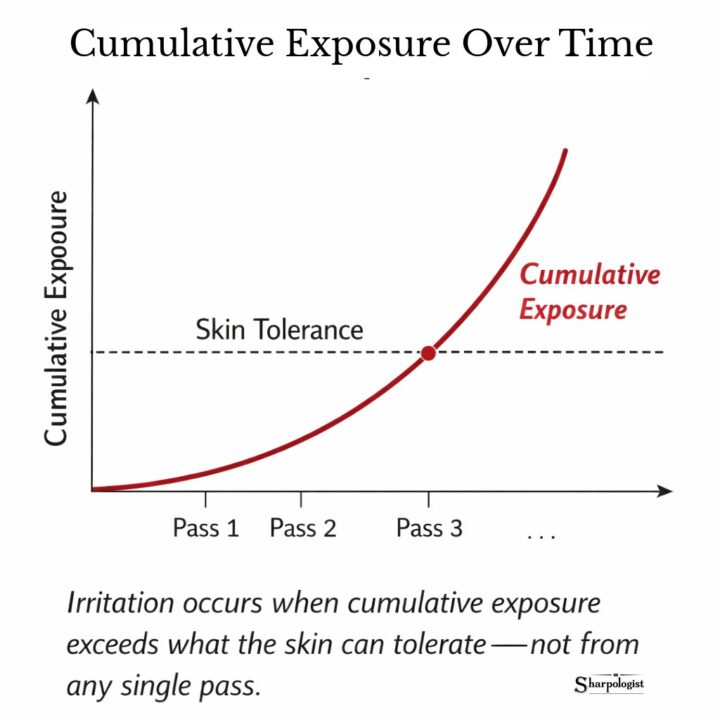
The most stable way to understand irritation is through cumulative exposure.
Irritation occurs when cumulative exposure during the shave exceeds what your skin can tolerate in the moment.
Each pass removes hair, but it also interacts with the skin. Even with good technique, there is some level of mechanical impact. The skin can absorb a certain amount of that impact without reacting.
Beyond that point, it can’t.
This threshold is not fixed. It changes based on how the shave is executed and how much exposure has already accumulated.
Understanding irritation shifts the question from what went wrong to how much total exposure occurred. In other words, irritation is less about a single mistake and more about how the entire shave adds up.
What Happens To Your Skin During A Shave
A shave is a repeated interaction between a blade edge and both hair and skin.
The goal is to cut hair cleanly. But the blade does not interact with hair alone. It also moves across the surface of the skin, creating friction and minor disruption.
With each pass, the skin experiences:
- direct blade contact
- lateral movement across the surface
- slight disruption of the outer layer
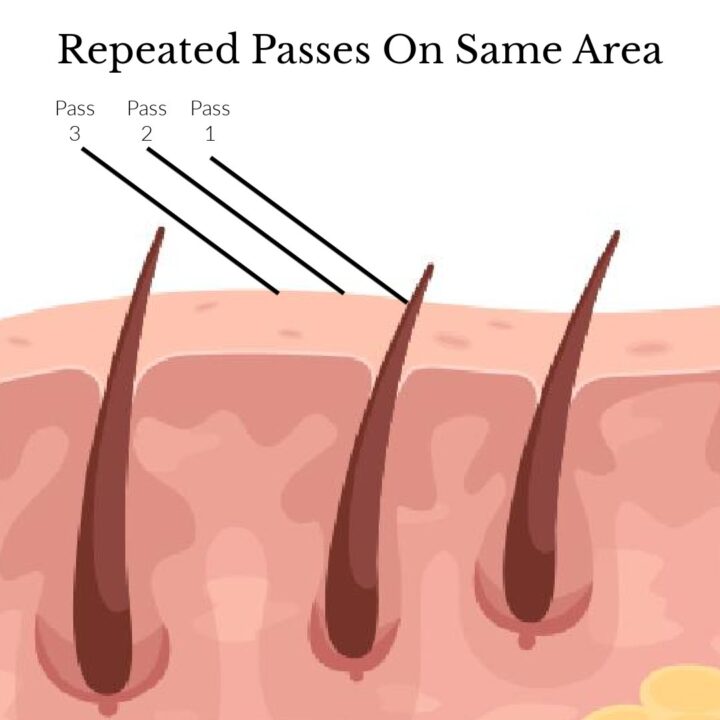
Individually, these effects are small. They are often not noticeable during the first pass.
But they aren’t isolated events–each pass builds on the previous one. Areas that have already been shaved are exposed again, often at a slightly different angle or direction.
This repeated exposure is what creates the conditions for irritation. It happens even when each individual pass feels controlled.
The way interaction happens is also influenced by how the blade cuts hair in the first place, which affects how much additional contact the skin experiences during each pass.
Rate vs Total Exposure: Why Some Shaves Fail Faster Than Others
Irritation does not build at the same pace. Some shaves fail quickly, while others feel fine until the final pass. The difference comes down to two variables:
- how much impact each pass creates
- how many passes are performed
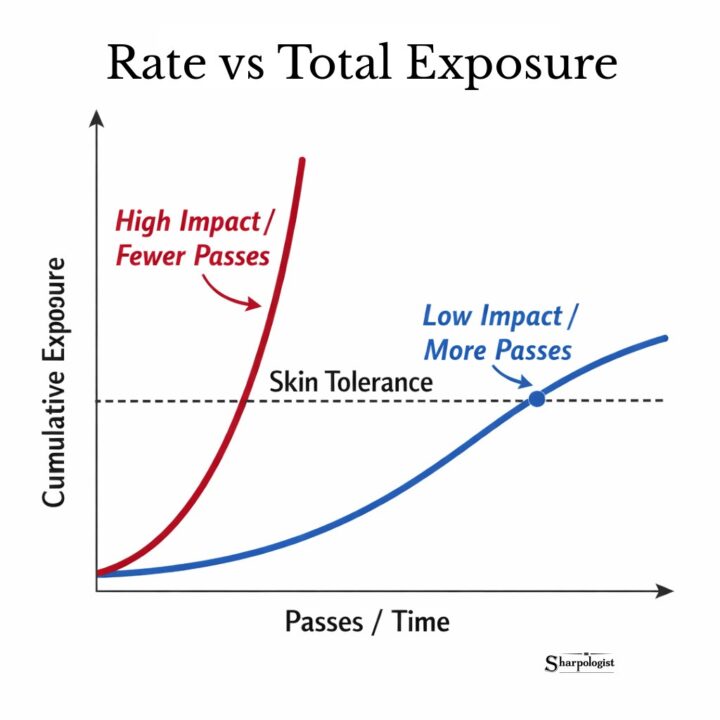
A shave with high impact per pass can exceed your skin’s tolerance quickly. This often happens with:
- excessive pressure as explored in Why The Pressure Problem Comes Back Even When You Think It Is Gone
- unstable angle as explored in Blade Angle And Shave Quality)
- more aggressive razor behavior (as explored in Why a More Efficient Razor Can Make Your Shave Worse)
This is why a shave can feel gentle pass by pass, but still end in irritation. A shave with lower impact per pass can still lead to irritation if the number of passes is high enough.
The interaction between rate of exposure and total exposure explains why changing only one variable can produce inconsistent results. A shave can feel smooth pass by pass, but still end in irritation.
Why Irritation Often Feels Sudden (But Isn’t)
Irritation starts to behave differently than most people expect.
A common pattern shows up repeatedly in real-world shaving:
The shave feels fine. Then the last pass causes irritation.
This creates the impression that the final pass is the problem.
But in most cases, it’s not.
The final pass is simply the point where cumulative exposure exceeds what the skin can tolerate. The earlier passes contributed to the same total, but they did not cross the line.
Threshold behavior is what makes irritation feel unpredictable. The process is gradual, but the result appears all at once.
How Irritation Shows Up (Razor Burn, Bumps, And Sensitivity)
Irritation does not always show up in the same way.
Razor burn is usually surface-level irritation, where the skin feels warm, tight, or inflamed.
Shave bumps or ingrowns are another form of the same underlying issue. They often occur when hair and skin are affected together under higher exposure conditions.
General sensitivity can also increase over time. Skin that has been repeatedly exposed to high levels of mechanical stress becomes more reactive, even if the shave itself does not change.
These are not separate problems. They are different outcomes of how cumulative exposure affects the skin.
Common Misinterpretations That Lead To Irritation
Several patterns tend to repeat among experienced shavers.
It often feels like the razor is the problem. While razor design matters (as explored in The Art and Science of Safety Razor Head Design), technique and total exposure usually play a larger role (as explored in Why Technique Beats Razor Choice Every Time).
Another is relying too heavily on preparation. Good prep improves lubrication, but it doesn’t eliminate the effects of repeated blade contact.
A third is assuming that fewer passes will always solve the problem. Fewer passes can reduce total exposure, but only if each pass is controlled.
These misinterpretations persist because they focus on isolated variables instead of cumulative interaction. The pattern is consistent: the problem is usually not one factor, but how multiple factors combine over time.
How Experience Changes Your Exposure To Irritation
As technique improves, the shave becomes more controlled.
Pressure is reduced. Angle becomes more consistent. The impact of each pass decreases.
At the same time, expectations often increase. Closer results become the goal. Additional passes are added to refine the shave.
This creates a shift.
Early in the learning process, irritation often comes from poor control. Later, it often comes from increased total exposure (as explored in Why Changing Less Improves Your Shaves and How Wet Shaving Principles Change as You Gain Experience).
The problem hasn’t disappeared. It’s changed in form. Irritation can return even when your technique has improved.
Practical Implications — Managing Exposure Instead Of Chasing Fixes
Understanding cumulative exposure changes how you approach the shave.
The goal isn’t to eliminate blade contact. That’s not possible. The goal is to manage how exposure builds.
That means paying attention to:
- how much impact each pass creates
- how many times an area is shaved
- how your skin responds as the shave progresses
There is always going to be a tradeoff between closeness and total exposure.
Managing irritation is not about finding a single fix. It is about understanding how decisions during the shave affect the total.
Conclusion — Irritation Is Predictable, Not Random
Irritation can feel unpredictable, even when your routine hasn’t changed, but it follows clear patterns.
It develops through cumulative exposure. It appears when a threshold is crossed. It changes based on how the shave is structured.
Once you understand what is happening during the shave, irritation becomes easier to interpret.
Not because it disappears, but because it becomes predictable.
That’s why irritation can feel unpredictable, even when your routine hasn’t changed.
And when it’s predictable, it becomes manageable.

Good advice. As a beginner years ago, I learnt to accept what I achieved with two or three passes and not get into the temptation to go over and over the same small area to perfect the shave. I put my razor down and said to myself “do better next time”. Also, product ingredients make a difference to skin protection for the shave and I think you get what you pay for.