
If you spend time in wet shaving communities, you will often hear the same advice repeated: if your skin is irritated, switch to a milder razor for less irritation.
It makes sense. Mild razors feel safer. They usually offer less blade feel and a calmer shaving experience in the moment. Yet many shavers discover something frustrating after weeks or months of doing exactly that. Despite doing everything “right,” irritation persists. Sometimes it even gets worse.
The contradiction isn’t unusual. It isn’t a failure of skill, and it’s not a mistake in judgment. It’s the result of how irritation actually develops during a shave, which is very different from how most people expect it to.
Quick Answer
Why can mild razors cause more irritation than efficient ones?
Mild razors often require more strokes, more touch ups, and more pressure to achieve the same result. Irritation is driven by cumulative skin contact, not momentary blade feel. Efficient razors frequently reduce irritation by removing hair in fewer passes with clearer feedback, even if they feel more assertive during the shave.
What “Mild” Is Supposed To Mean
When shavers describe a razor as mild, they usually mean one or more of the following:
- low blade feel
- limited blade exposure
- forgiving angle range
- reduced sensation during the stroke
Mildness feels reassuring, especially early on. Less sensation is often interpreted as less risk. That assumption is understandable, but it leaves out how irritation actually forms.
Why Irritation Is A Cumulative Problem
Irritation does not come from a single stroke. It builds over time.
Each pass removes not just hair, but also oils and moisture from the skin. Each stroke creates friction. Each touch up adds another layer of contact. Individually, these actions feel harmless. Together they can overwhelm the skin.
This is why irritation often appears after the shave rather than during it. The damage is incremental, not dramatic.
How Mild Razors Increase Skin Contact Without Being Obvious
Mild razors usually remove less hair per stroke. To compensate, shavers naturally add passes and touch ups.
The shave feels controlled and safe, but total skin contact increases quietly. By the time the shave is finished, the skin has had far more interaction than what the shave may have realized.
Pressure Creep
Low feedback makes it harder to sense how much pressure is actually being applied. Without realizing it, many shavers press slightly harder to maintain cutting effectiveness.
This pressure creep is not reckless. It is a natural response to limited feedback. Unfortunately, it compounds irritation quickly.
Delayed Feedback
Mild razors often feel comfortable during the shave. The discomfort shows up later.
Because the irritation is delayed, it gets misattributed to skin sensitivity, blade choice, or bad luck rather than the true cause.
Why Efficient Razors Can Reduce Irritation
Efficient razors remove hair more decisively. That efficiency changes the math of the shave. What feels assertive during a single stroke often turns out to be gentler over the full shave.
Fewer strokes are needed per area. Touch ups are reduced. Feedback is clearer, which helps pressure stay in check. The skin experiences less total contact, even if each stroke feels more noticeable.
Efficiency doesn’t require extreme blade exposure, and it doesn’t require pushing comfort limits. It isn’t about harshness. It’s about clarity.
What Adjustable Razors Reveal About Irritation
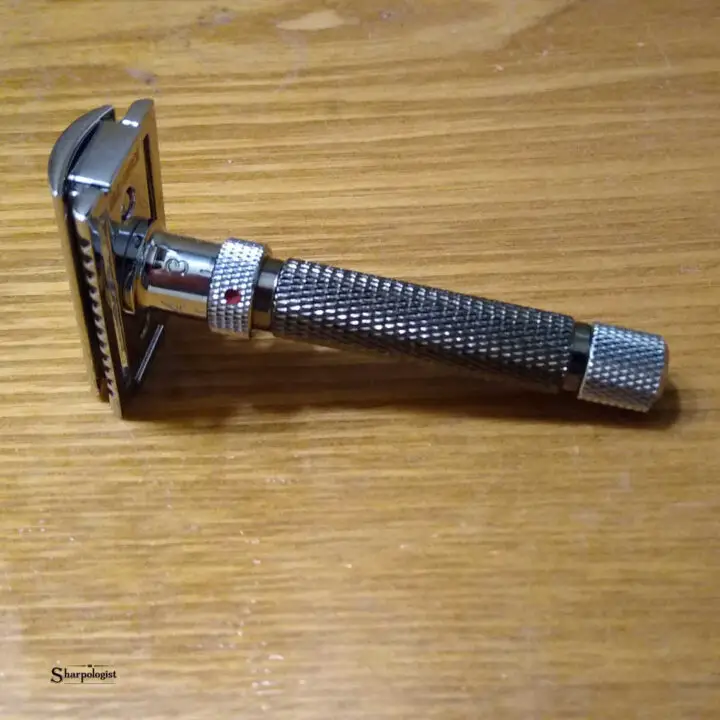
Adjustable razors can make the underlying mechanics easier to see. On lower settings, many adjustables behave like mild razors, often requiring extra strokes to achieve the same result. As the setting increases, efficiency rises, stroke count drops, and feedback becomes clearer.
What surprises many shavers is that irritation does not increase in a straight line as the setting goes up. In many cases, irritation decreases once fewer passes are needed, even though the razor feels more present during each stroke.
This does not mean higher settings are better. It means that irritation depends more on total skin contact than on how assertive a razor feels in the moment.
Why This Feels Backwards At First
For many shavers, blade feel triggers caution. And caution gets equated with danger.
This mismatch between sensation and outcome is where confusion can come from. A razor that feels calm can quietly cause irritation. A razor that feels assertive can leave the skin in better condition afterward.
The instinct to avoid sensation is understandable. It just does not always align with results.
Who Mild Razors Actually Work Best For
Mild razors are not bad tools. They are simply situational.
They tend to work best for:
- shavers with refined pressure control
- those who shave conservatively and avoid repeated strokes
- light to moderate beards
Problems arise when mildness is treated as universally safer rather than context dependent.
How To Rethink Razor Choice Without Chasing Gear
Instead of focusing on labels like mild or aggressive, more useful questions are:
- How many strokes does it take to reach an acceptable result?
- Where does irritation actually appear?
- Does pressure increase without being noticed?
- Does a more efficient razor reduce touch ups?
These questions shift attention from design intent to real outcomes.
Conclusion: Gentle Is About Total Contact, Not Design Labels
Mild razors feel gentle in the moment. Efficient razors often behave gently over the course of the shave.
Irritation is not caused by sensation alone: it is caused by accumulation. Once that distinction is understood, many long standing contradictions begin to make sense.
Gentleness is not about how a razor feels during a stroke. It is about how much the skin endures before the shave is over.

Thank you for this article on mildness and efficiency. With roughly 2 years plus experience in wet shaving, I have experienced all you said with mild and efficient razors, and gradually felt more comfortable using more efficient razors. Currently, my go-to face shaver is the Rex Envoy, which took me time to master. To me it’s the perfect razor in terms of build and efficiency. With experience, I have developed a personal understanding that let’s me know when to just allow the weight do the work, and when to add the smallest pressure to achieve a deeper shave with less strokes. I have had wonderful shaves with this razor, and observed that the BBS achieved lasts longer than my other razors. I also have a Rockwell 6C, which gives me the best head shaves than any other razors. I start the first pass with the 6 plate, then change to plate 5 for pass two, change to plate 4 for the against the grain pass and touch ups. Often I achieve very pleasurable BBS without any irritations. With these two razors now, I can’t imagine what could be better for me, though I still sometimes use the razor I bought in India last year, (the Parker 78R) just to rotate and have a different feel. It’s equally a very good mid-range razor that pairs well with a sharp blade like the Gillette nacet or personna comfort coats from the USA. In summary, I believe most shavers eventually settle for efficient razors once they have developed good usage. Rex Envoy is just it for me on the face, and Rockwell 6C for the head.