
There’s a reason experienced wet shavers keep chasing smoother results, cleaner finish, and fewer rough spots: a very close shave is satisfying.
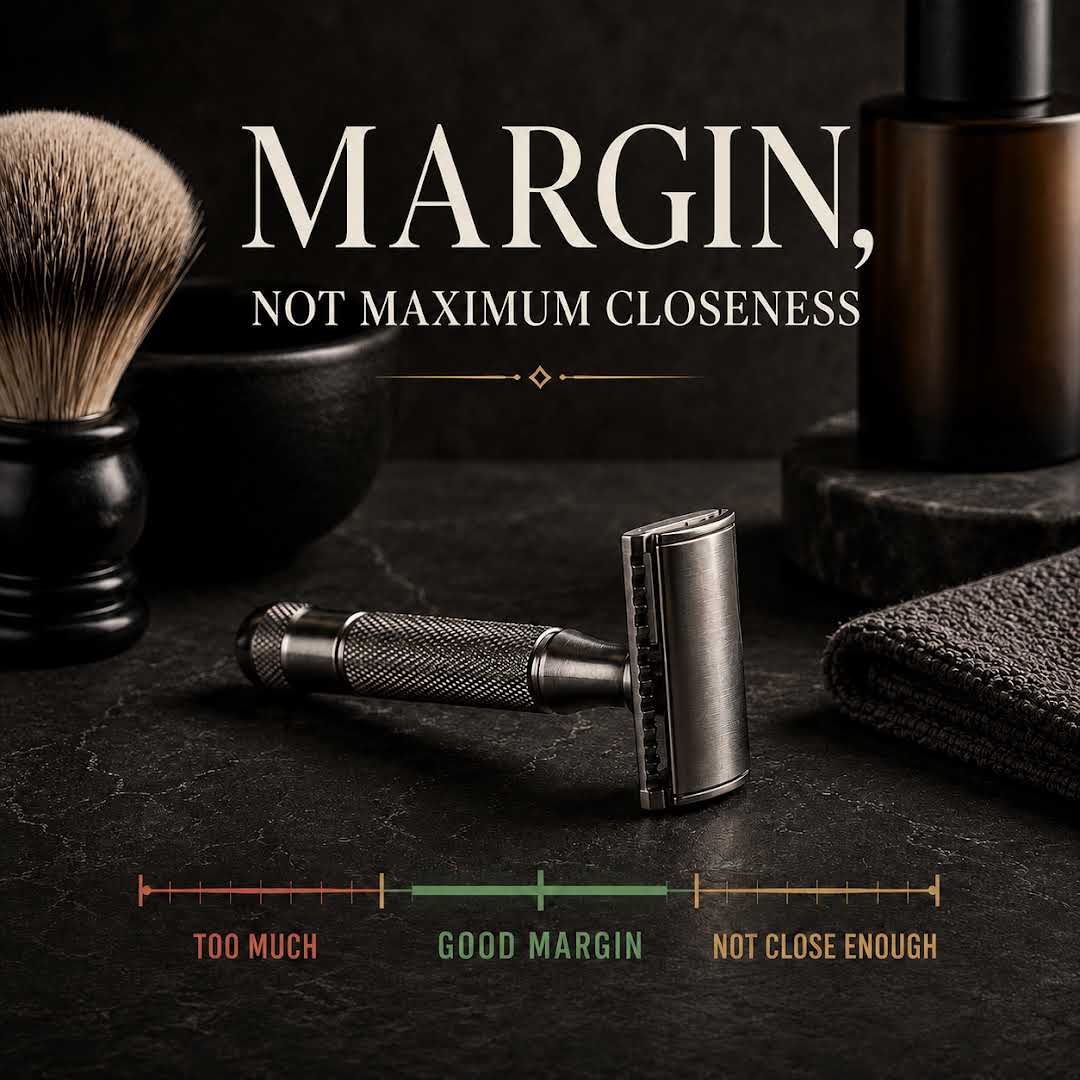
But the closest possible shave is not always the better shave. That doesn’t mean closeness is bad. It means closeness is only part of the result.
A better shave leaves something in reserve.
Quick Answer: Why A Better Shave Depends On Margin
A better shave depends on margin because the closest possible shave often leaves little room for error. Every extra pass, touch-up, pressure increase, or angle mistake can remove a little more stubble, but it also increases the skin’s exposure to the blade.
Margin Is The Room Between Close Enough And Too Much
Shaving margin is the room between the closeness you want and the irritation that can appear when you keep trying to reach it.
Margin is not a feature built into a razor. It is not a fixed personal number, either. It comes from the way the shave works on different parts of your face, with your tools, on that particular day. The same approach that leaves plenty of margin on your cheeks may use it up quickly on your neck.
So the useful question is not only, “Can I remove more stubble?”
But also, “What does it cost to remove more?”
That shift matters because closeness gives immediate feedback. Skin cost can be delayed: a shave can feel successful while you are rinsing, then feel less successful after the skin has had time to react.
Why Maximum Closeness Feels Like Success
Maximum closeness feels like success because it gives proof. The face in the mirror looks cleaner. Your fingertips find fewer rough spots.
That feedback is hard to ignore. It encourages one more pass, one more touch-up, one more short stroke under the jaw. A small rough patch can make an otherwise good shave feel unfinished.
This is where BBS, or “baby butt smooth,” can become misleading. BBS describes a very smooth result with no noticeable stubble when rubbed in different directions. It can be satisfying, and some shavers can reach it comfortably in some areas or on some days.
The trouble starts when BBS becomes the default standard for every shave, every part of the face, every razor, and every day.
BBS is a result. It should not automatically become the rule by which every shave is judged.
For many shavers, especially those with dense growth, sensitive areas, complicated grain direction, or a habit of chasing small imperfections, the last bit of closeness may cost more than it gives back. The shave may look better for a while. The skin may not agree later.
Where Margin Gets Used Up
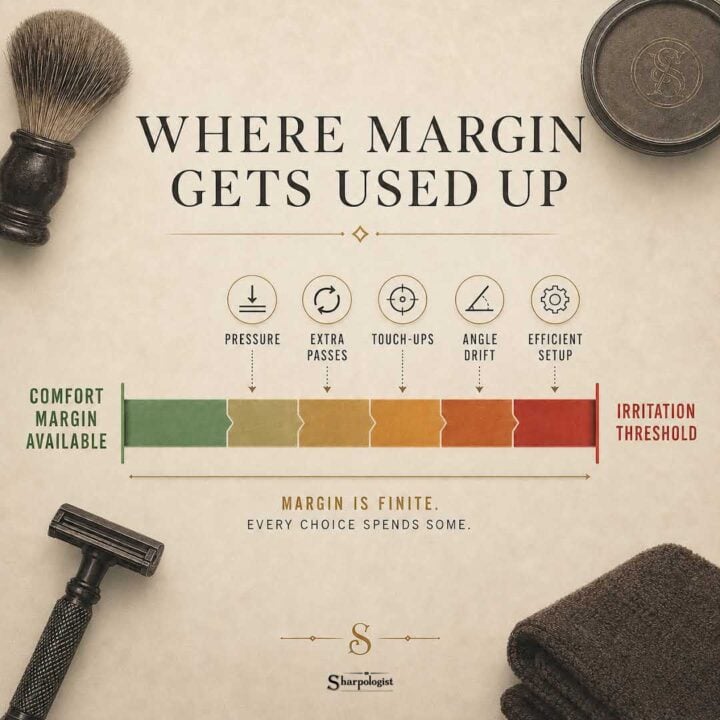
Margin usually doesn’t disappear in one dramatic moment. It gets spent a little at a time.
A stroke can seem harmless because it doesn’t hurt right away. But skin responds to the total shave, not just to the one stroke that felt rough.
Pressure Uses Margin Quickly
Pressure can make a razor feel more effective. It may remove stubble more aggressively, flatten a difficult area, or make the result seem closer right away.
That’s why pressure is such a persistent problem. It appears to help before it hurts.
Added pressure reduces the space between clean cutting and unnecessary skin contact. It also leaves less room for angle drift, repeated strokes, or a blade that is sharper than the skin can comfortably tolerate under those conditions.
Extra Passes Spend Margin More Gradually
A first pass may feel easy. A second pass may still feel controlled. The trouble often shows up during the third pass or the cleanup work that follows.
Each pass works over skin that has already been shaved. Even when individual strokes feel reasonable, total exposure still matters.
Multiple passes are not the issue by themselves. The value of an extra pass depends on what it adds and what it costs. A pass that improves the whole shave without irritating the skin may be worth it. A pass that exists only to erase one remaining hint of roughness may be where the result stops improving.
Touch-Ups Spend Margin In Small Areas
Touch-ups are deceptive because they feel minor. The whole shave may be fine, but one stubborn patch gets worked again and again.
That is how a good shave gets spoiled by a small area. The cheeks may be calm. The upper lip may be fine. But the same spot under the jaw or low on the neck takes repeated strokes until it crosses its tolerance.
The whole shave may not have been the problem. One area may have been asked to meet the same closeness standard as the easiest parts of the face.
Angle Drift Reduces Margin Without Always Stopping The Cut
A razor can still cut hair at a less forgiving angle. That is one reason angle drift is easy to miss.
Hair removal doesn’t prove the angle was good. A slightly scraping angle can still produce a close result, but with more skin cost than necessary. The shave may feel productive because stubble is coming off, even while margin is shrinking.
Efficient Setups Can Narrow Margin
Efficient razors are useful. In controlled hands, they can reduce hair with fewer strokes and make the shave easier.
But efficiency changes how quickly extra strokes matter.
If a razor removes hair readily, each added stroke can look productive. That makes it easier to keep going past the useful endpoint. But more capability does not automatically create more margin. It depends on how that capability gets used.
Your Margin Is Not The Same Everywhere
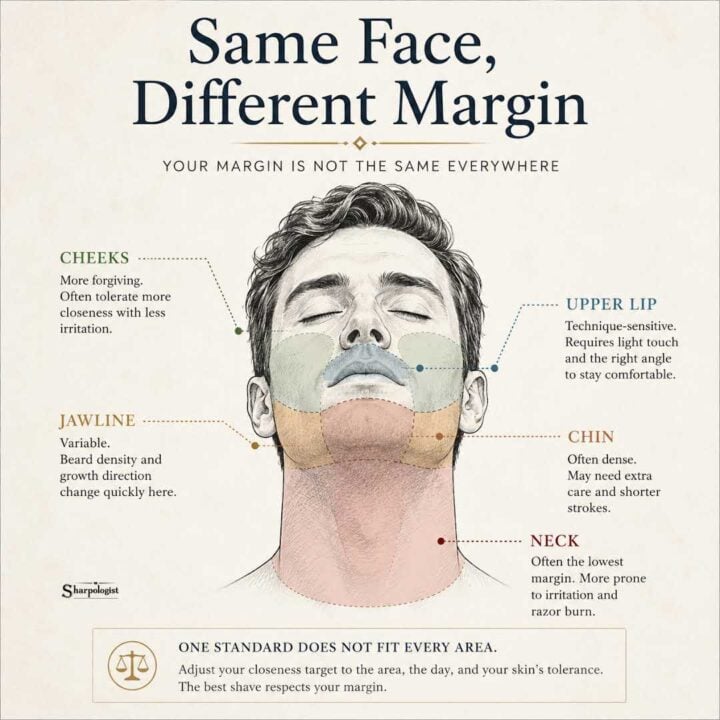
Your face does not have one universal closeness limit.
The cheeks often tolerate more closeness than the neck. The chin, upper lip, jawline, and throat can each behave differently. Hair density, growth direction, skin movement, and sensitivity all change how much shaving an area can tolerate.
Margin can also change from one shave to the next. Beard length, skin condition, lather quality, prep, blade age, recent irritation, and the quality of the first pass can all change what the skin will tolerate.
The practical lesson is straightforward: the same closeness target may not make sense for every area or every shave.
This isn’t permission to shave carelessly: it’s a more realistic way to judge the result. Experienced shavers learn where closeness is easy, where it is expensive, and where stopping sooner produces the better long-term result.
How To Tell When You Have Lost Margin
A shave that has lost margin usually leaves clues. They don’t always point to one exact cause, but they can show that the final closeness cost more than the skin comfortably tolerated.
| What You Notice | What It May Suggest |
| The shave looks good but feels tight | The final result may have exceeded comfort margin |
| One area feels hot or tender | Local touch-ups, pressure, or grain direction may be involved |
| Aftershave stings more than usual | The shave may have left the skin more exposed or irritated |
| Redness appears later | Cumulative exposure may be showing up after the shave |
| The same area gets irritated repeatedly | That area may need a different closeness standard |
These signs are more useful when they repeat. One rough shave may be an outlier. The same pattern over several shaves usually means something in the process is spending margin in the same place.
A shave that looks close but feels tight may not need a different razor first. It may need one less cleanup pass. A neck that gets irritated every time may not need to match the cheeks. A blade that feels excellent on the first pass may still require restraint on the final pass.
The skin’s response is part of the shave result. It’s not a separate event that happens after the “real” shave is finished.
How To Build More Margin Into The Shave
Building more margin usually starts with doing less where the shave is already good enough.
Start by stopping one touch-up earlier. Use lighter pressure before changing gear. Make the final pass less ambitious on sensitive areas. Let the neck have a different endpoint than the cheeks.
Those changes may seem small because they are small: that’s the point. Margin is often recovered by removing the few strokes that add little visible improvement and create most of the discomfort.
Choose control over raw capability when evaluating razors and blades. A setup that gives you slightly less maximum closeness but more predictable control may produce a better shave over time. The goal is to use tools that let you stay within your margin.
Then judge the shave later, not just at the sink. The immediate result matters, but it’s not the whole result. If a shave looks excellent right away but consistently feels poor later, the method is probably spending too much margin.
Changing gear can help. Better lather can help. A different blade can help. But none of those fully compensates for a closeness standard that exceeds the skin’s tolerance.
Close Enough, Calm Enough, Repeatable Enough
A strong shave should be close enough to do its job, calm enough that the skin still feels good later, and repeatable enough that the result does not depend on pushing every variable to the edge.
Close enough is not settling. It means the shave has met its practical purpose without making the last trace of stubble the only measure that matters.
Calm enough protects the next shave. Skin that feels good later gives you more room tomorrow. Skin that feels overworked reduces your margin before the next blade ever touches your face.
Repeatable enough gives the shaver a standard that can improve. A one-time perfect result is less useful if it depends on pressure, excessive touch-ups, or a setup that regularly leaves the skin irritated. Shaving is not a single event: it’s a repeated process.
That’s often where experienced shavers have to adjust their judgment. The problem is not basic competence but over-refinement. Once the shave is already good, the hardest decision is knowing whether more work will improve the result or only increase the cost.
The Best Shave Leaves Something In Reserve
Maximum closeness can be satisfying, but it is not always the better result. A shave that leaves the skin calm has more long-term value than a one-time perfect finish that creates tenderness, redness, or delayed irritation.
The best shave does not have to prove that every possible trace of stubble can be removed. It has to remove enough while preserving enough comfort for the result to remain worthwhile.
