
Introduction
A lot of shaving frustration starts with a question most people never actually answer.
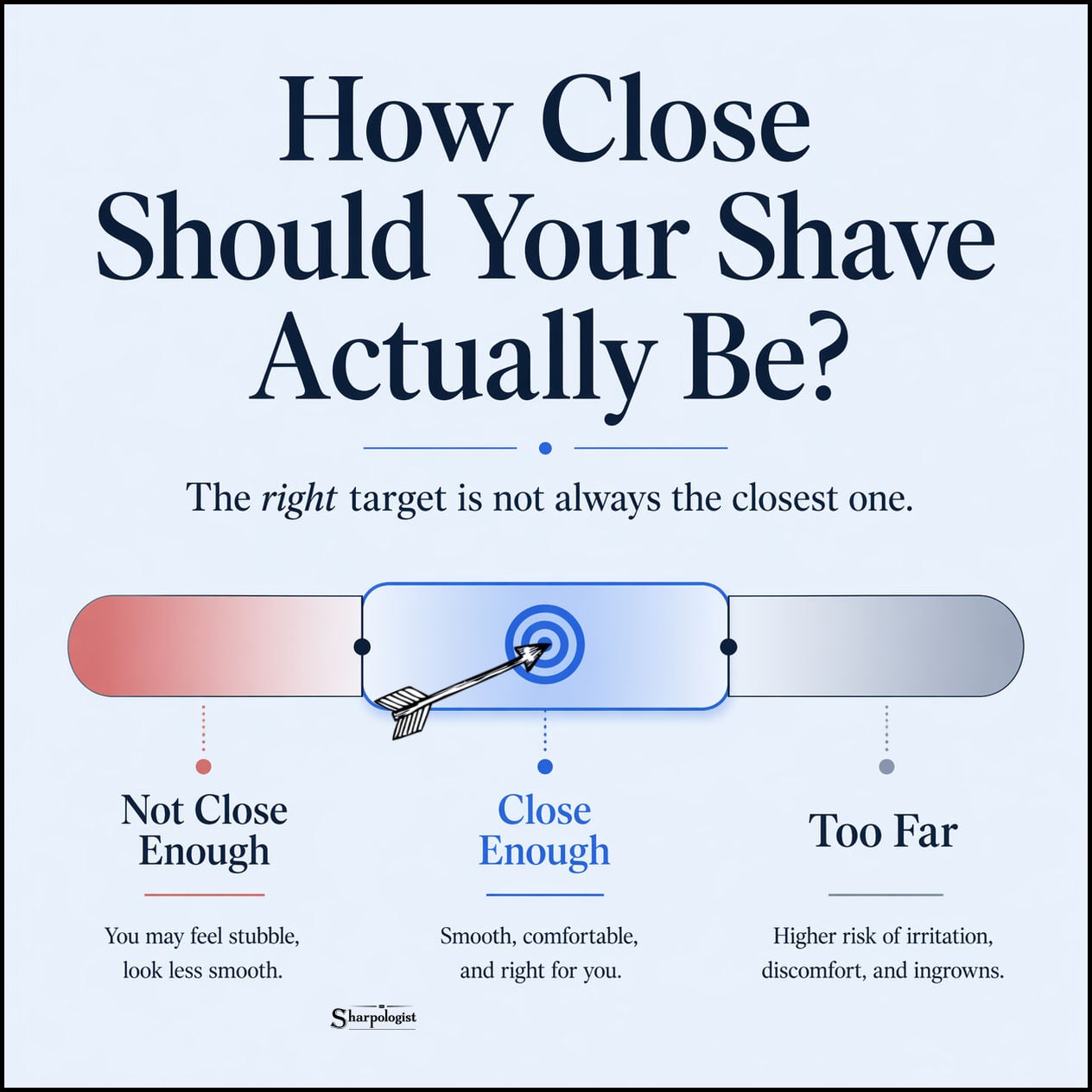
How close is close enough?
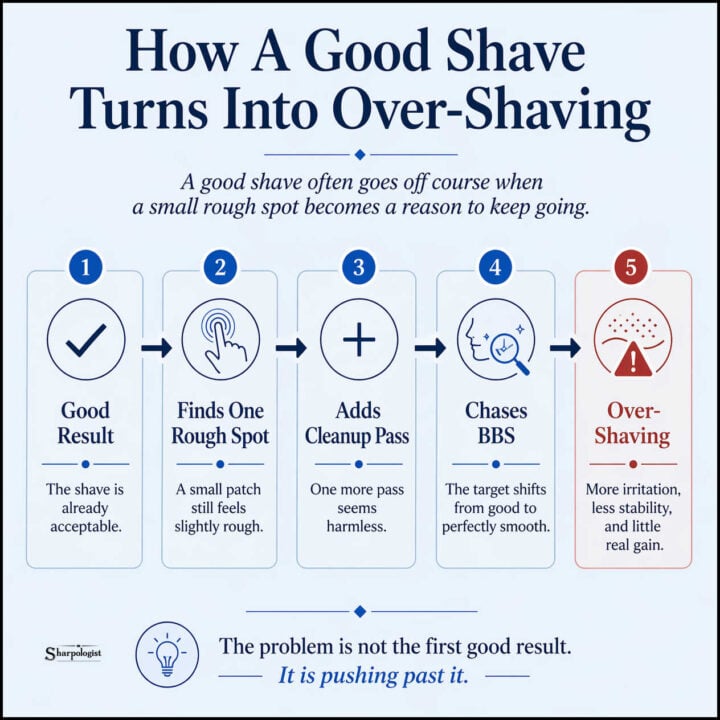
Instead, the target stays vague. The shave feels pretty good, but there is still a little roughness on the jawline. The cheeks are fine, but one spot under the chin still does not feel as smooth as it could. So the instinct is to keep going, to chase the “Baby’s Butt Smooth” (BBS) shave.
That is where a lot of otherwise decent shaves start to go off course.
For many wet shavers, the default standard is not a clearly chosen result. It is just some version of “closer.” Sometimes that standard gets reduced to one acronym: BBS. And once that becomes the benchmark, it’s easy to judge the whole shave by whether every area feels perfectly smooth right after the rinse.
The problem is not wanting a close shave. That makes sense. The problem is treating the closest possible shave as the automatic definition of a good one.
Quick Answer
Your shave should be only as close as needed to meet your goal without making the result less comfortable or less repeatable. A good target is not the closest shave possible. It is the closest shave you can get consistently, without forcing extra passes or increasing irritation risk.
The Real Question Is Not “How Close Can You Get?”
Many shavers start with the wrong question.
“How close can I get?” sounds practical, but it pushes the shave toward maximization. It turns the process into a test of how much hair can be removed, rather than a decision about what result is actually useful.
Those aren’t the same thing.
A shave can be very close and still be a poor result if it leaves the skin irritated, makes tomorrow’s shave harder, or requires extra cleanup work that throws the whole shave out of balance. A slightly less close shave can be the better result if it looks good, feels good, and can be repeated without drama.
Closeness and comfort do not always move together, and trying to maximize closeness often makes the shave less consistent. The better question is not how close you can get. It is how close you actually need to get.
What “Close Enough” Actually Means
“Close enough” does not mean mediocre. It does not mean giving up. And it does not mean pretending a poor shave is acceptable.
It means the shave has met the real standard that matters.
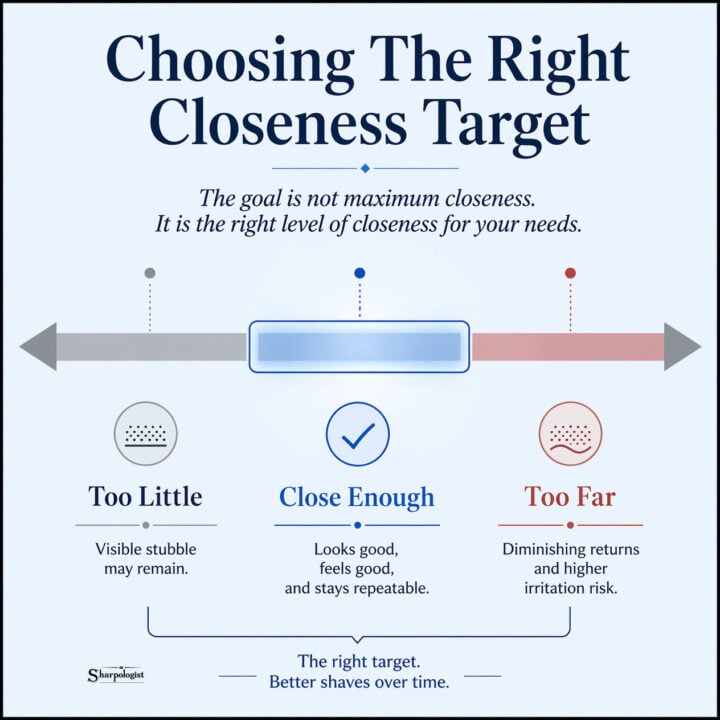
A close enough shave is one that looks acceptable in normal life, feels acceptable to you, and can be repeated reliably. It removes enough hair to do the job you need it to do without pushing the shave into diminishing returns.
That standard will not look exactly the same for everyone. For one person, it may mean a clean, professional appearance with only minimal detectable stubble. For another, it may mean a very close result on the cheeks and neck without chasing every last rough patch in difficult areas.
The important point is that “close enough” is a chosen target. It is not a consolation prize. It is a controlled endpoint.
Why Most Shavers Set The Wrong Target
A lot of shavers do not really choose a target. They borrow one.
Sometimes that borrowed target is BBS. Sometimes it is the idea that a good shave means perfectly smooth skin everywhere. Sometimes it is the habit of feeling one small patch of remaining stubble and deciding the shave is not finished yet.
Those standards are understandable, but they are often poorly matched to real life.
BBS has a strong appeal because it feels complete. It feels like success you can confirm with your fingertips. But it also has a way of narrowing the whole evaluation of the shave down to one question: is every area perfectly smooth right now?
That can distort judgment quickly.
Many shavers judge the entire shave by whether it feels BBS immediately after rinsing, especially in a few high-sensitivity areas. That often leads to extra cleanup work in spots that were already shaved well enough. The result may be slightly more closeness in one small area, but the overall shave becomes less stable.
This is part of why chasing BBS every day is such a common trap. The problem is not that BBS is always wrong. The problem is using it as the default target whether or not it actually fits your skin, your routine, or your needs.
What Should Determine Your Target
A better target comes from your real conditions, not from an abstract ideal.
Shaving frequency matters first. If you shave every day, the right target is usually different from the right target for someone shaving every three or four days. A result that feels rewarding occasionally may be too aggressive to maintain consistently.
Skin sensitivity matters too. Some skin areas will tolerate extra closeness without much trouble. Other areas will push back quickly, especially where the beard is dense or growth patterns are awkward. In those cases, the smartest target is often the one that leaves a little margin instead of trying to remove everything possible.
Beard density and coarseness matter in a practical way. Very dense or wiry growth changes the cost of that last bit of closeness. The same target that feels easy on one face may require much more exposure on another.
Appearance needs matter as well, but they are often overstated. Many shavers chase smoothness that is more noticeable to them in the mirror than to anyone else in normal interaction. That doesn’t mean appearance does not matter. It means the standard should reflect real visibility, not just fingertip inspection in the bathroom.
Then there is simple preference. Some shavers are willing to accept more irritation risk for more smoothness. Others would rather keep the skin calmer even if a small amount of detectable stubble remains. Neither is automatically wrong. The mistake is not choosing deliberately.
Razor efficiency also fits here. Once you define what kind of result you actually need, it becomes much easier to judge whether a razor is helping you reach that target efficiently or pushing you past it.
Why A Repeatable Result Matters More Than A Maximum Result
A maximum result is seductive because it feels like a peak.
A repeatable result is better because it fits the way shaving actually works in real life.
One very close shave that leaves the skin overworked is often less useful than a slightly less close shave you can reproduce consistently. The first may feel impressive in the moment. The second gives you control.
This is where a lot of experienced shavers quietly change their standards. They stop asking whether a shave reached the highest possible level of closeness and start asking whether the result was worth what it cost.
That shift matters because shaving is rarely a one-time event. It is part of a sequence. Today’s shave affects tomorrow’s skin, tomorrow’s tolerance, and tomorrow’s margin for error. A result that looks perfect in isolation may be a poor result in context.
A repeatable shave also makes troubleshooting easier, especially once you understand how the shave actually works. When the target is clear and sustainable, it becomes easier to see when something has actually gone wrong. When the target is always drifting toward maximum closeness, almost every shave invites one more adjustment.
A Practical Way To Decide How Close Your Shave Should Be
Start with what the shave actually needs to do.
Does it need to look clean and professional through the day? Does it need to feel especially polished for an event? Does it just need to be comfortably presentable by your own standards? Those are not identical goals, and they should not automatically produce the same target.
Then decide what you need both visually and tactically. That distinction matters. Some shavers overvalue tiny areas of detectable roughness that are invisible in normal conditions. Others chase perfectly smooth skin in every direction when a very good visual result would already be enough.
Once the practical target is clear, stop before diminishing returns. The last bit of closeness usually costs more than it gives back. That is where extra passes, extra pressure, and extra cleanup work start to feel justified, even when they are no longer improving the whole shave in a meaningful way.
It also helps to evaluate the shave as a whole, not by the single best or worst isolated spot. A shave does not fail because one awkward patch under the jaw is slightly less smooth than the cheeks. In many cases, that is simply where the sensible stopping point is.
And if you shave frequently, leave room for tomorrow. That is not settling. That is understanding the shave as a process instead of a single performance.
How Your Target Changes With Experience
Beginners often aim too high because they do not yet have a reliable sense of cost.
More closeness sounds like obvious progress, and BBS feels like the natural proof that the shave was successful. So the target gets set at the top end before the reader has enough experience to judge whether that target is actually sustainable.
Intermediate shavers often become more analytical, but they can still get stuck chasing refinement. This is where a lot of over-adjustment happens. The shave is already good, but there is still the temptation to improve one more area or remove one more trace of roughness.
Experienced shavers usually make a quieter shift.
They stop treating the best possible shave as the standard and start treating the right shave as the standard. That’s not compromise–it’s better judgment. The target becomes clearer, narrower, and easier to repeat.
In that sense, maturity in wet shaving often looks less like pushing harder and more like knowing when the shave is already done.
Conclusion
The right target is not the closest shave possible. It is the closest shave that fits your real needs without making the shave less comfortable, less consistent, or harder to repeat.
That may still be very close. Sometimes it may even be BBS. But it should be chosen because it suits the situation, not because it has become the automatic benchmark for success.
Once you define the right target, the shave becomes easier to control. You stop chasing an ideal that keeps moving, and you start judging the result by whether it actually works.
That is one of the clearest ways to improve your shaves.

Quite informative and inspiring post. I had been struggling with inconsistent shaves for a while now. This helps.
Agree completely, experience teaches us to accept the best we can achieve after identifying our beard growth direction, and shaving with 2 or 3 passes at most. What I’ve personally found is that small rough spots at the finish of the shave feel smooth after my post shave routine of applying cold water to close pores .