
Introduction – The Frustration Of “I Changed Something And Nothing Happened”
Most experienced wet shavers have run into this at some point.
A shave starts going wrong. Irritation shows up, closeness drops off, or consistency disappears. So you change something. A new blade. A different razor. Maybe a better soap.
And nothing improves. Sometimes it even gets worse.
The natural conclusion is that the change “didn’t work.” But that conclusion is usually based on a misunderstanding of how the shave works.
Quick Answer
A bad shave is rarely caused by a single factor. Multiple variables interact during the shave, so changing one element often does not resolve the underlying issue. Without identifying the dominant cause, changes can appear ineffective or produce inconsistent results.
The Core Problem: Shaving Results Come From Interacting Variables
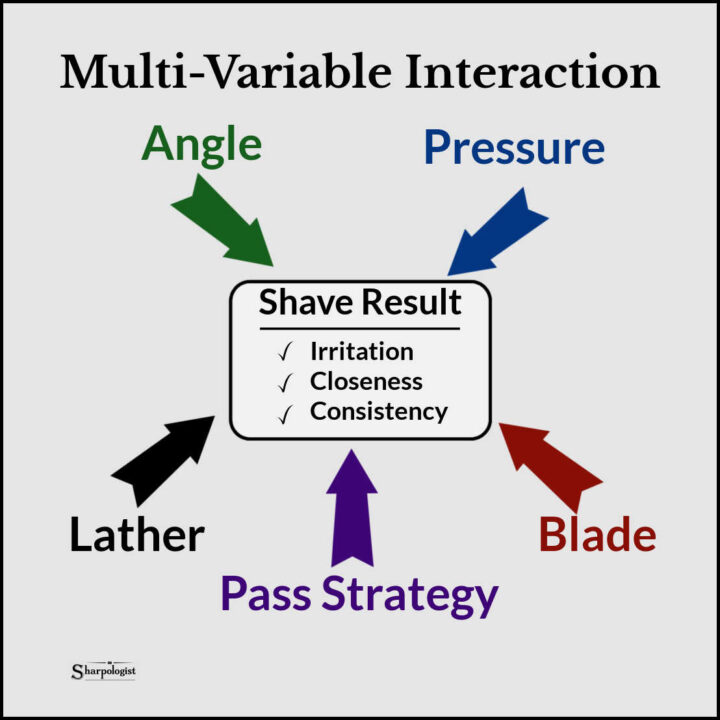
A shave is not driven by one input. It is the result of several variables working together at the same time.
Angle, pressure, blade condition, razor design, lather quality, and pass strategy all contribute. Each one changes how the others behave.
This is why a single adjustment often does not produce a clear result. The change is real, but it is interacting with everything else that is still unchanged.
Simply swapping blades often fails to fix irritation. The blade matters, but it’s only one part of what is happening during the shave. (See: Why Changing Blades Rarely Fixes Irritation)
Why Single Changes Often Fail To Show Results
Even when a change is directionally correct, its effect can be difficult to see. This is because the result is shaped by more than the variable you changed. Changes do work, but their effect is only visible when the surrounding variables are stable.
First, the variable you changed may not be the dominant cause of the problem. If irritation is primarily coming from angle or pressure, changing the blade may have only a minor effect.
Second, variables can offset each other. A sharper blade might reduce tugging but increase sensitivity to pressure. The net result can feel the same, even though something did change.
Third, improvements can be masked. A better lather might reduce friction, but if technique remains inconsistent, the benefit is harder to notice.
Finally, there is an adaptation effect. Changes in tools often require subtle adjustments in technique. Without that adjustment, the new variable does not have a chance to show its intended benefit.
The goal is not to avoid change, but to make changes in a way that produces clear information.
The Misdiagnosis Pattern Most Shavers Fall Into
When results are unclear, most shavers do not pause. They interpret. When a change is made, the result is usually attributed to that change.
If the shave improves, the new variable gets credit. If it doesn’t, the new variable gets blamed. It’s a natural response, but it leads to the wrong conclusions.
The change was layered on top of existing conditions, so the result reflects the interaction, not the change itself.
Across forums and shave logs, one of the most consistent patterns is rapid gear switching. A blade is replaced after one poor result. A razor is judged after a single shave. Conclusions are formed quickly, even when the underlying cause has not been identified.
That pattern reinforces the misdiagnosis. The more frequently variables change, the harder it becomes to see what is actually driving the result.
Experience Changes How You Interpret Results
As experience increases, the way results are interpreted changes.
Less experienced shavers tend to isolate variables incorrectly. They expect direct cause and effect, where one change produces one clear outcome.
Intermediate shavers often respond by changing multiple variables at once. A different blade, a new razor setting, and a modified lather may all be introduced within a few shaves. The result is more noise than clarity.
More experienced shavers approach the shave differently. They look for the dominant influence rather than the most recent change. They also understand that results need to be observed over multiple shaves before drawing conclusions.
Why Over-Adjusting Makes The Problem Worse
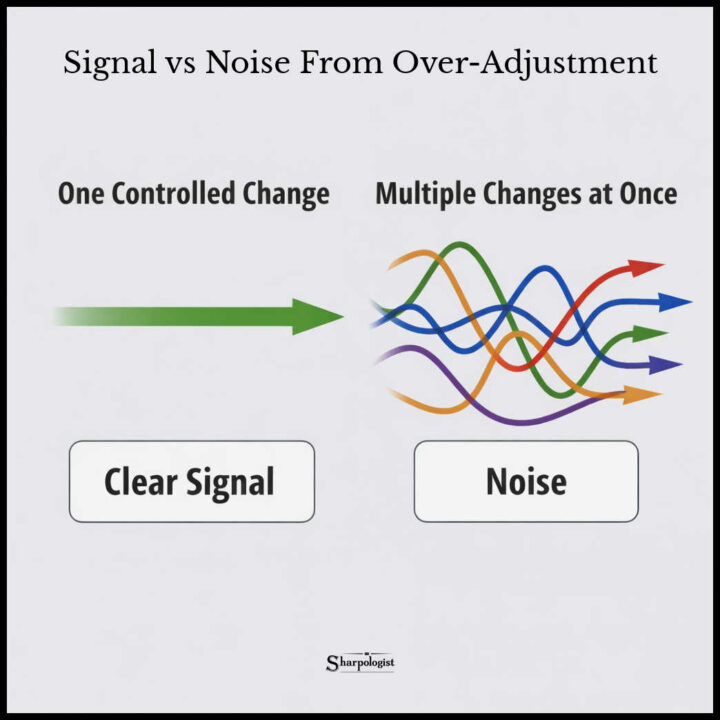
When a shave goes wrong, the instinct is to fix it quickly. That usually leads to multiple changes at once.
A different blade, a new razor setting, a modified lather, and an altered pass strategy might all be introduced within a few shaves.
At that point, the signal is lost because each change interacts with the others.
Over-adjusting tends to prolong problems rather than solve them.
Practical Correction: How To Actually Diagnose A Bad Shave
Improving a shave requires isolating what is actually driving the problem.
The first step is identifying the most likely cause. It is not always obvious at first, but it becomes clearer when changes are controlled.
Once a likely cause is identified, adjust only that variable. Keep everything else as consistent as possible. This isolates the effect and makes the result easier to interpret.
Observation also needs to happen over multiple shaves. A single result can be misleading due to small variations in execution or conditions.
Consistency reveals patterns, and patterns make accurate diagnosis possible.
Over time, this approach builds a clearer understanding of how the variables interact. It also reduces the tendency to react to every individual shave as if it requires a new solution. Without this kind of control, most changes will continue to feel random, even when they are directionally correct.
Conclusion – Why Patience Beats Constant Adjustment
A bad shave rarely comes from a single cause, and it rarely improves through a single change.
What matters is not how quickly something is changed, but how clearly the effect of that change can be understood.
When adjustments are controlled and observed over time, the dominant factors become easier to identify. Once those are addressed, improvement tends to follow.
Until then, most changes will appear ineffective, not because they are wrong, but because they are being applied in isolation to a problem defined by interaction.
