
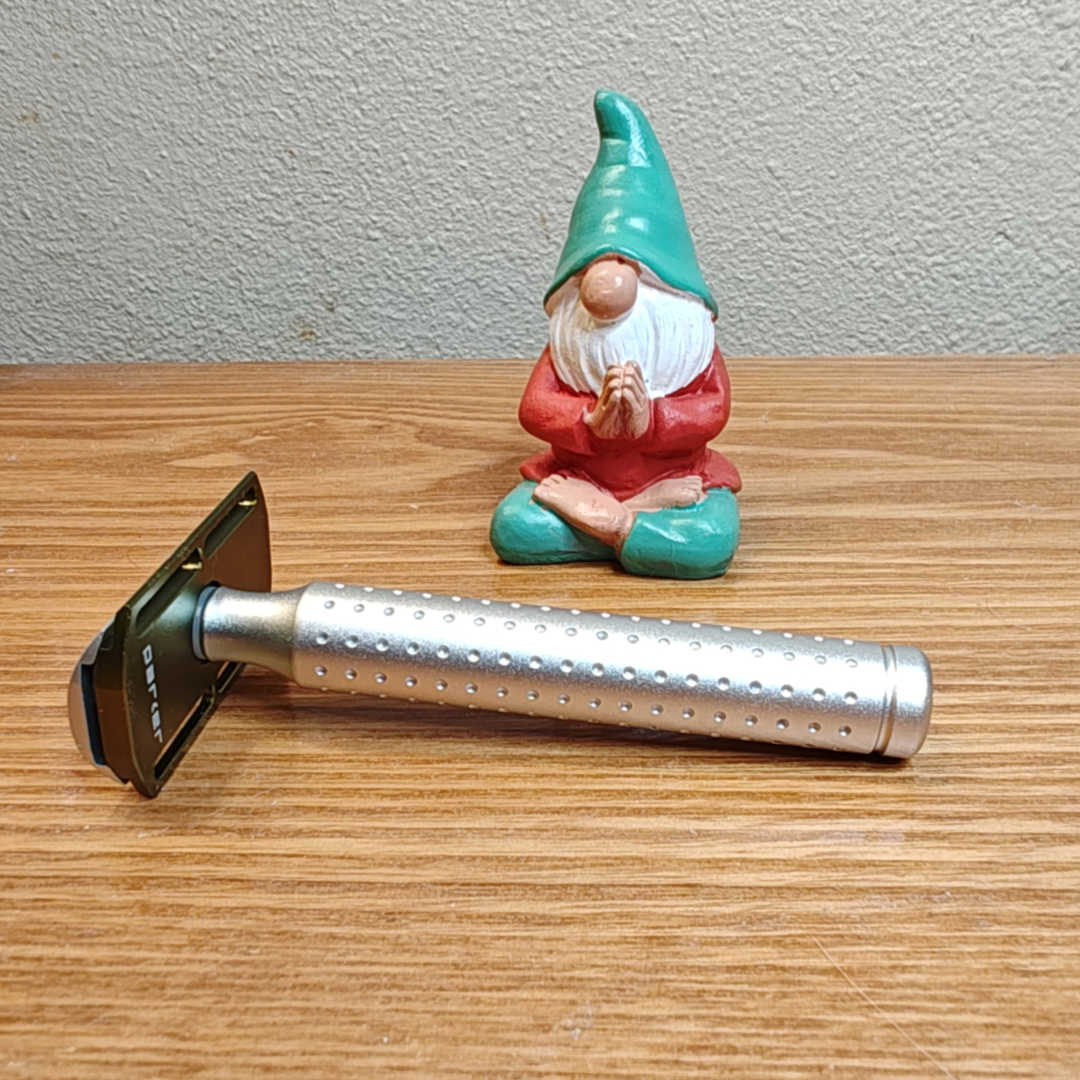
The Parker AeroShave isn’t an unusual razor because of how it looks. It’s unusual because of what light weight in the right design can bring to the shave.
In a category dominated by brass, stainless steel, and zamak (not to mention Parker’s heavyweight razor line), the AeroShave’s aluminum construction raises a more interesting question than “How close does it shave?”
The better question is what can change when a razor removes weight from the equation, especially how pressure, angle, and feedback begin to interact differently. That makes them useful tools for understanding shave technique, even if they may not be the most efficient tools for removing stubble.
The Parker AeroShave is a lightweight aluminum double edge safety razor whose low mass changes how pressure, angle, and tactile feedback are perceived during shaving.
This review treats the Parker AeroShave less as a product to judge and more as a case study in how reduced weight changes shaving behavior.
Build, Materials, and Design Choices
[Note: I received a Parker AeroShave razor from Super Safety Razor at no cost. However the opinions here are my own and have not been reviewed or approved by Parker or Super Safety Razors. Geni.us links may be affiliate.]
The Parker AeroShave is CNC-machined from aluminum and immediately feels different from most safety razors the moment it’s picked up. The weight (1.5 oz./42g) is low enough that balance becomes noticeable rather than assumed. There is very little downward force.
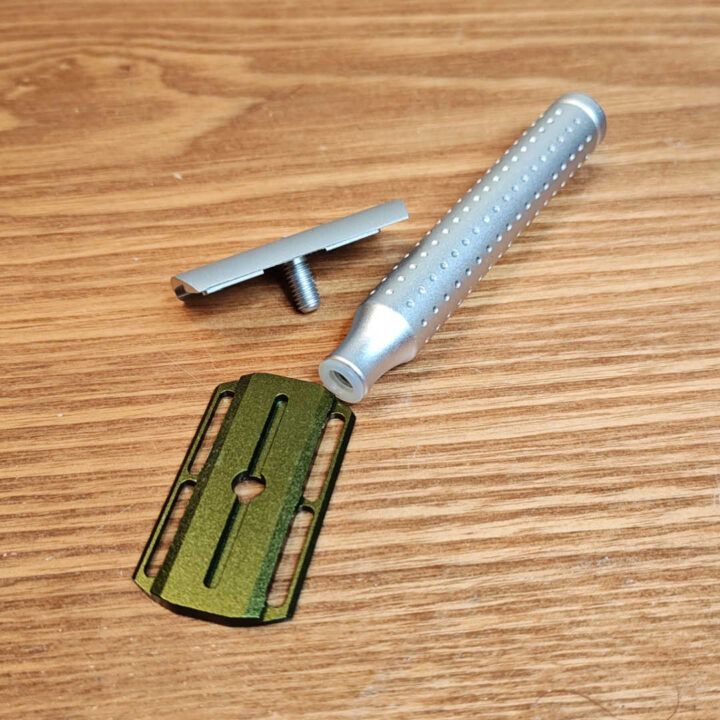
The head profile is a conventional closed comb design with a straightforward three-piece construction. There aren’t any exaggerated scallops or unusual contours. Everything about this razor seems to be intentionally restrained.
The handle length (96 mm / 3.8 in) and the overall balance point sit differently than many heavier razors. Instead of the handle pulling the head into the skin, the razor feels neutral in the hand.
I think the grip pattern bears a passing resemblance to Tatara razors but it’s definitely not a clone.
Shave Geometry and Razor Personality
The AeroShave is a mild razor in use, but “mild” here describes behavior rather than efficiency. Blade feel is there but controlled: the razor doesn’t disguise the blade, but it doesn’t encourage pressure either.
Angle discovery is relatively straightforward. The head geometry seems to reward shallow to neutral angles, and it feels clearly different when the angle drifts too steep.
The AeroShave requires the shaver to use it deliberately rather than following the conventional safety razor wisdom of letting the head do the work. This gives the razor a distinct personality. It feels less like a tool that does the work for you and more like one that mirrors what you’re doing.
Shave Experience Over Multiple Uses
The AeroShave emphasizes comfort and consistency over raw efficiency. It favors controlled passes rather than aggressive reduction: the razor feels most natural when used with restraint.
Daily shaving is where this design choice makes the most sense. On lighter growth, the razor is calm and predictable. On heavier growth, it asks for patience rather than force.
The number of passes required may increase for some, but irritation risk remains low as long as technique is disciplined. The razor doesn’t punish mistakes harshly, but it also doesn’t compensate for them, either.
The Lightweight Question: Benefit or Limitation?
This is the core question the AeroShave raises.
By removing weight, the razor removes momentum, too. Pressure must come from the hand instead of gravity. That makes pressure management more important and visible.
For some shavers, this is beneficial. The light weight can make it easier to avoid over-shaving. For others, the lack of momentum feels inefficient, especially on dense stubble.
What matters is not whether this razor’s light weight is better or worse, but what it reveals. The AeroShave makes pressure mistakes harder to hide. It also makes good technique feel intentional rather than automatic.
Blade Pairing

Blade choice seems to interact differently with the AeroShave than with heavier razors for me. Sharper blades (like Feather or Kai) feels more manageable to me here because the razor doesn’t amplify its shave through weight. Smoother blades may feel underpowered depending on beard type. For me personally, Parker’s own double edge blade (my usual go-to blade) works well as a “middle of the road” blade here.
Rather than dramatically changing the character of the razor, blade choice fine-tunes feedback. The AeroShave still behaves like itself regardless of blade, which suggests the geometry may play a larger role than blade pairing alone.
What the AeroShave Reveals About Shaving Mechanics
The most interesting thing about the AeroShave is what it makes obvious.
Weight hides pressure. Momentum hides repeated strokes. Efficiency can hide angle errors. When weight is removed, these variables reappear.
The AeroShave can show how much modern shaving habits rely on variables other than deliberate control. It shows that mild razors are not always easier. They are often just more honest.
This makes the AeroShave less about the shave result and more about the process that creates it.
Who the AeroShave Is Actually For
The AeroShave is not simply a beginner razor or an advanced razor. It’s better described as a technique-exposing razor.
It suits shavers who prioritize comfort, daily consistency, and controlled pressure. It may frustrate those who prefer weight-assisted efficiency or who rely on momentum to compensate for angle changes.
This is a razor that works best for shavers who are willing to do the guiding rather than letting the razor do it for them.
Final Thoughts Without a Score
The value of the Parker AeroShave safety razor lies in what it teaches rather than what it conquers, especially when paired with heavier razors that mask pressure differently. As part of a rotation, it can sharpen awareness of pressure, angle, and restraint. As a daily tool, it rewards patience and consistency.
Whether it belongs in your lineup depends less on your beard and more on how you prefer to learn.

Hello guys well for me I had a few shades on this razor and for me I like it. I know if it’s because I pressed too hard or something. I’m not exactly sure it is a new razor to me and they all have their own personalities and dues and don’ts to go with them, but I really like this razor at first I wasn’t sure But I guess I just like having more control of it instead of the razor
I’ve found that the aluminum razors are just too light for a good shave.
I’ve purchased several different ones thinking ‘this is the one.’
But all have fallen short.
I’ll stick to my PILS, Hone, and the other heavyweights that I own.
I picked up an Aeroshave; it arrived a bit more than a week ago. I’m four shaves in.
I agree with much of what you say. I’m also used to using aluminum razors; my first DE was a Henson medium, and I own six aluminum razors besides the Aeroshave.
I like everything about this razor except for its efficiency. Even with a Feather, it leaves stubble my other aluminum razors would not. In every other respect, it would give my favourite aluminum razor (a Karve Overlander) a run for the money.
If I were a daily morning shaver, this would likely make a good choice – the stubble it leaves would be passable for the day, and there would be no irritation (for me, most DE razors are every 2 to 3 day shavers, to avoid irritation).
If Parker were to make a “plus” base plate for this, I’d buy it in a heartbeat. It just needs a bit more efficiency to put it in contention for a spot among my favourite razors.
I appreciate your insight! I’ve been shaving with the Parker 99R heavyweight butterfly razor for a little over two years now. It took time for me to get used to the heft, but I believe I’ve learned to use the weight to my advantage. With that said, I still need to remind myself, occasionally, that extra pressure is both unnecessary and undesirable.