
Introduction
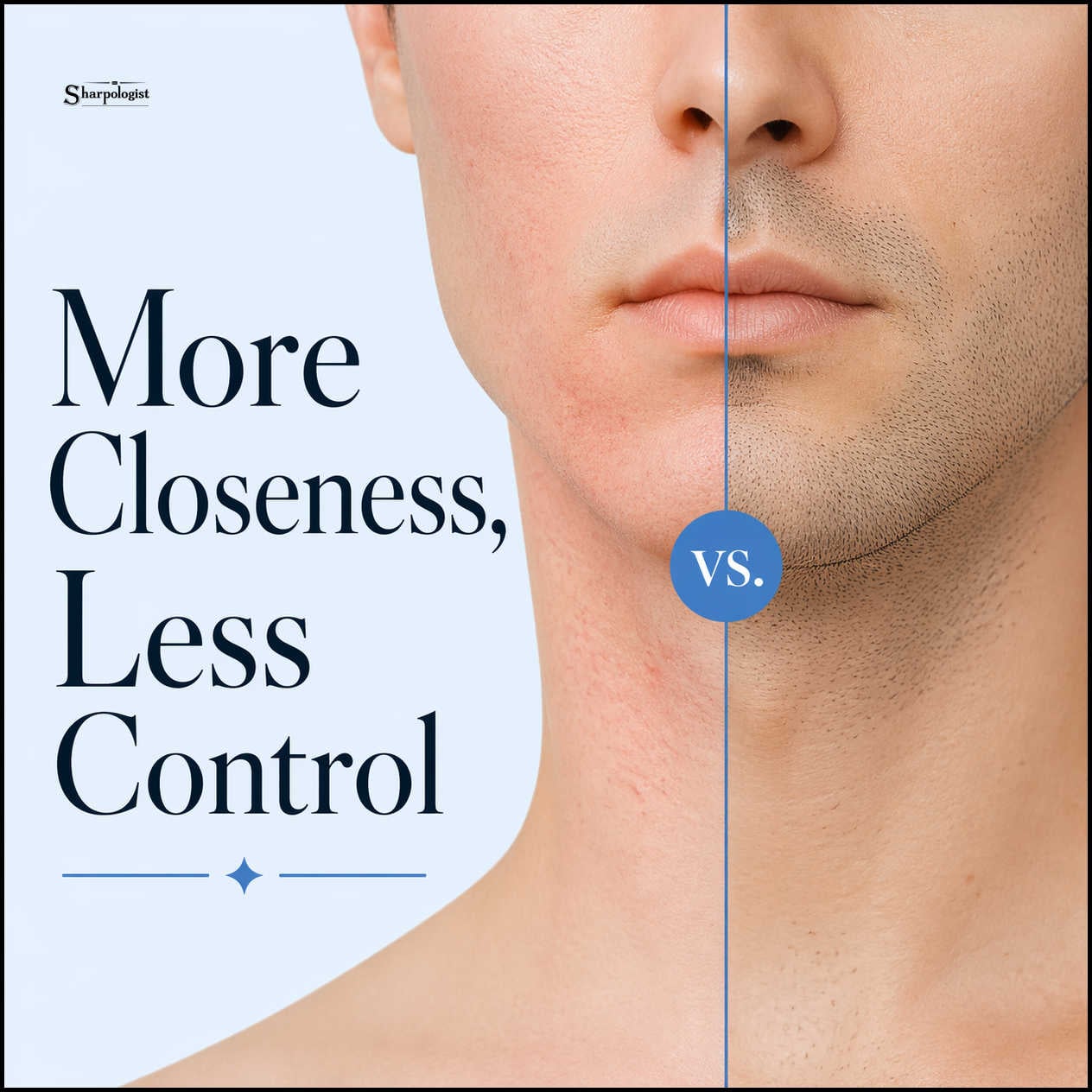
If you want a better shave, the instinct is simple: get closer.
A closer shave should mean a better result. Smoother skin, fewer visible hairs, longer time before the next shave. But many shavers run into a pattern that doesn’t fit that expectation.
They push for more closeness and get worse results. One shave feels great, the next feels harsh. The same setup produces different outcomes. Small adjustments seem to have outsized effects. It starts to feel unpredictable.
The problem is not effort. It’s what happens when you try to maximize closeness instead of controlling it.
Quick Answer
Trying to maximize closeness makes your shaves less consistent because it increases exposure and reduces tolerance for small variations. As you push for more hair removal, the shave becomes more sensitive to changes in pressure, angle, and passes. Better results come from controlling closeness, not maximizing it.
This builds on the idea that closeness and comfort don’t move together. As you increase one, you affect the other, and the margin for error gets smaller.
This is a direct result of how the shave works, particularly how razor efficiency, pressure, and cumulative exposure interact.
The Core Principle: Maximizing Closeness Reduces Stability
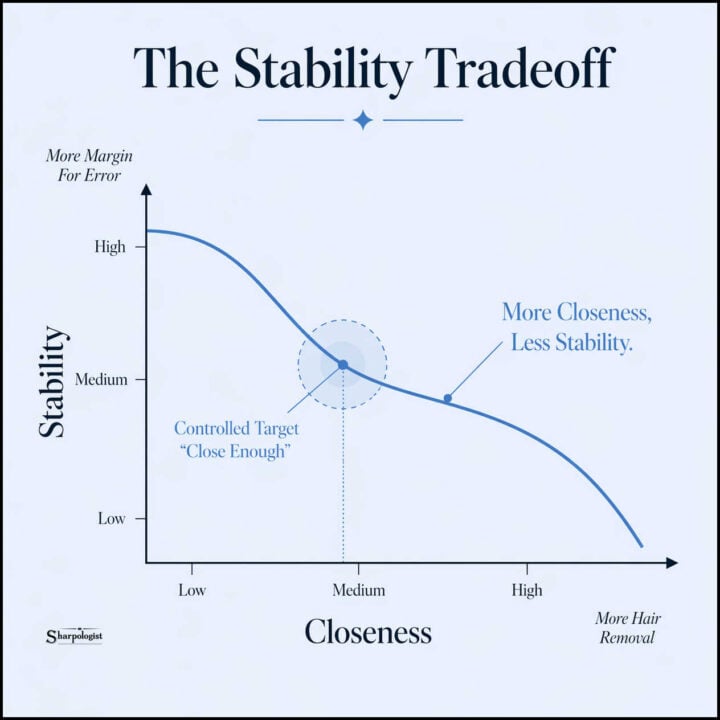
Maximizing closeness means pushing for the highest possible level of hair removal in a single shave.
In practice, this usually shows up as a combination of changes rather than a single adjustment. More passes are added, angles become more direct, tools with higher efficiency are used, and extra effort is applied to remove the remaining stubble. Each of these increases how much the blade interacts with the skin.
That interaction isn’t just about irritation. It also affects how stable the shave is.
Think of this as a stability tradeoff: as closeness increases, stability decreases.
The more you push for closeness, the smaller your margin for error becomes. Differences that would normally go unnoticed begin to affect the result.
More closeness does not just increase results. It increases sensitivity to variation.
Why Small Variations Matter More When You Push For Closeness
Every shave includes small variations, even when your routine stays the same.
Lather may be slightly wetter or drier. Angle may shift slightly. Pressure may change without you noticing. Under normal conditions, these differences have limited impact.
When you’re pushing for maximum closeness, those same differences become amplified.
A slightly drier lather can increase drag enough to change pressure. A small angle shift can increase how directly the blade meets the skin. What used to be minor variation becomes a meaningful change in outcome.
This is one of the main reasons a shave can feel inconsistent even when nothing obvious has changed.
For a broader explanation of how these variables interact, see:
→ What Most Wet Shaving Advice Gets Wrong
The Diminishing Returns Problem
Hair removal does not happen evenly across passes.
The first pass removes the majority of the stubble. The second pass removes less. Each additional pass removes progressively smaller amounts. At the same time, each pass adds exposure.
This creates a diminishing returns effect. Less hair is removed, but more skin interaction is introduced, increasing the risk of irritation.
The remaining stubble is often shorter, flatter, or more difficult to reach. Removing it requires more precise contact between blade and skin, which increases the chance of affecting the skin rather than just the hair.
The final passes are where the tradeoff becomes most visible. You are working harder for smaller gains while increasing the cost. Maximizing closeness means spending more time in this high-cost, low-return part of the shave.
This is closely tied to how cumulative exposure builds across passes:
→ [Cumulative Exposure And Irritation]
The Control-Seeking Trap
When the shave is not as close as you want, the natural response is to push a little further. That often means adding another pass, adjusting the angle slightly, or increasing pressure without fully realizing it. These changes feel small, but they shift the conditions of the shave.
When irritation appears, the response often continues. The instinct is to correct it mid-shave, adjust technique on the fly, or compensate for what just happened.
This creates a loop. The more you try to force closeness, the more variable the shave becomes. The more variable the shave becomes, the harder it is to correct.
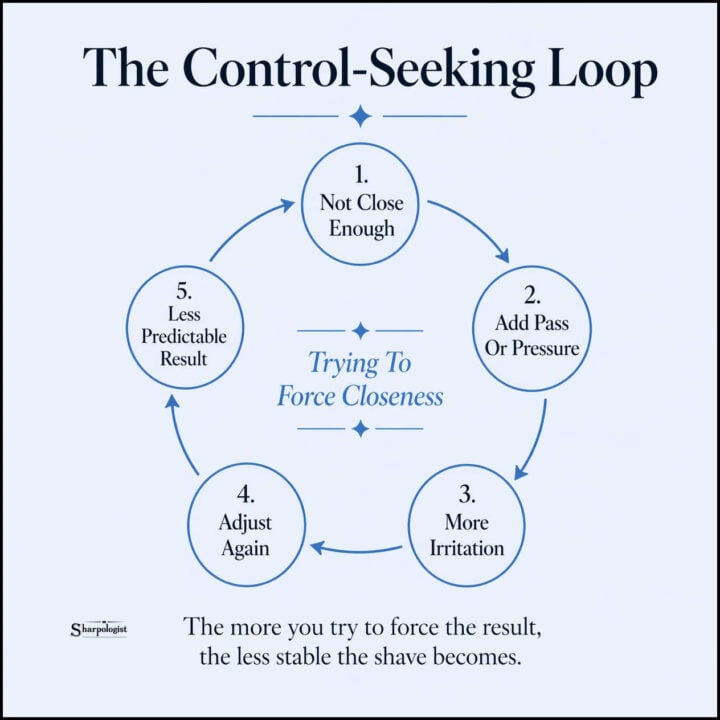
Each attempt to fix the result changes the conditions again. The result is instability.
For a deeper explanation of why multiple adjustments make problems harder to diagnose, see:
→ Why One Change Rarely Fixes A Bad Shave
How This Changes With Experience (And Why Skill Doesn’t Remove It)
Most shavers go through a similar progression.
At first, the goal is simple: get as close as possible.
With experience, it becomes clear that more closeness does not always produce better results. Intermediate shavers often push the limits, experimenting with additional passes, different angles, and more efficient tools. Results improve at times, but consistency does not.
This might seem like something experience eventually solves. But experience doesn’t remove the tradeoff. It just makes it easier to see.
At higher levels of closeness, the shave becomes less forgiving. Even small deviations in angle or pressure can affect the result.
Experienced shavers make a different shift. They stop trying to maximize closeness and instead define what “close enough” means. Closeness becomes a controlled variable rather than an open-ended goal.
This shift is what stabilizes the shave.
Practical Correction: Control Closeness Instead Of Maximizing It
The goal is not to get as close as possible. It is to get close enough in a way that is repeatable.
That starts with defining your goal before the shave begins. Without that, the shave becomes a moving target that encourages constant adjustment. Once that target is set, the shave becomes easier to control.
Stopping before diminishing returns is critical. The final pass often adds more exposure than meaningful improvement.
Limiting the number of passes helps maintain consistency. Adding passes in response to what you feel during the shave often increases exposure without meaningfully improving results.
Avoid changing multiple variables at once. Adjusting pressure, angle, and passes together makes it difficult to understand cause and effect.
Stabilizing technique should come before evaluating tools. Tools can influence results, but they do not remove the underlying tradeoff.
These are not optimizations. They are guardrails that keep the shave from becoming unstable.
Conclusion
Trying to maximize closeness makes your shaves less consistent because it reduces your margin for error.
As exposure increases, the shave becomes more sensitive to small variations. Effort increases, but control decreases.
Better results come from defining a level of closeness that works for you and staying within it.
Once you understand how these variables interact, the pattern becomes predictable.
A good shave is not the closest possible result. It is a result you can achieve consistently.

If you do not wish to achieve maximum closeness, why bother with the complete mindful shaving ritual? My father was a confirmed electric guy his whole life. He always had the moderate closeness you desire, and he got it done quickly.
I pursue BBS as a kind of excellence. My current achieves BBS with zero cuts, no lasting redness, and no ingrown hairs.