
If you have tried to improve your shave, you have probably followed a familiar pattern.
You change a razor. You try a different blade. You experiment with a new soap or cream. Each change feels like it should move things forward.
Sometimes it does. Sometimes the result is unclear. And sometimes the shave gets worse without an obvious reason.
The frustrating part isn’t just the inconsistency. It’s that the inconsistency doesn’t feel random. It feels like there should be a reason behind it, even if you can’t quite identify it.
This doesn’t mean you’ve been doing something wrong. It means the way shaving is usually explained leaves out how the process actually behaves.
Most shaving advice doesn’t really explain that reason. It tends to focus on what to use instead of what is actually happening during the shave. The what to use approach can work in simple cases, but it breaks down as soon as results become inconsistent.
Most shaving advice treats shaving as a product decision. In practice, results depend on how and why the shave works. Once that becomes clear, the patterns behind good and bad shaves are much easier to recognize.
This article is meant to give you that underlying explanation so you can see what is actually driving your results, rather than guessing based on individual changes.
Quick Answer
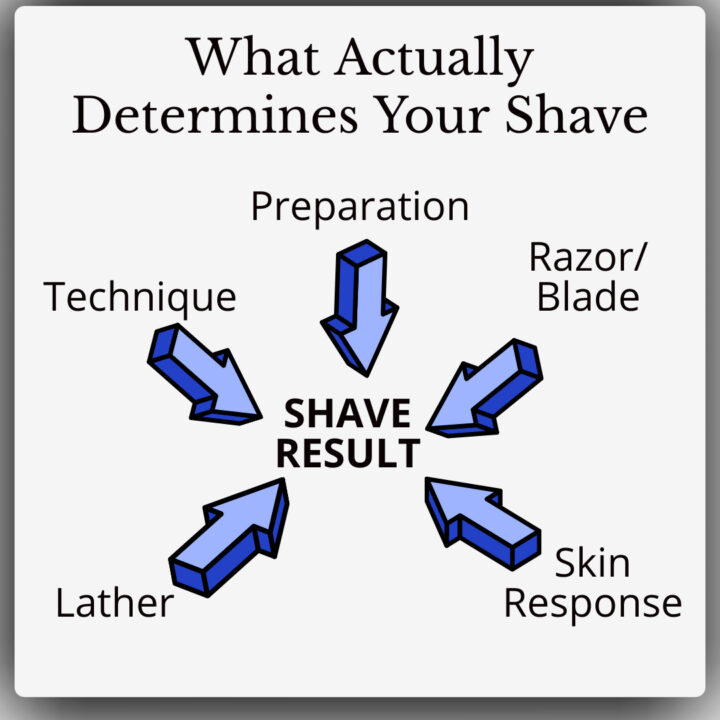
Wet shaving results are determined by how multiple variables interact, including preparation, lather, razor and blade choice, technique, and skin response. Changing products alone rarely fixes problems because these variables influence one another rather than operating independently.
Wet Shaving Is Driven By Interacting Variables
A shave is not the result of any single factor. It is the result of how multiple variables interact at the same time.
A useful way to understand shaving is to think in terms of interacting variables instead of isolated choices. Preparation, lather, razor and blade, technique, and skin response all contribute to the final result.
Each of these variables has a clear role on its own. Preparation determines how well the hair is hydrated and how easily it can be cut. Lather affects lubrication and how smoothly the blade moves across the skin. The razor and blade determine how efficiently hair is removed. Technique controls how the edge meets the hair and how much pressure is applied. Skin response reflects how all of these factors combine during and after the shave.
This is the point where most shaving advice breaks down. It treats each part of the shave as if it works independently, when in reality the result comes from how those parts interact.
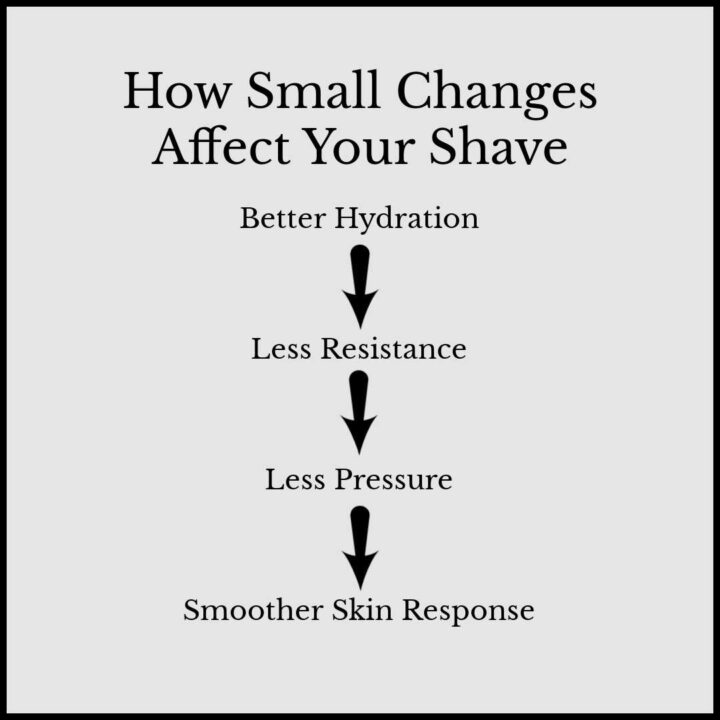
For example, well-hydrated stubble combined with properly built lather reduces resistance during the shave. That reduction in resistance changes how the razor feels, which in turn changes how much pressure is applied (even if you aren’t consciously adjusting it). That small shift in pressure can be enough to change skin response.
Similarly, a razor that feels smooth under careful technique can begin to feel harsh if angle or pressure is slightly off. In that situation, the razor hasn’t changed, but its behavior has.
This is why product descriptions alone are often misleading. A razor described as “mild” or “aggressive” will not behave the same way for everyone, or even for the same person from one shave to the next. Its behavior depends on how the rest of the shave is working.
Once shaving is understood in terms of how the variables interact, the focus naturally shifts from finding the “right” product to understanding what is actually happening during the shave.
Why The Same Setup Can Give Different Results
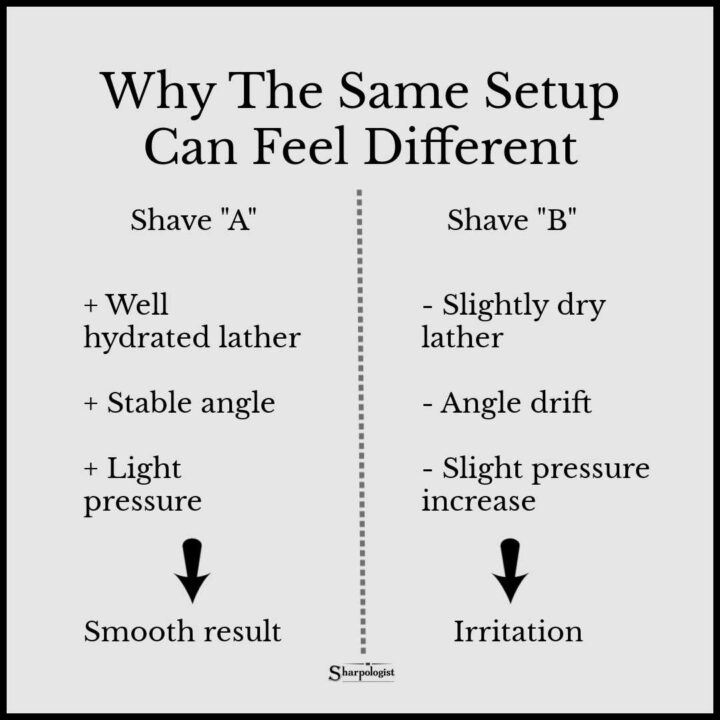
One of the most common frustrations in wet shaving is inconsistency. The same razor, blade, and soap are used, yet the result changes. This is why a shave can feel unpredictable, even when your routine hasn’t changed in any obvious way.
This is often interpreted as randomness, but in most cases, the change comes from small variations that are easy to overlook.
Water content in the lather may be slightly higher or lower. That alone can change how the blade moves across the skin. A slightly drier lather can increase drag, which encourages more pressure. A slightly wetter lather can reduce feedback, which can lead to subtle angle drift.
Technique is also rarely identical from one shave to the next. Even small changes in angle, stroke length, or pressure can affect how efficiently hair is cut and how much stress is placed on the skin.
Skin condition plays a role too. Shaving after rushed preparation or on slightly irritated skin can change how the entire shave behaves. The same number of passes can produce a different outcome because the starting condition is different.
Each of these variations is minor on its own. The problem is that they tend to occur together. When they combine, they change how the shave works in a way that feels unpredictable.
This is why it can feel like “nothing changed,” even when several small variables shifted at once.
If this pattern sounds familiar, a deeper explanation is explored here:
→ [Why Some Shaves Fail Even When Nothing Changed]
Why Changing Products Feels Like Progress (Even When It Isn’t)
When a shave does not go well, the most obvious response is to change something visible. A different blade or razor provides a clear action to take and a clear point of comparison.
And sometimes that change produces a better result. That improvement feels like progress, and in some cases it is. But it may not be as reliable as it seems.
The underlying issue is that product changes are easier to track, while changes in technique and preparation may be harder to see. When a shave improves after a product change, it’s natural to credit the improvement to the product itself.
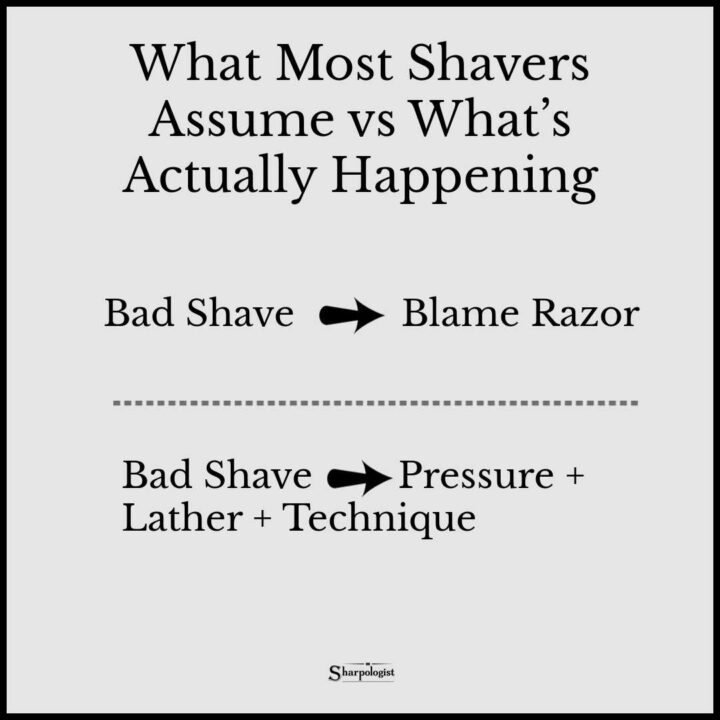
But the improvement may have actually come from more careful technique, better preparation, or even increased attention during the shave. The new product becomes associated with the improvement, even if it was not the primary cause.
The opposite can also happen. A product may be blamed for irritation or poor results when the real cause is excessive pressure, insufficient hydration, or inconsistent lather.
This can create a cycle of adjustment without clear understanding. New variables are introduced before existing ones are controlled, making it difficult to identify cause and effect. This is one of the main reasons many experienced shavers go through long periods of product experimentation without seeing consistent improvement.
A more reliable approach shifts the focus away from constant product changes and toward understanding how the shave behaves.
For a more detailed breakdown of when tool changes actually help:
→ [When A Tool Change Helps And When It Does Not]
How Shaving Understanding Changes Over Time
Most wet shavers move through a similar progression, even if it is not obvious while it’s happening.
In the beginning, the focus is almost entirely on products. The assumption is that better equipment will produce better results. This leads to experimentation and, occasionally, to noticeable improvements.
After some experience, that assumption starts to feel incomplete. Some combinations work well, while others don’t. Results improve, but not consistently. This stage often feels confusing because effort is increasing, but predictability is not.
This is where many people begin to question what is actually happening during the shave.
Over time, the focus shifts. Instead of asking what to use, the question becomes how the shave works. Attention moves away from individual products and toward how variables interact. What changes over time is not just skill, but how clearly you can see the interaction between variables.
At that point, changes become more deliberate. Fewer variables are adjusted at once. Observations become more meaningful because cause and effect are easier to see.
Consistency improves because the shave is better understood, not because a perfect product combination has been found.
How To Actually Improve Your Shave
A more reliable approach to improvement focuses on controlling variables rather than constantly introducing new ones.
It starts by anchoring the parts of the shave that have the greatest impact. Preparation should be consistent. Lather should be built with a repeatable method. Technique should be applied deliberately rather than adjusted unconsciously (and why shaving problems are usually solvable once the underlying behavior becomes clear).
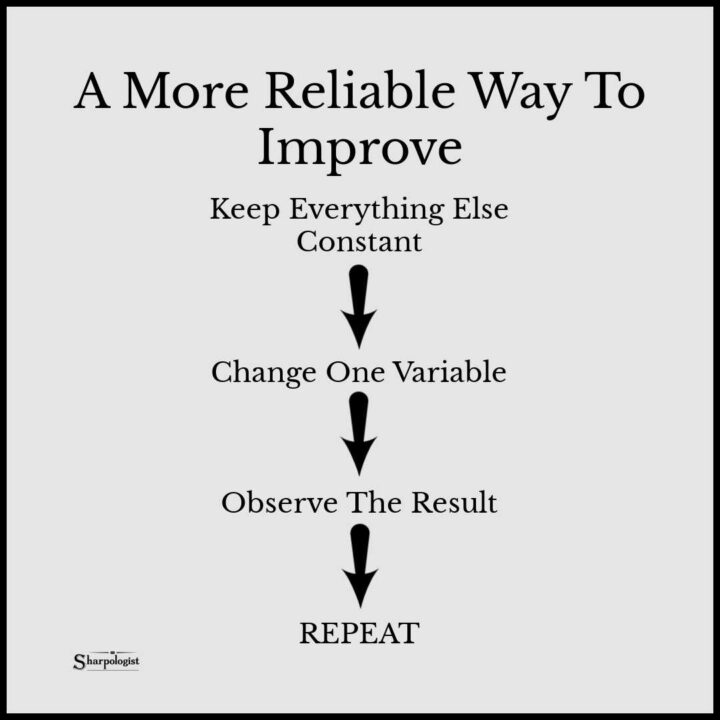
A useful rule is to keep as much of the shave consistent as possible while you change one variable at a time. A different blade can be tested while everything else remains constant. A change in lather hydration can be evaluated without changing the razor.
This approach makes it possible to see what actually improves the shave and what doesn’t. It reduces the likelihood of false conclusions and helps build a clearer understanding of how each variable contributes to the result.
Over time, this leads to more predictable outcomes. The goal is not to eliminate variation entirely, but to understand it well enough that it can be managed.
For a practical example of how tool differences fit into this context:
→ [Merkur 34C vs Henson AL13]
How To Use Sharpologist To Improve Your Shave
Not all shaving content serves the same purpose, and understanding that distinction can make the Sharpologist site more useful.
Some articles are designed to explain how shaving works. These provide the context needed to understand why certain problems occur and why certain solutions are effective.
Other articles focus on specific problems or decisions. These include comparisons between razors, explanations of irritation, and discussions of technique adjustments.
A useful approach is to move between these types of content intentionally. Foundational articles help you understand how the shave behaves. Diagnostic and comparison articles help you apply that understanding to specific situations.
Used together, they allow for more controlled improvement. Instead of trying random changes, you can make adjustments with a clearer expectation of what should happen and why.
Conclusion
Once you understand how the shave works, the process becomes more predictable.
Instead of chasing better results through constant change, improvement comes from understanding how the variables interact and learning how to control them.
That shift doesn’t happen instantly. It develops over time as patterns become clearer and adjustments become more deliberate.
But once it does happen, the difference is noticeable. Shaves become more consistent. Decisions become more confident. And the process starts to feel less like guesswork and more like something you can actually understand and manage.
Once you start looking at your shave this way, the changes you make become easier to understand and easier to control.
FAQ
Why does my shave change from day to day?
Small variations in preparation, lather, technique, and skin condition can change how the shave behaves, even when products remain the same.
Does a better razor fix irritation?
Not necessarily. Irritation usually results from how multiple variables interact rather than the razor alone.
Why does the same blade feel different sometimes?
Blade performance is influenced by lather quality, technique, and skin condition, all of which can vary between shaves.
Should I keep trying new products?
New products can help in some cases, but consistent improvement typically comes from better control of existing variables.

Mark, a very thorough and comprehensive article covering the variables of wet shaving. Because of the complexity, I think you may have inadvertently made the case for people to return to using a cartridge razor, which is simple and intuitive to use. Personally, I use the Proof (v2) razor for my morning shave, partly because I do not want to concentrate that hard before I have had my morning coffee.
I’m a man. I don’t have the time or energy to worry about how my shave feels or looks! Just be careful don’t injure yourself. Damn, just to shave the hair off your face is not a big deal. We’re MEN aren’t we???