
Introduction
You finish a shave and notice something that doesn’t feel right.
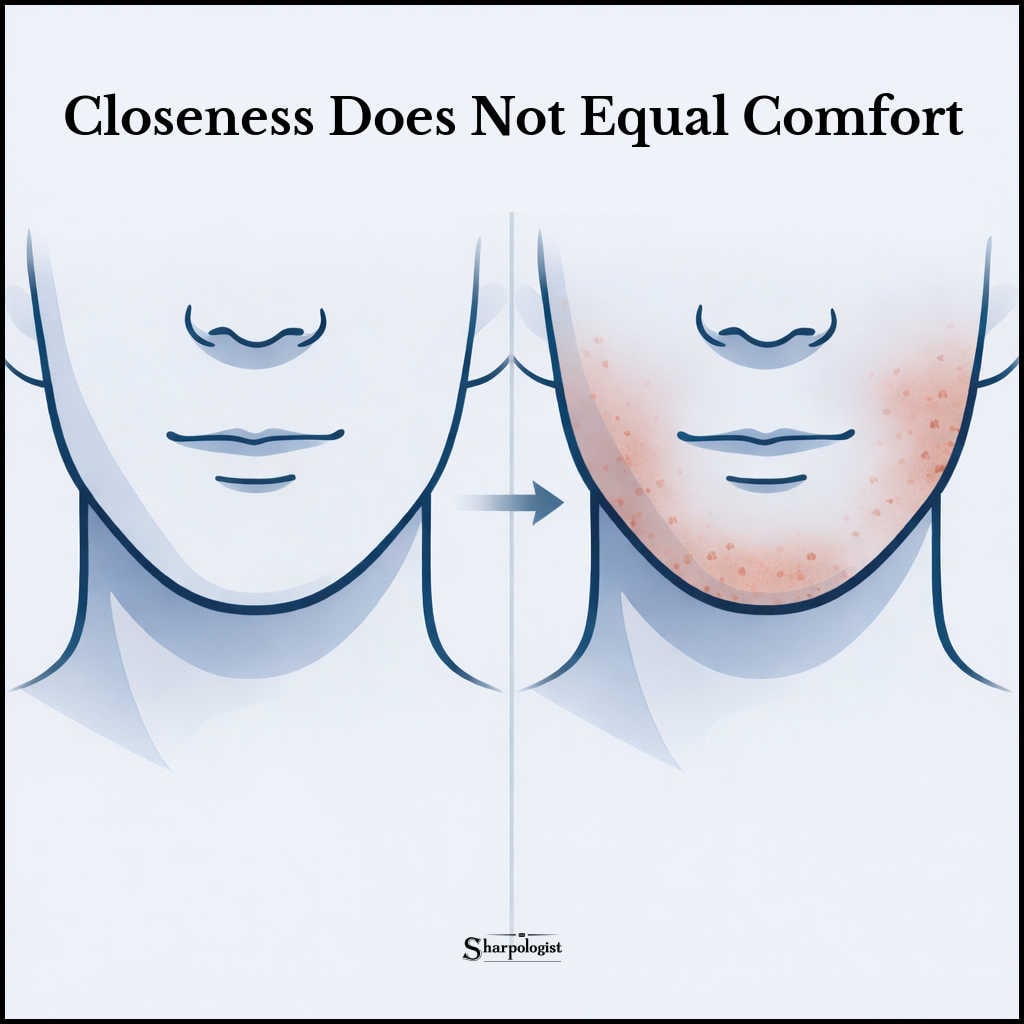
The result is closer than usual, but your skin feels worse. Or the shave feels smooth and easy, but not quite as close as you expected.
A closer shave should feel better. A more comfortable shave should feel closer.
But they don’t move together.
It creates a contradiction. If the shave is improving, both outcomes should improve at the same time. When that doesn’t happen, the shave starts to feel unpredictable.
It feels like you’re doing something wrong, even when you aren’t.
Quick Answer
Closeness and comfort don’t move together because they’re driven by different parts of the shave. Increasing hair removal usually increases skin exposure, which raises the chance of irritation. A better shave comes from managing the tradeoff, not trying to maximize both at the same time.
This tradeoff is a direct result of how the shave works, particularly how razor efficiency, pressure, and cumulative exposure interact.
The Core Principle: Closeness And Comfort Are Separate Outcomes
Closeness is the level of hair removal. Comfort is how your skin responds during and after the shave.
They come from the same process, but they are not aligned. Improving one does not guarantee improvement in the other.
Most shavers carry an implied expectation that progress should be linear. If technique improves, both outcomes should improve together. When that expectation breaks, it feels like something is wrong.
What’s actually happening is simpler. The variables that increase closeness also increase how much the blade interacts with the skin. That interaction is what your skin responds to.
These outcomes are linked in a way that makes tradeoff unavoidable, not optional.
While many shaving problems come from how variables interact, this is one of the clearest examples of how those interactions feel in practice.
Why More Closeness Usually Reduces Comfort
Getting a closer shave means removing hair more completely. That usually requires one or more of the following:
- more passes
- a more direct angle of contact
- a more efficient razor
Each of these increases how much the blade interacts with the skin.
This is where cumulative exposure becomes important. Every pass and every adjustment increases the total contact between blade and skin. At some point, that added contact starts to affect how the skin feels.
Removing hair closer to the skin requires the blade to operate closer to the skin surface, which increases the chance of affecting it.
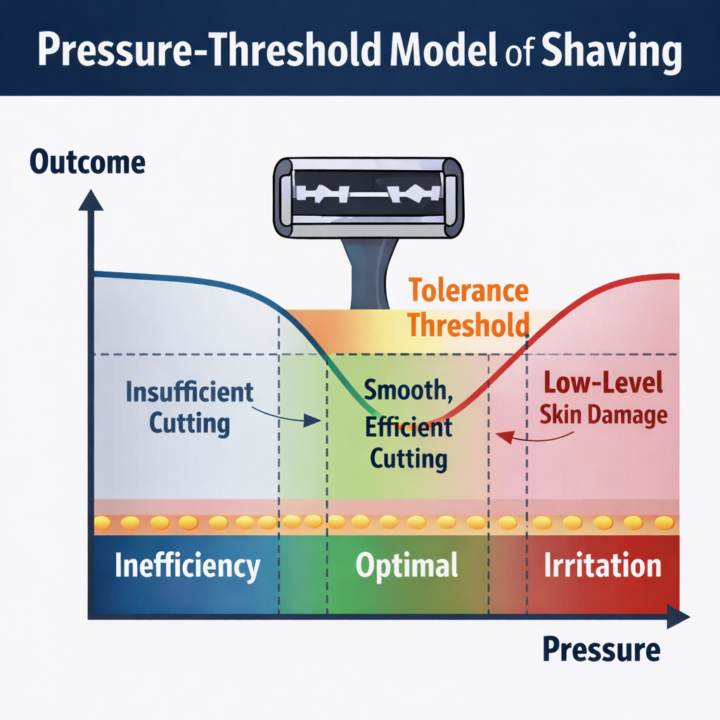
The result is predictable. As hair removal increases, the likelihood of irritation increases too.
This is not a mistake in technique. It is a direct outcome of how the shave works.
Why Comfortable Shaves Often Feel Less Close
Comfort improves when exposure is reduced, but that same reduction limits how completely hair can be removed.
A comfortable shave usually comes from reducing how much the blade interacts with the skin:
- fewer passes
- lighter pressure
- a less direct angle
These choices reduce irritation, but they also limit how much hair is removed.
The result is a shave that feels smooth and controlled, but not as close.
A less close shave can feel like a step backward, even when it is actually a more controlled and repeatable result.
Comfort is not the absence of closeness. It is the result of managing how much exposure the skin experiences.
The Control-Seeking Mistake Most Shavers Make
When closeness and comfort move in opposite directions, the shave starts to feel unstable.
The natural response is to try to fix it quickly:
- add another pass
- increase pressure slightly
- adjust angle mid-shave
- change multiple variables at once
These actions are attempts to regain control. But instead of stabilizing the shave, they increase variability and make the result harder to predict and harder to correct.
This is why a shave can spiral: each adjustment changes the conditions of the shave, making the next result less reliable.
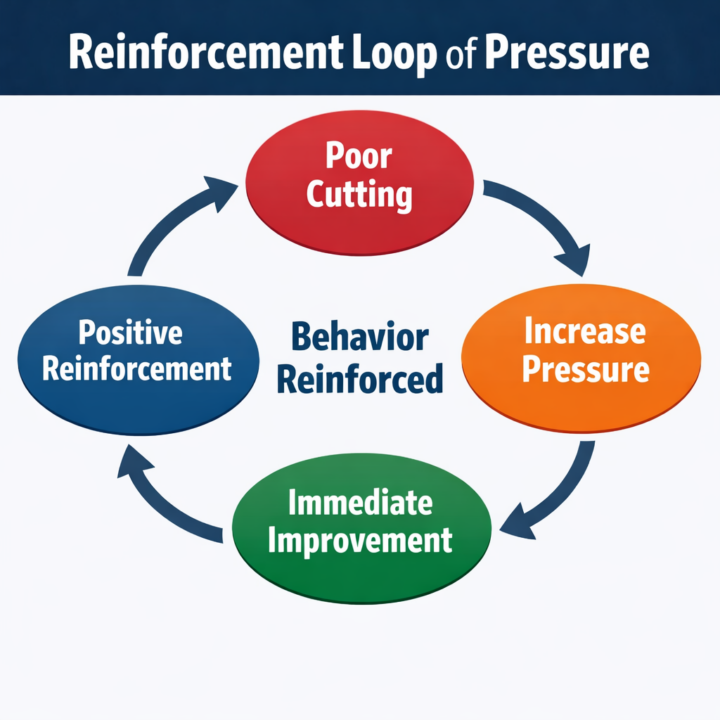
This pattern shows up repeatedly in real-world behavior. Shavers chase a closer result, feel irritation, then try to correct it within the same shave. The result is neither close nor comfortable.
The more you try to force both outcomes, the less predictable the shave becomes. The problem is not effort. It is trying to force both outcomes to improve at the same time.
For a deeper breakdown of why multiple adjustments make problems harder to diagnose, see:
→ Why One Change Rarely Fixes A Bad Shave
How This Changes With Experience
Experience changes how shavers define success.
Beginners often equate a good shave with maximum closeness. If the result is not as smooth as possible, it feels incomplete.
Intermediate shavers start to recognize the tradeoff and try to balance both outcomes.
Experienced shavers stop trying to eliminate the tradeoff. Instead, they prioritize consistency. A shave that is predictably good becomes more valuable than one that is occasionally perfect.
Closeness becomes a controlled variable, not the primary goal. Comfort becomes a constraint, not an afterthought.
This shift is what stabilizes results over time.
Practical Correction: How To Balance Closeness And Comfort
The goal is to decide how much of each you want, not to maximize both outcomes, by controlling the process.
One constraint matters more than the others: define what “close enough” means before you start. Without that, the shave becomes a moving target.
A few additional guardrails make this easier.
Limit passes instead of adjusting mid-shave. Adding passes in response to what you feel often increases exposure without improving consistency.
Avoid changing multiple variables at once. If you adjust pressure, angle, and passes together, it becomes difficult to understand what caused the result.
Stabilize technique before evaluating tools. Tools can change the outcome, but they do not remove the underlying tradeoff.
For how tool changes fit into this without creating new variables, see:
→ When A Tool Change Helps And When It Does Not
These are not optimizations. They are guardrails that keep the shave from becoming unstable.
Conclusion
Closeness and comfort do not move together because they are driven by different parts of the shave.
Trying to maximize both at the same time usually leads to inconsistency. The shave becomes harder to control, and the results become less predictable.
A better approach is to accept the tradeoff and manage it deliberately.
A good shave is not the closest possible result or the most comfortable one in isolation. It is a shave where the balance between the two is understood, controlled, and repeatable.
