

Good shaving advice can still fail.
That’s one of the more frustrating parts of wet shaving. A tip sounds reasonable. It comes from someone with real experience. Plenty of other shavers say it helped them.
Then you try it, and your shave doesn’t improve. Sometimes it even gets worse.
That does not always mean the advice was bad. More often, the advice was missing context. It was meant for a different beard, a different razor, a different habit, or a different problem.
Shaving advice is often right in principle and wrong in application.
Quick Answer: Why Good Shaving Advice Has To Be Applied To Your Own Face
Good shaving advice works only when it is applied to your own face because shaving results depend on the interaction between advice, tools, beard growth, skin tolerance, technique, and goals. A tip that solves one shaver’s problem may not solve yours if the underlying cause is different.
Good advice gives you a principle, not a finished answer. The useful question is not simply, “Does this advice work?” but “What problem was this advice meant to solve, and does that match what is happening in my shave?”
Advice Is A Starting Point, Not A Diagnosis
Shaving advice becomes useful when it helps you interpret your own shave. It becomes less useful when you copy it without context.
Most advice is incomplete by nature. It comes from someone else’s beard, skin, razor, blade, water, lather, hand pressure, goals, and tolerance. Even when the advice is sincere and technically sound, it is still filtered through another person’s face.
Shaving problems can also look similar from the outside. Irritation, roughness, missed stubble, tugging, redness, and inconsistent closeness don’t all come from the same cause. One shaver may need less pressure. Another may need a sharper blade. Another may need to change the pass strategy. Another may need to stop chasing the same result on the neck that works easily on the cheeks.
Good advice can point you in the right direction but it can’t finish the diagnosis for you.
Why Good Advice Often Sounds Contradictory
Wet shaving advice often sounds contradictory because different shavers are solving different problems.
One person says to use a sharper blade. Another says to use a smoother blade. One recommends a milder razor. Another suggests a more efficient razor. One shaver says to add a pass. Another says to stop doing so many passes. One says prep matters more than products. Another says the soap or cream made the difference.
Those recommendations are not equally useful for every shaver, but they are not automatically nonsense. They may be describing different starting points.
Advice becomes confusing when the problem it was meant to solve gets separated from the advice itself.
A more efficient razor may help a shaver who is doing too many strokes with a very mild setup. The same advice may punish a shaver who is already using pressure and chasing maximum closeness. A sharper blade may reduce tugging for one person and increase blade feel for another. Fewer passes may help if the issue is over-shaving, but not if the first pass is poorly controlled.
The condition behind the advice matters.
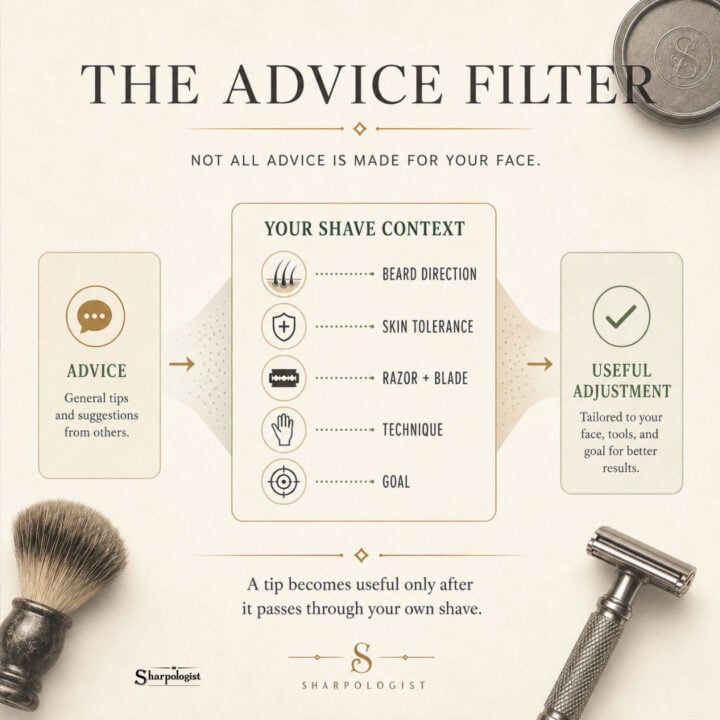
The Variables That Change The Meaning Of Advice
The same sentence can mean different things depending on the face, tools, and problem involved. Broad advice needs interpretation before it becomes useful.
Beard Growth Direction Changes The Advice
Advice about shaving with, across, or against the grain obviously depends heavily on beard growth direction. That does not mean every shaver needs an elaborate beard map before every shave. But “with the grain,” “across the grain,” and “against the grain” are not universal directions.
Razor type changes the beard direction discussion, but doesn’t erase it. With multi-blade cartridge razors, grain direction can matter more because some cartridge systems are designed to cut very close to the skin. A single blade reduces that particular issue, but that doesn’t make beard direction irrelevant.
With a single blade, growth direction still affects resistance, comfort, touch-ups, and how much margin a pass may use. The edge may not be using the same multi-blade cutting sequence, but the hair is still growing in a direction. The skin is still responding to how the stroke meets that hair.
The practical question is not whether beard grain matters. It is how much it matters for this area, with this razor, and for the result you are trying to get.
Skin Tolerance Changes The Advice
Some shavers tolerate more passes, closer results, sharper-feeling blades, and more ambitious cleanup work. Others have less room before the skin objects.
That can change the meaning of advice. “Do another pass” may be reasonable for someone with high tolerance and a controlled stroke. It may be the wrong move for someone whose neck already feels warm after two passes.
Tolerance is not evenly distributed across the face, either. The cheeks may tolerate a closer result than the throat. The jawline may need a different endpoint than the upper lip. Advice that works well in one area can become too aggressive in another.
Razor And Blade Pairing Changes The Advice
Blade advice often sounds more universal than it is.
A blade that feels smooth in one razor may feel dull, harsh, or too sharp in another. A mild razor may still cause irritation if the shaver compensates with pressure. An efficient razor may reduce strokes for one shaver and encourage over-shaving for another.
Product advice needs context because the tool is only part of the behavior it encourages.
If a setup gives you control, reduces unnecessary strokes, and leaves the skin calm, it may be a good fit even if it is not the most efficient option available. If a setup keeps tempting you to chase a result your skin will not tolerate, the technical capability may not be helping.
Technique Changes The Advice
Technique changes the meaning of nearly every shaving recommendation.
“Use less pressure” is widely useful advice, but it still has to be applied to a real stroke, on a real part of the face. “Find the angle” is not a magic phrase. The angle has to be maintained through curves, hollows, jawlines, and grain changes.
Pass strategy works the same way. A recommendation to do fewer passes may not help if the first pass is rushed or poorly controlled. A recommendation to add a pass may fail if pressure is already too high or if the same area keeps getting reworked.
Good technique is not one isolated behavior. It is pressure, angle, stroke length, pass direction, lather handling, and stopping point working together.
Goals Change The Advice
A shaver preparing for a formal event may accept a different closeness and comfort tradeoff than a shaver shaving every morning before work. A daily shaver may need a standard that preserves the next day’s skin. A weekend shaver may tolerate a little more closeness because there is more recovery time.
This is where advice about BBS, or “baby butt smooth,” often becomes unclear. BBS may be a satisfying result, but it should not automatically become the default goal for every shave.
Good advice should match the intended result. If your goal is a comfortable daily shave, advice built around maximum closeness may not be the best fit. If your goal is a rare ultra-close shave, advice built around daily restraint may feel too conservative.
The same advice can be sensible or excessive depending on what the shave is supposed to accomplish.
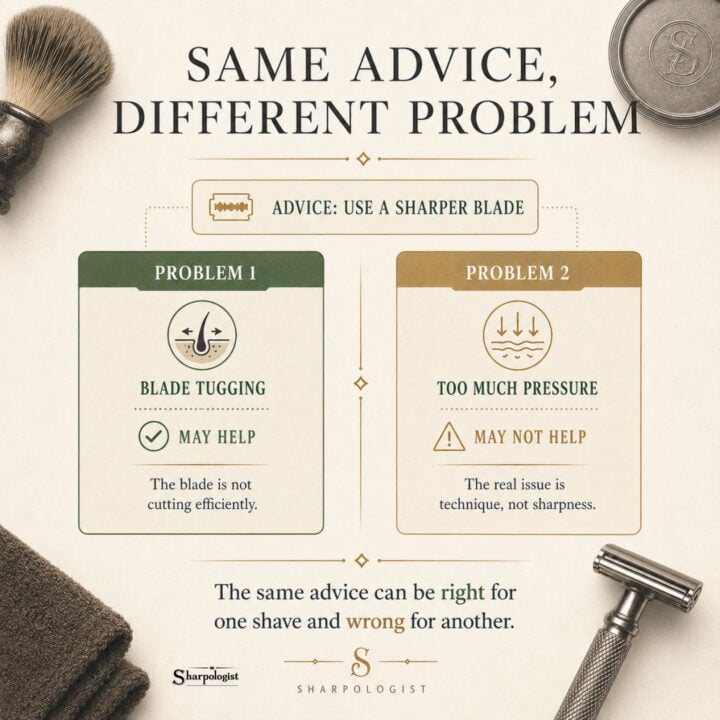
The Most Common Mistake: Copying The Fix Without Identifying The Problem
Many shaving mistakes start with copying the fix before identifying the problem.
A shaver switches to a sharper blade because the razor seems to tug, but the real issue may be poor angle. Another switches to a milder razor because the shave feels harsh, but the real issue could be pressure. Someone changes soap because the shave is inconsistent, when the problem is actually repeated touch-ups on the neck.
The fix may be reasonable. It may even be a good fix for someone else. But if it does not match the cause, it adds noise.
This is why product changes can be both helpful and misleading. A different razor, blade, brush, soap, or cream can improve a shave when it addresses the actual problem. The same change can hide the real issue when it merely moves the symptoms around for a few shaves.
A better sequence is to identify the pattern first, then choose the adjustment.
How To Translate Advice Into Your Own Shave
Good advice becomes more useful when you ask what problem it is trying to solve. Where does the problem happen? When does it appear? Does it show up during the shave, right after, or later? Does it happen everywhere or only in one area? Did the problem change, or did it only move?
| Advice You Hear | Ask First |
| Use a sharper blade | Is the blade failing to cut, or am I using pressure? |
| Use a milder razor | Is the razor too much, or am I overworking the area? |
| Do fewer passes | Which pass is causing the problem? |
| Improve your lather | Is the lather failing, or is the issue stroke, angle, or pressure? |
| Stop chasing BBS | Which area costs too much to make perfectly smooth? |
This kind of translation keeps advice from becoming a rule before it becomes a diagnosis.
It also protects you from changing the wrong thing. If the problem is pressure, a milder razor may help a little, but the pressure problem remains. If the problem is poor lather stability, changing blades may not solve much. If the problem is repeated work on one patch of the neck, the best advice may be to stop sooner, not to buy something different.
Don’t reject advice. Ask whether the advice is aimed at the problem you actually have.
The One-Change Rule Still Matters
Applying advice requires restraint.
If you change the razor, blade, soap, pass count, pressure, and prep all at once, you may get a different shave. You probably just won’t know why. Improvement becomes harder to repeat. Failure becomes harder to diagnose.
Good advice becomes better evidence when only one variable changes.
That does not mean every shave has to become a formal experiment. It means you should give yourself a chance to see cause and effect. If you are testing a blade, do not also change your pass strategy and lather. If you are testing pressure, do not also switch razors. If you are trying a different stopping point on the neck, keep the rest of the shave as familiar as possible.
Changing less is not a lack of progress. It is how progress becomes understandable.
When Advice Should Be Ignored, Adapted, Or Tested
Not every piece of good advice deserves the same response.
Some advice should be ignored because the problem does not match. If someone recommends a more aggressive razor but your issue is pressure, that advice is probably aimed at a different shave. If someone tells you to improve prep when the problem is repeated buffing in one area, prep may not be the first place to look.
Some advice should be adapted because the principle applies but the details do not. “Use less pressure” may apply broadly, but the way you notice pressure on the neck may differ from the cheeks. “Shave with the grain first” may apply, but the grain direction has to be identified on your own face, not assumed from a diagram.
When the problem seems similar but the cause is not certain, test the advice instead of adopting it permanently. Try one blade change. Adjust one pass. Stop one touch-up earlier. Then give the result enough repetition to see whether it actually helped.
The goal is to keep advice from outrunning diagnosis.
Why Experienced Shavers Still Need To Personalize Advice
Experienced shavers may not need basic instruction, but they can still make a more subtle mistake: assuming that advice from another experienced shaver should transfer cleanly.
The more refined the shave becomes, the more personal the remaining problems often are. Early improvement may come from obvious corrections: better lather, lighter pressure, better blade handling, fewer careless strokes. Later improvement often comes from more specific interpretation.
General advice still matters: it just has to be applied with more attention.
Experience does not remove the need for personalization. It makes the feedback more specific.
Use Advice To Read Your Shave Better
The best shaving advice does not tell you to copy someone else’s routine. It helps you understand your own.
A good tip should make the shave easier to read. It should help you notice what changed, where it changed, and whether the result improved during the shave or later. It should help you tell whether a problem disappeared, moved, softened, or simply returned under different conditions.
That is the difference between advice as instruction and advice as interpretation.
Instruction says, “Do this.” Interpretation asks, “Does this match what is happening?” The second question is usually more useful for experienced shavers because the visible symptom is rarely the whole story.
If advice helps you read your own shave more clearly, it has done its job. If it only gives you another rule to follow without context, it may add confusion instead of clarity.
Good Advice Needs A Face To Apply To
Good shaving advice matters. It can prevent mistakes, shorten the learning curve, and give shavers better language for what is happening during the shave.
But advice becomes useful only when it is matched to the face, beard, tools, and feedback in front of the shaver. Without that context, even good advice can become another variable.
The better question is not “Which advice is correct?”
The better question is, “Which principle applies to what is happening on my face?”
Good advice points the way. Your own face tells you how far to follow it.

Mantic59 for a 11 year DE shaver is fantastic. Yes I do collect razors. I now have 18.
I have an 11 razor lineup that I fill after 4\3 pass shaves. I am curious how many passes people use and how many shaves they have.