
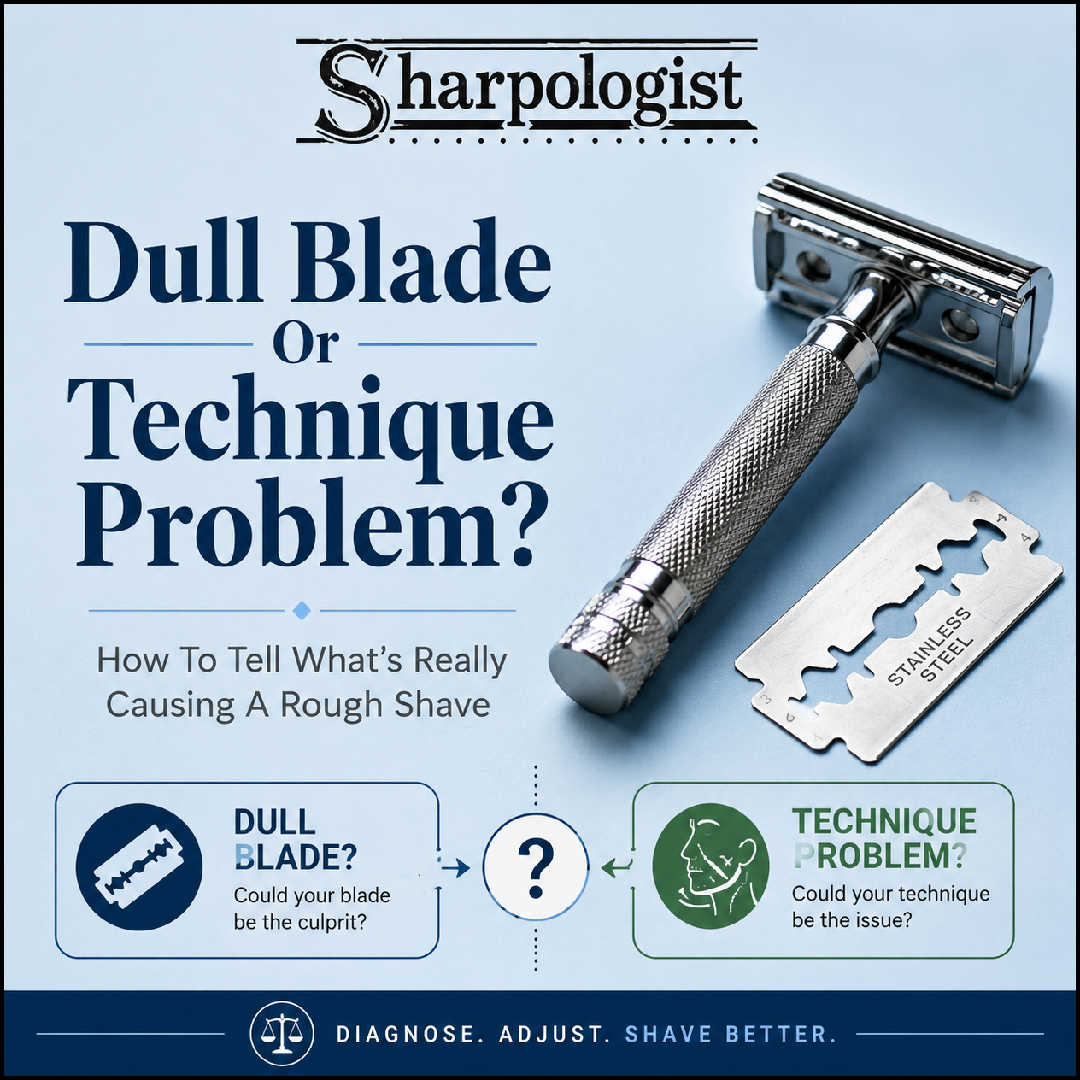
A rough shave often creates an obvious suspect: the blade.
That makes sense. When a razor starts tugging, scraping, skipping, or leaving irritation behind, replacing the blade is one of the easiest fixes available.
But that same bad shave can have another cause. Pressure, angle, weak lather, poor prep, repeated touch-ups, and shaving against the grain too soon can all make a good blade feel worse than it is.
So “Is this blade dull?” is often the wrong first question. The better question may be: did the blade change, or did the shave change?
Quick Answer
A razor blade is probably dull when it starts tugging, scraping, skipping, leaving more stubble than usual, or causing irritation even though your prep, lather, razor, angle, and pressure have stayed consistent.
If the same blade feels bad only when your pressure increases, your angle changes, your lather weakens, or you keep touching up one area, technique may be the larger problem.
The practical test is consistency. If the shave changed but your process did not, suspect the blade. If the shave changes whenever your process changes, diagnose technique before blaming the blade.
The Mainstream Answer Is Useful, But Incomplete
Mainstream grooming advice has returned to blade replacement as a practical shaving issue. Recent guidance tends to emphasize replacement frequency, tugging, irritation, hygiene, rinsing, drying, residue, and storage.
Men’s Health recently framed blade replacement by razor type and noted that safety razor blades usually need replacement more often than cartridges, commonly after about 10-12 shaves. Gillette’s March 25, 2026 guidance gives broader replacement advice, including changing blades when they feel dull, tug, irritate, or when residue, moisture, shaving frequency, hair coarseness, and skin sensitivity affect performance.
That is useful advice: a dull blade can absolutely make a shave worse. A blade that pulls instead of cuts can increase irritation, require more strokes, and make the shave feel less controlled.
The limitation is that those signs don’t prove the blade is the only problem. Tugging, scraping, and irritation can also come from how the razor is being used. Experienced wet shavers need more than a replacement interval. They need a way to interpret what changed.
A Dull Blade Is A Change In Cutting Behavior
A dull blade is not just a blade that has reached a certain number of shaves. It’s a blade whose cutting behavior has changed.
That change may show up as more resistance through the stubble, more tugging at the start of a stroke, more missed hair after a normal pass, or more irritation for the same level of closeness. The key phrase is for the same level of closeness. A blade that suddenly requires more work to produce the same result may be telling you that its edge has changed.
This is why fixed numbers can mislead and often defy “conventional wisdom.” One shaver may get three comfortable shaves from a blade. Another may get seven. A third may use the same blade much longer, especially with a lighter beard, mild razor, forgiving skin, and consistent routine. Wet shaving communities often show this spread clearly, with some shavers replacing double edge blades every shave and others using them for several shaves or more.
The useful question is not, “How many shaves should this blade last?” It is, “Does this blade still behave the way it did when the shave was working?”
Why Technique Problems Can Feel Like A Dull Blade
A dull blade and a technique problem can create similar feedback because both interfere with clean cutting.
Too much pressure can make the razor feel harsh, even when the blade is sharp. The edge is no longer simply cutting hair. It is being pressed harder into the skin while cutting, scraping, or riding over uneven surfaces. That can feel like blade roughness, but the cause is the way force is being applied.
Angle creates another overlap. A razor held too steeply may scrape. A razor held too shallowly may skip or fail to cut efficiently. Either mistake can make the blade feel less capable than it really is.
Lather can confuse the diagnosis too. A weak or drying lather increases drag. The blade may feel like it is pulling, but the problem is that the shaving surface is not supporting the stroke well. In that case, replacing the blade might help temporarily, but it will not fix the underlying condition that made the shave rough.
Touch-ups are another common trap. A blade may feel worse in one area because that skin has already been shaved too many times. The neck is especially prone to this. The blade gets blamed, but the problem is cumulative exposure: too many passes, too much pressure, or too much correction in the same place.
Signs That Point More Toward A Dull Blade
A blade is more likely to be the problem when the shave gets worse even though the rest of the shave stayed stable. Look for patterns like these:
- The blade tugs even with good prep and lather.
- The same razor suddenly needs more strokes to reach the same result.
- The roughness appears across the shave, not only on one difficult spot.
- Rinsing the razor no longer restores the blade’s normal feel.
- The blade feels inconsistent from the first pass onward.
- Irritation increases even though pressure, angle, and pass structure have not changed.
None of these signs is absolute proof. But together, they suggest the blade has changed behavior.
The strongest signal is comparison. If the same razor, same soap or cream, same pass structure, same prep, and same technique produced a better shave recently, and now the blade feels worse everywhere, replacement is a reasonable next step.
Signs That Point More Toward Technique
Technique is more likely when the problem appears only under certain conditions.
If the cheeks shave comfortably but the lower neck burns, the blade may not be the main issue. Beard direction, skin sensitivity, pressure, angle drift, and repeated touch-ups may be doing more damage than the blade itself.
If a blade feels harsh only when chasing extra closeness, the problem may be over-shaving. The first pass may be fine. The second pass may be acceptable. The irritation appears when the shave moves from reduction to correction: one more buffing stroke, one more against-the-grain touch-up, one more attempt to make a difficult area perfectly smooth.
A fresh blade can also expose technique problems. Because it cuts more easily, it may tempt the shaver to keep going. Because it is sharper, it may punish pressure more quickly. That does not mean the blade is bad. It may mean the margin for error has narrowed.
A useful test is location. Blade problems tend to follow the blade. Technique problems often follow behavior. If the same roughness appears only where pressure rises, where the angle changes, where lather thins, or where you keep correcting, diagnose the shave before blaming the edge.
The New Blade Test Can Mislead You
Replacing the blade is a legitimate diagnostic step. It is cheap, fast, and often correct. But it can also create a false conclusion.
A fresh blade may make the shave better because the old blade was worn out. That’s the simple case. The blade changed, and replacing it fixed the problem.
A fresh blade may also make the shave better because it temporarily compensates for poor technique. A sharper edge can cut through imperfect prep, weak lather, or slightly inefficient angle for a while. The shave improves, but the underlying habit remains. A few shaves later, the same symptoms return, and the shaver starts chasing blade brands instead of diagnosing the shave.
The opposite can happen too. A new blade may feel worse because it is less forgiving. Pressure that was barely tolerable with a smoother or more worn blade becomes obvious with a sharper one. You may conclude that the new blade is too aggressive, when the real issue is that the technique needs less force and more control.
The new blade test works best when only one variable changes. Replace the blade, but do not also change razors, soaps, pass structure, aftershave, and expectations on the same day. Too many changes make the result impossible to interpret.
A Practical Diagnostic Progression
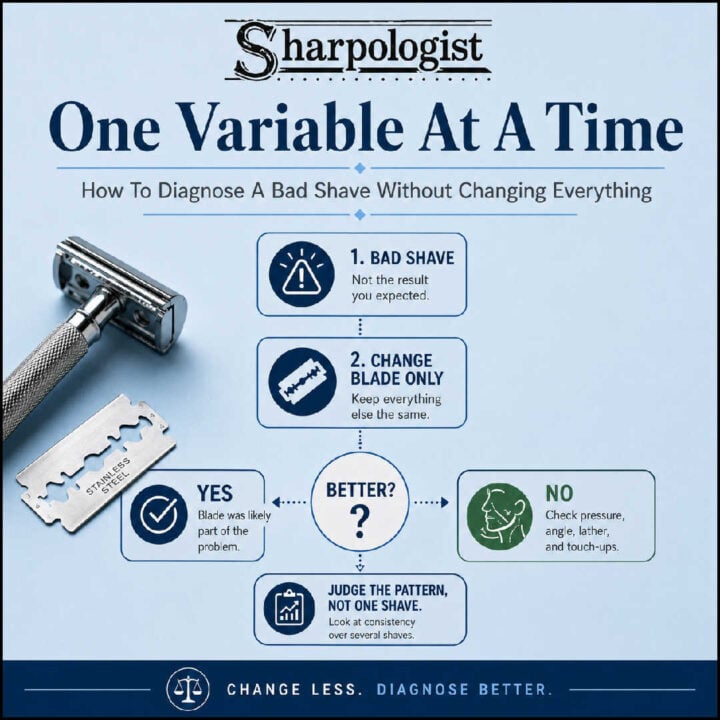
When the shave goes bad, start with Occam’s razor: the simplest reasonable explanation is usually correct. Avoid changing too much at once.
Replace the blade if it is obviously dragging, damaged, rusty, clogged, or far beyond its normal range. Blades are inexpensive compared with several days of irritation. There is no virtue in stretching a blade that has already stopped performing well.
If the new blade fixes the shave, the old blade was probably the main problem. Keep the rest of the routine stable for a few shaves before drawing broader conclusions.
If the new blade also feels bad, stop changing hardware for the moment. Keep the razor, blade brand, lather, pass structure, and aftercare consistent. Then reduce pressure, pay attention to angle, and avoid extra touch-ups in the areas that usually become irritated.
After a few shaves, look for the pattern. If every blade starts well and then becomes rough after a predictable number of shaves, you have useful blade lifespan information. If every blade feels bad in the same place, the problem probably lives in the shave conditions around that place.
That’s the diagnostic difference. A worn blade changes the tool. A technique problem repeats the pattern.
When To Replace The Blade Anyway
A diagnostic mindset does not mean using blades as long as possible.
Replace the blade when it changes behavior. Replace it sooner if your skin is sensitive, your beard is coarse, your razor exposes a lot of blade feel, or the shave starts requiring more pressure to produce the same result. Replace it immediately if the blade is damaged, rusted, or contaminated.
Storage and care matter, but they should not become another obsession. Rinse the razor well. Do not leave shaving residue packed around the edge. Let the razor dry. Avoid storing blades in conditions that keep them wet longer than necessary. Gillette’s guidance also points to moisture, residue, rinsing, drying, and storage as factors that affect blade life.
Still, care has limits. You can preserve a blade’s normal performance for a while, but you cannot make an edge last forever. Once the blade has changed, replacement is not failure. It’s maintenance.
For a more detailed look at blade testing, read How Blade Lifespan Really Works And How To Test It Without Wasting Money
What This Means For Experienced Wet Shavers
Experienced wet shavers are not immune to this mistake. In some ways, they are more vulnerable to it.
Experience usually brings more variables: more razors, more blades, more soaps, more brushes, more aftershaves, more opinions, and more confidence in interpreting face feel. That can improve judgment, but it can also make diagnosis messy. A shaver who changes three variables after one rough shave may never learn which variable mattered.
This is where blade testing becomes useful, but only when the shave is stable enough to interpret. A blade sampler can help a shaver find a better match, especially when one blade feels tuggy, another feels harsh, and another seems smoother in the same razor. But sampler testing works best when the routine stays consistent.
If each blade is tested with a different razor, a different lather, a different pass strategy, and a different level of pressure, the result is not really a blade test. It is just another shave with too many moving parts.
Conclusion: Replace Blades When They Change, But Diagnose The Shave Too
A dull blade is real. When a blade starts tugging, scraping, skipping, or requiring more work for the same result, replacing it is often the right move.
But a rough shave is not always a blade problem. Pressure, angle, lather, pass structure, beard direction, and repeated touch-ups can all imitate dull blade symptoms. If the same discomfort keeps returning with fresh blades, the blade is probably not the whole explanation.
The best approach is practical, not heroic. Replace blades when they stop behaving well. Then look at the shave itself when the same problem keeps coming back.
