
Introduction – Why Razor Feel Changes Even When Your Technique Does Not
You use the same blade. You follow the same routine. And yet one razor feels smooth while another feels harsh, even when the result looks similar.
That difference is often blamed on vague ideas like “aggressiveness” or dismissed as personal preference. In practice, it’s the same confusion most people run into when one razor suddenly feels harsh and another feels smooth without an obvious reason.
Razor feel is not random but a direct result of how the razor’s design controls how the blade meets your skin.
Quick Answer
Razor design determines how much of the blade interacts with your skin and at what angle, which directly controls blade feel. That same design also changes how efficiently hair is cut and how much margin for error you have during the shave. Blade feel is not just a sensation, it reflects how the razor behaves.
The Core Principle: Razor Design Controls How The Blade Meets The Skin
Blade feel is the result of how directly the blade is allowed to interact with your skin during the shave.
Change the design, and you change both what you feel and how the shave behaves.
The Three Razor Design Variables That Shape Blade Feel
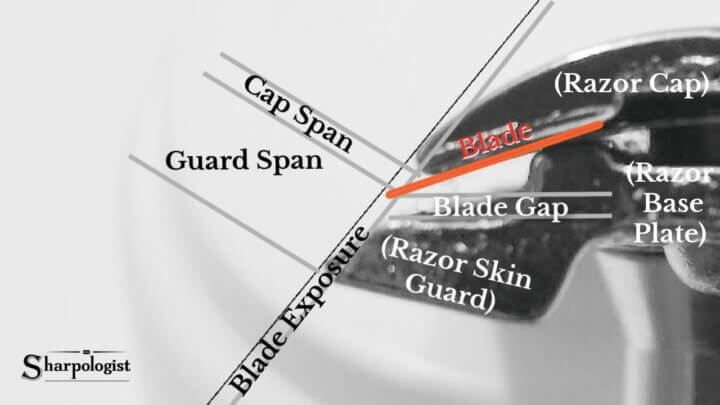
Blade feel is not created by a single factor. It comes from the interaction of three primary design variables.
Blade exposure refers to how far the blade edge extends relative to the razor’s safety bar or comb. When exposure increases, the blade has more direct contact with the skin, which increases blade feel.
Blade gap is the distance between the blade and the safety bar. A larger gap allows more hair and skin to reach the blade, which can increase cutting potential and change how blade feel is experienced, especially under pressure.
Head geometry includes the angle of the blade, the curvature created by the cap, and how the razor head guides contact with the skin. This determines how consistently the blade meets the skin and how easy it is to maintain a stable shaving angle throughout the stroke.
These variables work together to control how much of the blade interacts with the skin and how that interaction is perceived during the shave.
Why Blade Feel And Shaving Behavior Always Change Together
Blade feel is not just about sensation. It reflects how the razor is interacting with your beard and skin.
That interaction influences how efficiently hair is cut, but efficiency itself is a separate concept that describes how much hair is removed per pass.
When blade feel is higher, hair is cut more directly with less separation between the blade and your skin. While this often improves efficiency, it also reduces the margin for error. Small changes in pressure or angle become more noticeable.
When blade feel is lower, the razor relies more on repeated passes or subtle pressure to achieve the same result. This can feel smoother in the moment, but it may increase total skin exposure over the course of the shave.
This relationship is why discussions of comfort and closeness are inseparable. A razor that feels smoother is not always more forgiving over the entire shave. A razor that produces more blade feel is not automatically more irritating. Read Why Closeness And Comfort Don’t Move Together for more on this subject.
Why “Aggressive” And “Mild” Don’t Explain What’s Actually Happening
Terms like “aggressive” and “mild” are commonly used, but they compress multiple variables into a single label.
Two razors described as “aggressive” may feel completely different if one increases blade feel through blade exposure while another does so through gap and geometry. Likewise, a “mild” razor may feel smooth while still requiring more passes, which introduces its own risks.
These labels describe outcomes, not causes.
A deeper breakdown of blade exposure, gap, and geometry gives you a clearer explanation of why a razor behaves the way it does. This is especially important when comparing razors or troubleshooting inconsistent results.
The Threshold Model: When Blade Feel Becomes A Problem
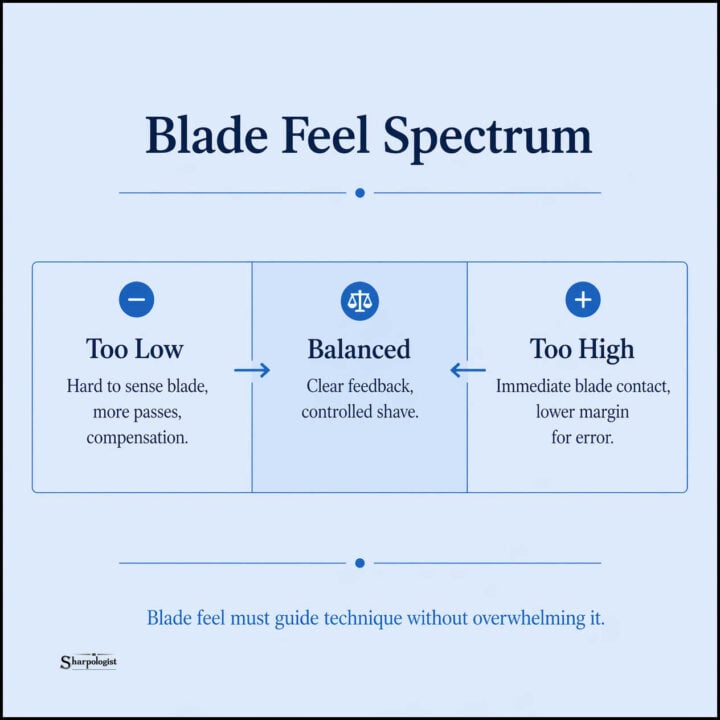
To understand when blade feel helps or hurts, it needs to be viewed as a range rather than a fixed characteristic. Blade feel exists on a spectrum, and problems tend to occur when you move too far in either direction.
When blade feel is too low, it becomes difficult to sense how the razor is interacting with your skin. Many shavers compensate by adding pressure or repeating strokes or passes. This increases total skin exposure and can lead to irritation, even if each individual stroke feels gentle. A shave can feel comfortable in the moment but still lead to irritation later. The adjustment feels correct while you are doing it, but the cumulative effect works against you.
When blade feel is too high, the blade becomes immediately noticeable. This increases the risk of irritation if pressure or angle is not well controlled. The shave becomes less forgiving, even if it’s more efficient.
Between these extremes is a range where blade feel provides useful feedback without overwhelming the shave. Finding that range depends on how the razor’s design interacts with your technique.
Blade feel only becomes useful when it is strong enough to guide your technique but not strong enough to punish small errors.
Observed Behavior: How Shavers Misread Razor Feedback
Across forums, reviews, and long-term user reports, the same patterns appear repeatedly.
Many shavers blame the blade when the issue is actually how the razor’s design changes blade feel. A blade that feels harsh in one razor can feel smooth in another because the way it contacts the skin has changed.
Others chase a smoother feel by switching to razors with lower blade feel, only to increase irritation over time through additional passes.
Another common pattern is switching razors frequently without adjusting technique. Because each design changes blade feel, the same approach does not produce the same result.
These patterns come from misinterpreting blade feel as a problem instead of a signal.
Experience Progression: How Blade Feel Is Interpreted Differently Over Time
Blade feel is often misunderstood early on because it is interpreted as something to avoid. Less experienced shavers tend to equate minimal blade feel with a better shave. The focus is on comfort in the moment, not the total effect on the skin.
As experience develops, blade feel becomes more informative. It signals whether the angle is correct, whether pressure is increasing, and how efficiently hair is being removed.
As consistency improves, blade feel becomes a form of feedback. It helps guide adjustments during the shave rather than being treated as a fixed characteristic of the razor.
Practical Implication: Matching Razor Design To Your Shaving Behavior
Razor design works best when it aligns with how you naturally shave. It shapes how the shave behaves, but technique determines how effectively you work within that design.
If you tend to apply pressure or favor quick passes, a design that produces more controlled blade feel can help reduce unintended irritation.
If you already use light pressure and maintain consistent angles, a design that produces more direct blade feel can improve efficiency without increasing risk.
The goal is not to find a universally better razor, but to understand how a razor’s design interacts with how you shave.
Conclusion – Blade Feel Is Feedback, Not Just Sensation
Blade feel is not just how a razor feels on your skin. It is a signal of how the blade is interacting with both hair and skin during the shave.
When you understand what creates that signal, you can interpret it more accurately. Instead of reacting to sensation alone, you begin to recognize how design influences behavior.
That shift turns razor choice from guesswork into a more controlled and predictable decision.
