
Introduction
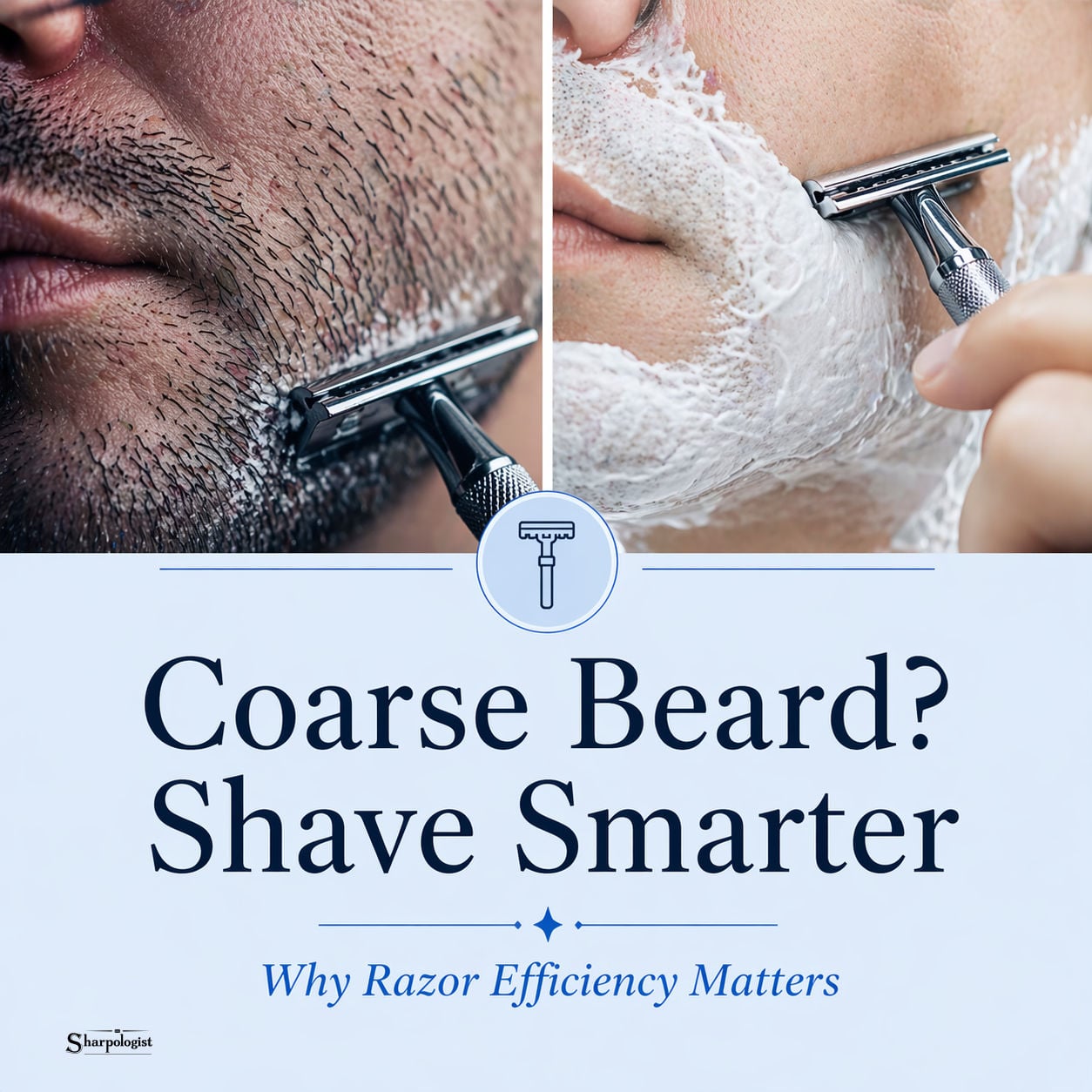
A coarse beard increases resistance during shaving, often causing tugging, extra passes, and irritation. You may feel tugging, extra passes, or finish with irritation even when your preparation is solid. The common response is to switch to a milder razor to “protect the skin.” In practice, that often makes the shave worse.
The problem is not comfort versus aggressiveness. It is how much hair the razor removes with each pass. When coarse stubble resists cutting, incomplete passes accumulate into more total skin contact and more irritation.
This guide is periodically updated to reflect current razor designs and real-world shaving performance.
Quick Answer
The best safety razors for coarse beards are efficient designs that remove more hair per pass and reduce cutting resistance. Open-comb, slant, and adjustable razors typically perform better because they clear dense stubble more effectively, requiring fewer passes and reducing overall irritation.
Why Coarse Beards Are Harder To Shave
Coarse beard here refers to hair that offers higher resistance during cutting, regardless of color or density pattern.
Coarse beard hair offers more resistance to the blade. Thickness and density both matter. Thicker hairs are harder to sever, and dense growth means the blade meets resistance more often during each stroke.
This is often more noticeable with grey or white beard hair, which can feel wiry and resist cutting even with good preparation.
The important point is what happens during blade contact. If the razor can’t remove enough hair in one pass, the shave becomes a series of partial cuts. That increases the total number of times the blade contacts the skin.
Why Mild Razors Often Struggle With Coarse Beards
Among experienced wet shavers, coarse beards are often associated with repeated passes using mild razors, followed by irritation on the neck and jawline. When switching to more efficient designs, many report fewer passes and more consistent results, even when initial blade feel is higher.
Mild razors limit blade exposure and reduce how directly the edge engages the hair. That can feel comfortable at first, but it also reduces how much hair is removed per stroke. On coarse beards, this leads to incomplete cutting.
The result is predictable. You need more passes to reach the same level of reduction. Each additional pass increases total skin contact. Over the course of a shave, this often produces more irritation than a slightly more efficient razor would.
Comfort during the first stroke is not the same as comfort across the entire shave. With coarse hair, the total number of passes becomes the dominant factor.
Why More Efficient Razors Can Improve Comfort
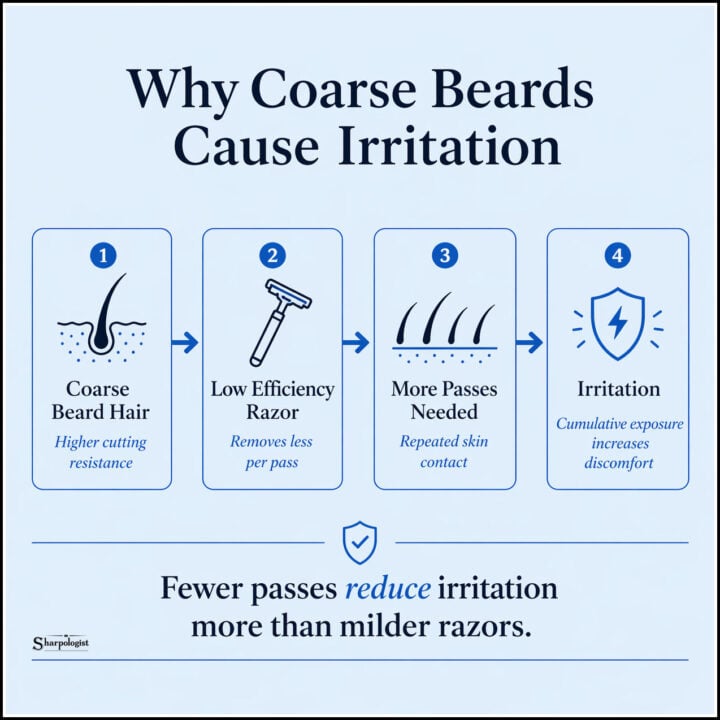
A more efficient razor reduces total skin contact by removing more hair per stroke.
This is the tradeoff many shavers miss. A more efficient razor may feel more present on the skin, but it also completes the work faster. Fewer passes means less cumulative exposure to the blade.
For coarse beards, reducing the number of passes is is typically the most reliable way to improve comfort. The goal is not to maximize smoothness in one stroke, but to complete the shave with fewer strokes overall.
While more efficient razors can feel more present on the skin at first, most users find that the reduced number of passes leads to less overall irritation once technique is adjusted.
Razor Types That Work Best For Coarse Beards
[Note: Amazon links for convenience and are affiliate. Geni.us links may be affiliate.]
The following razor types approach this problem in different ways. The goal is the same in each case: reduce resistance and improve how much hair is removed per pass. The recommendations below focus on designs that consistently reduce resistance and complete the shave in fewer passes.
Open Comb Razors
Open comb designs allow thicker stubble to reach the blade more directly without being flattened first . This reduces the tendency for hair to be flattened before cutting and improves performance on dense growth.
- Mühle R41
A high-efficiency open comb that removes dense stubble quickly. It is often chosen when milder razors require too many passes. It rewards careful technique but can significantly reduce total shave time on coarse beards. - Parker Open Comb Series
Parker’s open comb models share the same head design, with different handle styles and weights. More approachable open comb options that still provide strong cutting ability. These are a good choice if you want open comb efficiency with a slightly more forgiving feel.
For a more detailed comparison of how open comb and closed comb razors behave, see our guide to open comb vs closed comb razors.
Slant Razors
Slant razors change the angle of the blade relative to the hair. This creates a slicing action rather than a straight-on cut, which reduces resistance and minimize tugging.
- Merkur 37C / Merkur 39C
Proven slant designs that improve cutting efficiency on coarse hair. The 37C is lighter and easier to handle, while the 39C adds weight for those who prefer more momentum through the stroke. - RazoRock SuperSlant
A more modern slant design that combines efficiency with a smoother feel. This system offers multiple head configurations that change how efficiently the razor cuts, allowing you to tune performance to your beard. Often preferred by experienced users who want better refinement without sacrificing performance.
Adjustable Razors
Adjustable razors change how much blade is exposed, which directly affects how much hair is removed per pass. This can be useful when coarse growth requires higher efficiency early in the shave and less exposure during finishing work.
Adjustable razors approach this in two different ways. Some, like the Rockwell T2 Adjustable Razor or Parker Variant Adjustable Razor (there is also an open comb version), use a dial to change blade exposure during the shave. Others, like the Rockwell 6S, use interchangeable base plates with fixed levels of efficiency.
Dial-adjustable razors allow you to increase efficiency for initial passes and reduce it for finishing work. Plate-based systems are less flexible during a shave but often provide more consistent, repeatable results once you find the right setting.
How To Choose The Right Razor For Your Beard
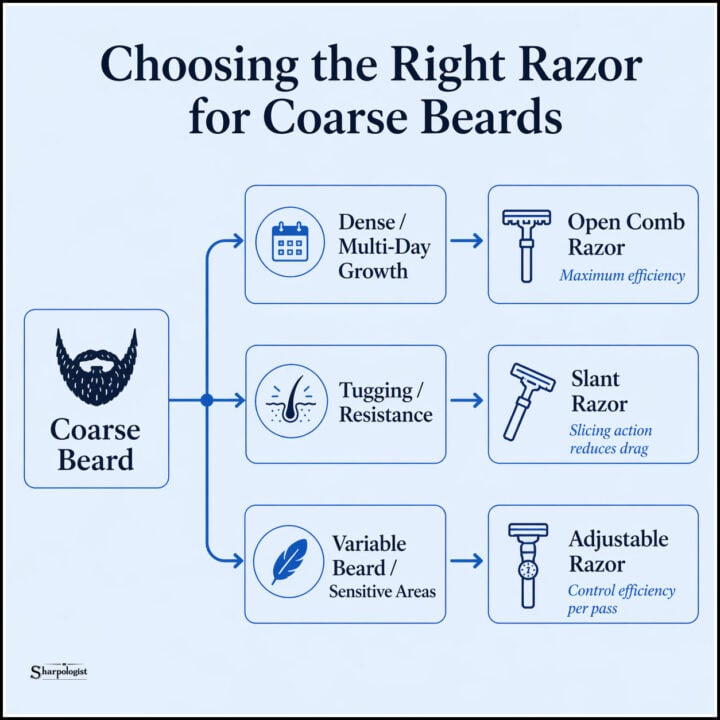
The right choice depends on how your beard and skin behave together.
If you regularly shave multiple days of growth, open comb designs often reduce it most efficiently. If you experience tugging even with sharp blades, a slant razor can improve how the hair is cut. If your beard varies across different areas of your face, an adjustable razor allows you to adapt your approach.
The decision is not about finding the most aggressive razor. It is about finding the level of efficiency that reduces passes without overwhelming your skin.
If you are unsure where to start, most coarse-beard shavers see the biggest improvement by moving to a slightly more efficient razor rather than a milder one.
As with any change in razor, there may be a short adjustment period as you refine your angle and pressure.
For a broader comparison across all razor types and performance characteristics, see our guide to the best safety razors.
Blade Choice Matters More With Coarse Hair
Blade sharpness plays a larger role with coarse beards. A sharper blade reduces resistance at the point of contact and allows the hair to be cut cleanly instead of bending.
This becomes especially relevant with grey or white hairs, which often require a sharper edge to cut cleanly rather than bend or tug during the stroke.
A less sharp blade in a mild razor increases the chance of tugging and incomplete cutting. That combination usually leads to more passes and more irritation.
For more detail on which blade might be best for you read Top Picks: Best Double Edge Razor Blades for Coarse Hair.
Signs Your Razor Is Not Efficient Enough
Certain patterns indicate that your current razor is not removing enough hair per pass.
- You feel tugging even with good preparation
- You need multiple passes to achieve acceptable closeness
- Irritation appears despite light pressure and proper angle
These are not always technique problems. They often indicate that the razor is not matched to the resistance of your beard and likely requires more efficient cutting than your current razor provides.
Technique Adjustments For Coarse Beards
Technique still matters, especially when using more efficient razors.
Angle control keeps the blade cutting cleanly rather than skipping across the surface. Light pressure prevents unnecessary irritation. Proper preparation softens the hair and reduces resistance before the blade touches it.
These adjustments support the same goal: reduce the total number of effective passes.
Common Mistakes With Coarse Beards
Several patterns make coarse beards harder to manage.
Choosing a mild razor in an attempt to avoid irritation often leads to more passes. Using blades that are too dull increases resistance during cutting. Adding passes instead of increasing efficiency compounds irritation.
Each of these increases total skin contact, even if each individual pass feels safer.
Conclusion
Coarse beards change the priorities of the shave. The goal is not to minimize blade presence at all costs. It is to complete the shave with fewer, more effective passes.
Efficient razor designs, paired with appropriate blades and controlled technique, do that more reliably.
FAQ
Are more aggressive razors better for coarse hair?
More efficient razors tend to work better because they remove more hair per pass. The benefit comes from reducing total passes, not from increasing aggressiveness alone.
Can a mild razor work for coarse beards?
It can, but it usually requires more passes. That increases total skin contact and may lead to more irritation.
What kind of blade works best for thick stubble?
Sharper blades generally perform better because they reduce resistance at the point of cutting.
Should I use an adjustable razor?
An adjustable razor can help if you want to vary efficiency across passes or across different areas of your face.

70 years old, hair grows all directions and different on each side of face/neck. Grew beards about 40 years as even electric razors didn’t work. Electrics got so expensive started blade shaving again 6 years ago. Learned my general hair directions and now shave with the grain, against the grain, and finally 45 degrees down from ear to chin with chin tucked down. Always used mild or adjustable razors with sharpest blades. I’d like to add respectfully to your recommended razor list the Merkur c15 open comb. Scared me to try but ended up being my grail razor! Open comb gets directly to hair but mild enough I can use daily if needed. I still use my other razors on occasion but usually reach for the Merkur first.
I am not sure that I have had a merkur 15C yet. I know I had the 41C so maybe both have the same head just different handles. I had the 41C several years ago before my face decided to become different. I may have to try the merkur again.
For electrics none of the standard types like foil or rotary were good in my bad spot. Matter of fact the rotary left me with significant ingrowns. I do have a foil razor that I use for under the nose ATG part but using it on my throat, it does not get close at all. Still get ingrowns.
The most frustrating part of DE are the blades. Sometimes I get lucky and shaves are great, next blade in the pack is just sad.
Wow, comments made me do more research as my 1st razor was a Merkur 34c and cut me to pieces. Now contribute that to being a “novice” and lack of knowledge about blades, beard direction, soaps, and preperation. Per AI, all Merkur “c” type razors (15c, 23c, 34c, 41c) use same head design but different handle lengths, diameters, and weights. BTW, “c” stands for chrome. Open comb is better for beards that are course, lay flat, longer, and crazy growth direction. Slant and adjustable heades do shave more aggressively due to direction of blade and blade gap respecitivly. Most “high efficent” razors tend to irritate my skin. Only tilt head I’ve tried is the old Atra razor and is great. Thanks everyone, now I understand! Bet Mantic59 has article somewhere about this too. 😁
this article comes at a time of where i am struggling a bit, especially for my throat region on the right side. being in my mid 50s i have a mix of both normal and white hairs. these hairs also lay mostly flat against my skin and seem to have a grain where they point up at around 2pm. on top of that there are several hairs that map in a different direction. oh, another factor is uneven skin (some minor valleys/pits). as of late i have had a difficult time shaving this region. i have had quite a few DE razors in the past but have dwindled down to a couple these days. i may need to try something else so looking for a suggestion. seems OC could be a benefit. i would avoid the R41 as that thing is not something the rest of my face would like as i shave daily. maybe back to supply SE. i also had tried older GEM style and still have blades on hand but i find those older handles to be not great. same with the blackland SE razor. it was ok but i am not going in that direction again.
Hello DB – Have you considered a razor with a pivot? The top of my rotation is Proof Razor’s Select 2.0. It uses 1/2 a standard DE blade and you can experiment with different blades to find a winning combination. There is a review on Sharpologist.com.
If you do not want to purchase a new razor, have you tried stretching your skin while you shave? Good luck mi amigo.
I did try the oneblade core razor (has a pivot you could say) when maggards had them on sale last year. Was not good for me. I don’t think the blades were that great. I have not heard of the proof razor before. What is the comparison between oneblade and proof? I have done a lot of skin stretching but the direction of my beard grain at my trouble spot is fairly odd. Also requires holding the razor in awkward way that is not easy. Weird angle, light touch, skin stretching is a bit much. I know people do it.
The Proof razor uses 1/2 DE blade vs. the OneBlade which uses a unique Feather Blade, and is thicker than a standard DE blade. OneBlade has started offering a carbon steel blade which they claim lasts several shaves, but I have not tried it.
If you have an ingrown hair problem, I used to get ingrown hairs and I started using a topical solution named Tend Skin. You can purchase it on Amazon.com. It’s a liquid and a cotton square is used to apply the product to the face. It may burn for a moment, but it dries quickly and it has helped me with my ingrown hair problem. Best of luck.
I have found using a razor with a thicker blade tends to go through coarse hair easier than a thinner blade. For example, an injector blade (Supply) or Artist Club blade (Blackland’s Vector) are thicker than a DE blade. Of course, YMMV.
This article affirms my recent experiences with my own beard. I’ve been wet shaving for 50 years and I thought I knew my beard better. I’ve always considered my beard to be average but, apparently things changed during the 10 years that I wore a full beard. I didn’t notice my beard becoming coarse because my shaving regimen was limited to straightening the margins. Thanks for validating my suspicions.