

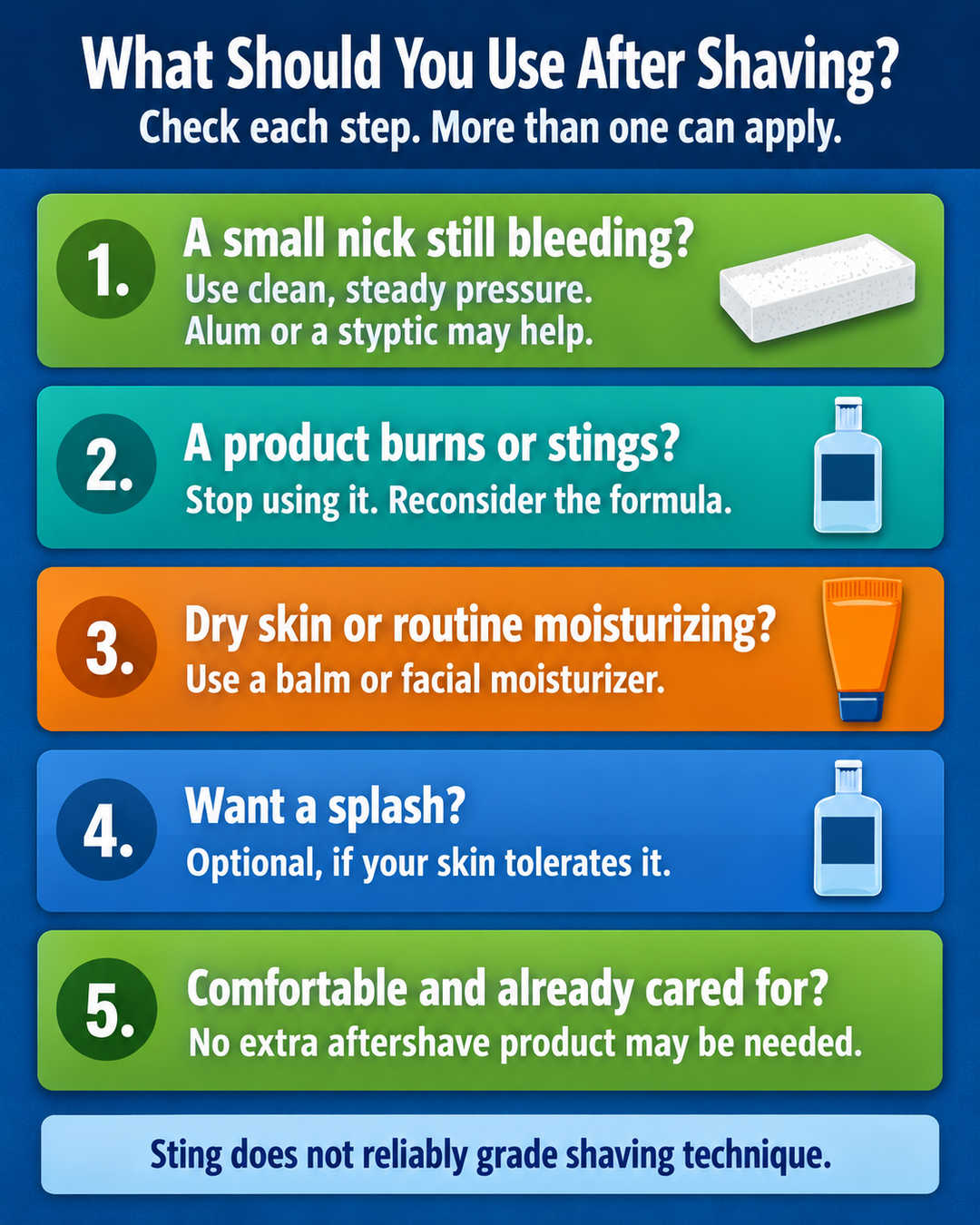
Quick Answer: Choose post-shave products by what they do and how your skin responds. Alum can help with small shaving nicks. A balm or facial moisturizer can support hydration, while a splash is an optional choice if you enjoy it and your skin tolerates it. Cooling or sting can provide subjective feedback, but neither reliably grades your shaving technique.
You don’t need to use all three. A comfortable routine may include one product, a useful combination, or no extra product beyond your usual skin care. Regular moisturizing is compatible with good technique; reducing the number of products you use is not a measure of progress.
Why This Question Keeps Coming Up
Post-shave products are often introduced as a bundle. A routine may include alum, a scented splash, and a balm without explaining why each step is there. It’s easy to assume that leaving one out means leaving the job unfinished.
The names add to the confusion. Aftershave is a broad category that includes balms as well as splashes and lotions. In this article, “splash” means a thin liquid aftershave, while “balm” means a cream or lotion used mainly for moisturizing and comfort. But the label alone won’t tell you everything a formula can do.
The useful starting point is your skin after rinsing, together with the care it normally needs.
What Each Product Is Actually For

Alum
Alum is an astringent, which produces a temporary tightening sensation. It can also help stop bleeding from small shaving nicks. Aluminum salts are used in styptic products for this purpose, although an alum block and a styptic pencil are not necessarily the same formulation. [1]
Some shavers notice that alum feels different from one shave to the next. Those observations may prompt a closer look at the routine, but strong sting does not identify excessive pressure, an incorrect angle, or too many passes. Conversely, little or no sting cannot confirm that the shave was ideal.
The Sharpologist alum block guide covers its application. Treat its discussion of cooling and sting as informal feedback rather than a dependable test of technique. You don’t need to add alum simply to assess your shave.
Aftershave Splash
A splash can provide fragrance and a light feel that some shavers prefer. Many traditional formulas contain alcohol; others do not. Some also contain moisturizing ingredients, so a thin texture does not automatically mean a product offers no hydration.
Alcohol can cause a burning sensation. That response involves the product and the skin it touches, so it cannot tell you on its own how well you handled the razor. You don’t need to seek a sting or endure it for the sake of feedback. Dermatology guidance recommends changing an aftershave that burns or stings. [2]
Balm Or Facial Moisturizer
A suitable balm or moisturizer can help skin retain moisture and feel more comfortable. This can be useful after shaving and as part of ordinary daily skin care. The American Academy of Dermatology recommends daily moisturizing, including application after shaving while the skin is still damp. [3]
A balm’s benefit depends on its formulation and your skin’s response. A randomized study of moisturizers on healthy forearm skin found that different formulations had different effects on the skin’s protective barrier. That supports choosing a product that suits your skin rather than assuming every balm performs alike. It does not mean everyone needs a separate post-shave product. [4]
If you want specific options, the Sharpologist aftershave balm guide compares products for different skin needs.
The Decision Tree
Work through these questions after rinsing. More than one answer can apply, so a useful routine could address a small nick and dryness separately.
- Is a small nick still bleeding? Deal with the nick first. Clean, steady pressure is a basic first step; an appropriate styptic or alum product may also help with minor shaving nicks. Follow its directions rather than applying it across your face to test for mistakes. Seek medical help for a deeper cut or bleeding that won’t stop. [1, 6]
- Does a product cause burning or stinging? Stop using it and reconsider the formula. If discomfort was already present before application, review the shave as well. Persistent, worsening, or recurring symptoms deserve medical advice; adding more products is not a substitute for identifying the cause.
- Does your skin feel dry or tight, or does your usual skin care include moisturizer? Use a tolerated balm or facial moisturizer. You don’t need to wait for visible irritation to justify moisturizing. If your skin is sensitive, mild, fragrance-free products are a sensible starting point. [3]
- Would you enjoy a splash? It can be an optional addition for fragrance or feel if it agrees with your skin. Its appeal does not depend on producing a burn. If you need moisturizing too, assess whether that formula provides enough or whether a separate moisturizer serves a clear purpose.
- Is your skin comfortable and already receiving the care it needs? You may not need an additional product marketed specifically for after shaving. There is no requirement to add alum, a splash, or a separate balm just to complete a conventional routine.
Where Witch Hazel Fits
Witch hazel is an ingredient used in different skin-care formulations, rather than a single uniform product. Some preparations may feel comfortable on your skin, but you can’t assume that every witch-hazel product is gentler than every alcohol splash or that it serves only as a milder feedback tool.
A controlled human study found anti-inflammatory effects from a particular witch-hazel formulation, with the cream’s base ingredients influencing the results. That finding cannot establish the performance of every bottle sold as witch hazel. Check the full formula, including alcohol and fragrance, and judge the product by its intended use and your own tolerance. [5]
When Combining Products Makes Sense

Using more than one product can be reasonable when each contributes something useful. You might treat a small nick locally, then moisturize the rest of your face. Or you may enjoy a comfortable splash and also prefer a moisturizer. Neither combination establishes that the shave was poor.
The difficulty comes when you add several unfamiliar products together and then experience discomfort. It becomes harder to identify which product disagrees with your skin. Introduce changes separately where practical, and keep the products that have a clear purpose.
Simplicity is useful when it makes the routine easier to understand or maintain. Choose the number of products by the jobs they perform and how your skin tolerates them.
Skin Care And Technique Both Deserve Attention
Experience can help you notice patterns, but dry skin, sensitivity, and the effects of weather still deserve attention. A skilled shaver may still benefit from daily moisturizing. Someone with naturally comfortable skin may prefer fewer products without that preference demonstrating superior technique.
If soreness begins during the shave or before any aftershave is applied, examine pressure, repeated strokes, and finishing passes. How Pass Strategy Affects Shaving Closeness And Comfort explains how those decisions affect the result. You can improve the shave while continuing to give your skin useful care.
Follow any specific advice from your dermatologist if you have a diagnosed skin condition. For the wider routine, The Correct Order Of A Men’s Skin Care Routine explains how the steps fit together.
Choose A Routine You Can Explain
A useful post-shave routine answers a practical need: attention to a nick, moisturizing, or an optional product you enjoy. Keep what works comfortably for your skin and reconsider what causes trouble. You can simplify without making bare skin the goal, and you can use a balm every day without treating that as a failure of technique.
Sources
[1] National Capital Poison Center. Are styptic pencils poisonous? Information on aluminum-salt styptics, minor shaving cuts, and possible irritation.
[2] American Academy of Dermatology. Razor bump remedies for men with darker skin tones.
[3] American Academy of Dermatology. Skin care tips for men.
[4] Buraczewska I et al. Changes in skin barrier function following long-term treatment with moisturizers, a randomized controlled trial. British Journal of Dermatology. 2007;156:492-498. Research abstract.
[5] Korting HC et al. Anti-inflammatory activity of hamamelis distillate applied topically to the skin. Influence of vehicle and dose. European Journal of Clinical Pharmacology. 1993;44:315-318. Research abstract.
[6] American Academy of Dermatology. How to treat minor burns and cuts.
