

Quick Answer: How to Identify a Vintage Razor. Most vintage safety razors can be identified accurately without knowing the exact model name. Start by determining the razor type (safety razor, straight razor, or injector), then note whether it is one-piece or multi-piece and whether it uses a solid bar or open comb. Next, look at head shape, guard style, and overall condition to judge shaving performance. Date codes, stamps, patina, and minor variants help confirm era or value, but they rarely affect how the razor shaves. If the razor aligns a blade properly and has no structural damage, identification is usually sufficient for everyday use.
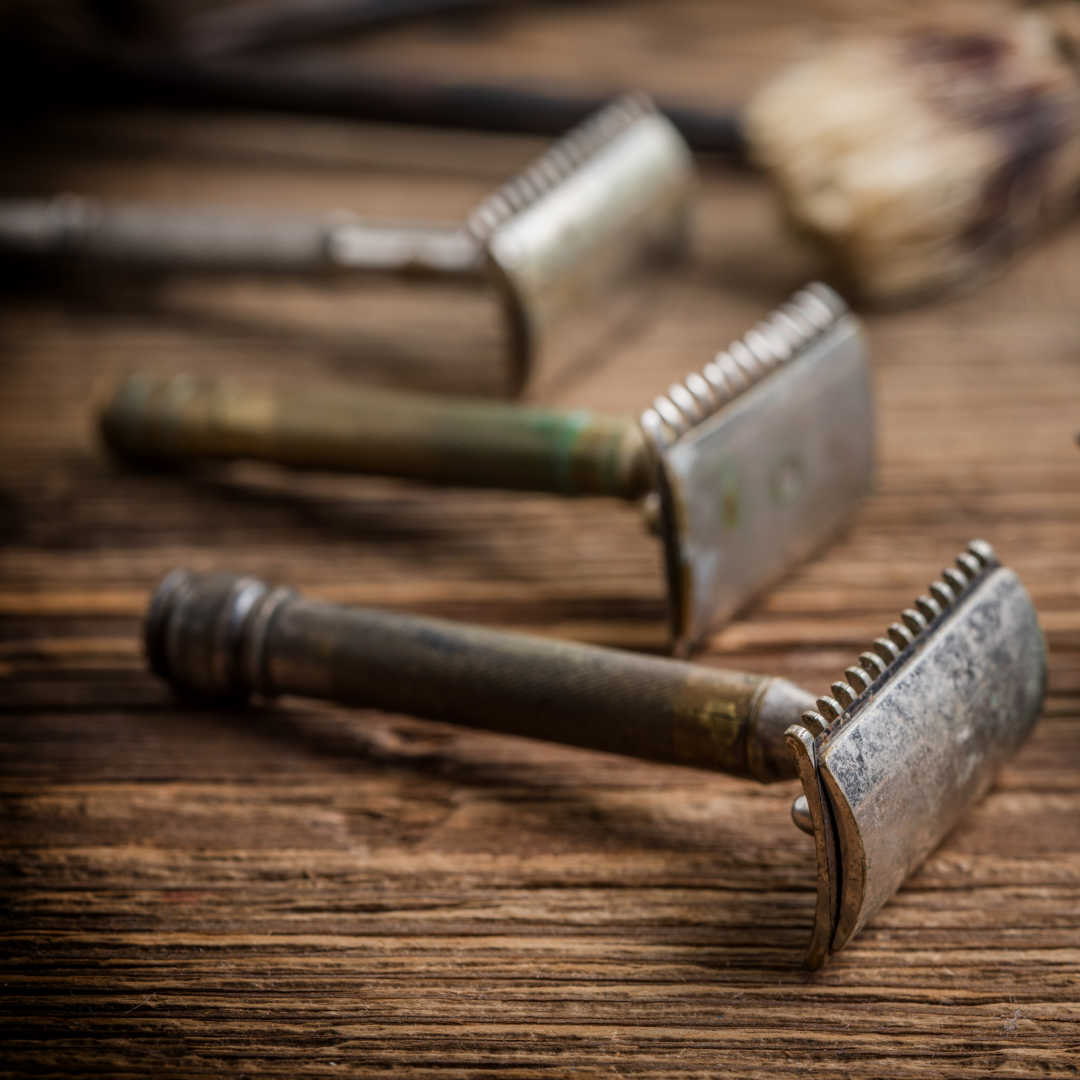
Why Vintage Razor Identification Feels Harder Than It Is
Vintage razor identification often feels overwhelming because people usually encounter it under pressure. That pressure might come from a blurry marketplace photo, a forum thread full of conflicting opinions, or the fear that they are about to miss something important (“FOMO”). In those situations, it is easy to believe that correct identification requires encyclopedic knowledge.
This belief is reinforced by online discussions that emphasize rarity, variants, and production minutiae. The result is anxiety rather than clarity. In reality, most vintage razors fall into a small number of broad families, and most of the details people argue about do not meaningfully affect how a razor shaves.
The purpose of identification is not perfection. It is confidence that you understand what you are holding well enough to decide what to do next.
Start With the Razor Type, Not the Model Name
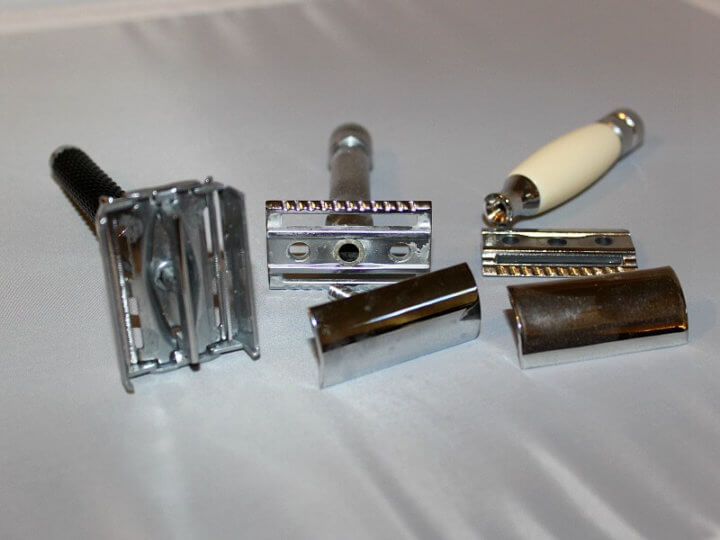
This article focuses primarily on vintage safety razors, which make up the majority of identification questions.
The most effective way to simplify vintage razor identification is to ignore branding at first and focus on function. Before looking for stamps, logos, or dates, identify what type of razor you are dealing with. Most vintage razors encountered today fall into a few categories. The majority are:
- Safety razors (which may be one-piece, two-piece, or three-piece designs.)
- Straight razors (which follow an entirely different identification logic).
- Injector or single-edge safety razors that use proprietary blade formats.
Once you know the type of razor you are dealing with, determine broad subcategories such as whether a safety razor uses a solid bar or an open comb and whether the head is a single integrated unit or assembled from multiple parts. This functional classification immediately narrows the possibilities and removes much of the uncertainty.
The Visual Features That Matter Most
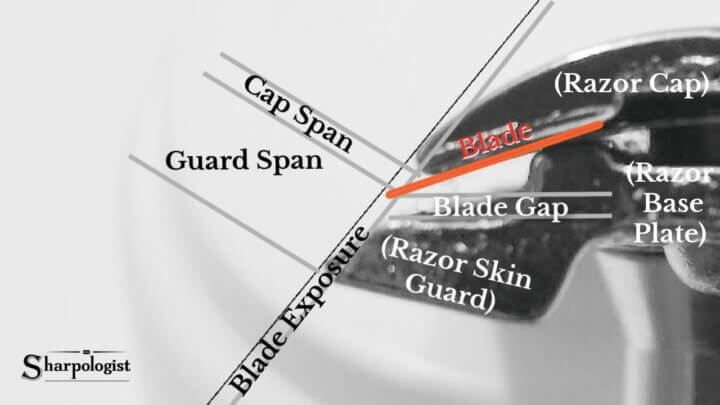
After determining the razor type, a small number of visual cues can do most of the remaining work. Head geometry is one of the most important. The shape and curvature of the cap often reflect the design philosophy of the era and may have more influence on shaving feel than brand markings.
These features determine how the razor holds and presents the blade, which is far more important for shaving performance than branding or production trivia.
The guard style is another strong indicator. Whether the razor uses a solid bar, an open comb, or a hybrid design quickly places it within a recognizable family of razors. Handle proportions also provide clues, though they should be treated cautiously. Handles are frequently swapped over decades of use, so they support identification rather than define it.
When these three features are considered together, most razors become far easier to place without resorting to catalogs or model lists.
A Simple Identification Checklist
Before going any further, it helps to pause and confirm that the basics are covered. Ask yourself whether you know what type of razor it is, whether it uses a solid bar or open comb, how the head is constructed, and whether there is any visible damage that would affect shaving. If you can answer those questions, you already understand the razor well enough to make practical decisions.
At this point, deeper research should be optional rather than mandatory. If you can answer these questions confidently, you are already past the point where most identification threads stop being useful.
Date Codes, Stamps, and Markings Without Obsessing
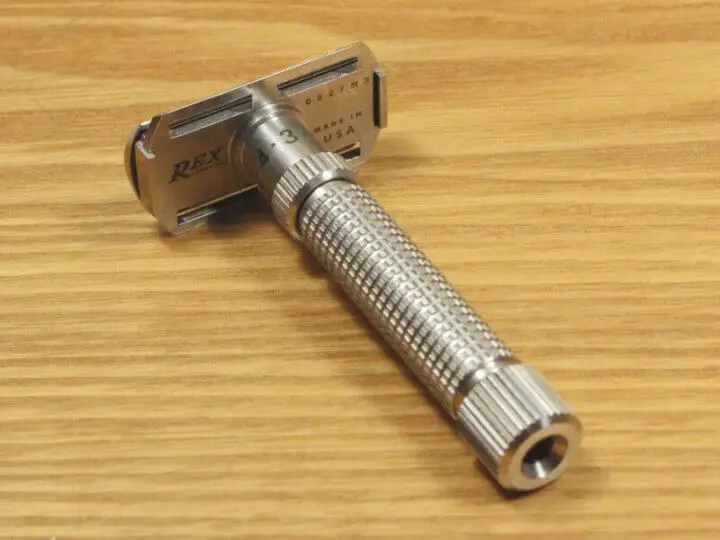
Many vintage safety razors include stamps or markings that can help place them within a general era or confirm a manufacturer. These markings are useful for historical context, but they can be misunderstood.
Date codes and serial numbers rarely tell you how a razor will shave. While they may confirm when and where something was made, they do not determine whether it suits your skin or technique. Faint, missing, or worn markings are common and do not automatically reduce a razor’s usefulness.
If decoding stamps feels like work rather than clarification, it is a sign that you have already gathered enough information.
Brand Specific Cues and When They Matter
Some manufacturers used structured marking systems that are well documented today. Gillette is the most common example, with letter and number codes that indicate production year and quarter, as well as logo changes that help place razors within specific time periods. Some modern razor manufacturers, including Rex Supply and Karve, have continued this marking technique.
Schick did not use a consistent marking system but model information based on visual design is certainly available.
These systems are helpful once you already know the razor family. They should not be the starting point. Brand specific decoding works best as confirmation rather than discovery. When used too early, it tends to increase confusion rather than resolve it.
Patina, Plating, And Wear (What The Color Really Means)

One of the most common identification panic points is surface appearance. Many people encounter a razor that appears copper colored or unevenly finished and assume something is wrong.
In most cases, the explanation is simple. Patina is a natural surface change that occurs over time and is usually cosmetic. Plating wear is also common and reflects decades of use rather than damage. True corrosion, which affects structural integrity, is far less common.
For shaving purposes, what matters is whether the razor aligns the blade properly and whether any structural damage is present. Cosmetic issues rarely affect performance. Surface appearance causes far more anxiety than it deserves.
Shaving Performance Versus Collector Significance
Separating shaving performance from collector value removes much of the stress around identification. Features that affect shaving include head geometry, blade exposure, alignment, and structural soundness. Features that affect value include exact production year, minor variants, original cases, and cosmetic condition.
A razor can be unremarkable to collectors and excellent for daily use. These two things are not in conflict.
Common Identification Traps
Certain habits consistently make identification harder than it needs to be. For example, two razors that shave identically can be debated endlessly online because of minor cosmetic or production differences. Chasing exact production variants, assuming heavier razors are automatically better, or treating rarity as a proxy for performance rarely leads to better decisions. Allowing forum debates to override direct inspection is another common mistake.
If the process of identification increases anxiety rather than confidence, it is time to stop.
When Identification Is Good Enough
Identification is complete when you understand how the razor is likely to shave, know whether any issues affect use, and can decide whether to buy, restore, or shave with it. Absolute certainty is not required, and consensus is not necessary.
At some point, the correct next step is to load a blade and shave.
When It Is Worth Going Deeper
There are situations where exact identification matters more. Restoration projects, collector-level purchases, or documentation of a personal collection may justify deeper research. For everyday shaving decisions, however, additional detail often provides diminishing returns.
A Simple Rule to Remember
Identification is a tool, not a test. If the razor shaves well, you identified enough.

I want to add that no matter how dirty or corroded an old razor looks, most of them are bullet proof and can be restored to a fantastic state with a little work, so please don’t throw them away.
The site I got this from is gone.
1a. If it can be disassembled into more than one piece, go to 2.
1b. If it is a one-piece razor, go to 6.
THREE-PIECE RAZORS:
2a. If it has teeth, go to 3.
2b. If it has a solid guard bar, it is a Tech.
3a. If the blade is held in place with cones that go from the cap through the base, go to 4.
3b. If the blade is not held in place with cones going from the cap through the base, go to 5.
4a. If the bottom plate of the head is curved to match the cap, it is an Old Type.
4b. If the bottom of the head is flat, it is a New Improved.
5a. If it has pins that go upward from the base into the cap, it is a Goodwill.
5b. If the blade is held in place with a raised bar under the cap that fits in a slot in the base, it is a NEW.
ONE-PIECE RAZORS:
6a. If it has a solid guard bar, go to 7.
6b. If it has teeth, congratulations, you have a comparatively rare razor. Check out these One-Piece Open-Combs and see if you can’t figure out which one it is.
7a. If it has a numbered ring on the handle, you have an Adjustable. Go to 8 for more information.
7b. If it does not have a numbered ring on the handle, it is likely a Super Speed (US), a Rocket (UK), or one of their derivatives. Check out these One-Piece Guard-Bar razors and see which one it is.
8a. If the handle is coated in black resin, you have a Super Adjustable (1968-1988). The SA is also known as the “Black Beauty.” It came in two handle lengths, short (84mm) and long (109mm).
8b. If the razor is all metal and the knurling on the adjustment ring matches the knurling on the handle, you have a Slim (1961-1967).
8c. If the razor is all metal and the knurling on the adjustment ring consists of simple vertical lines, you have a Fat Boy (1958 – 1961). Rare (and collectible) Fat Boy variants include the Bottom Dial (adjustment dial near the bottom of the handle), the Red Dot (dot painted on handle instead of a hole through which the detent spring can be viewed) and the Toggle (razor opens and closes with a toggle instead of a knob).