
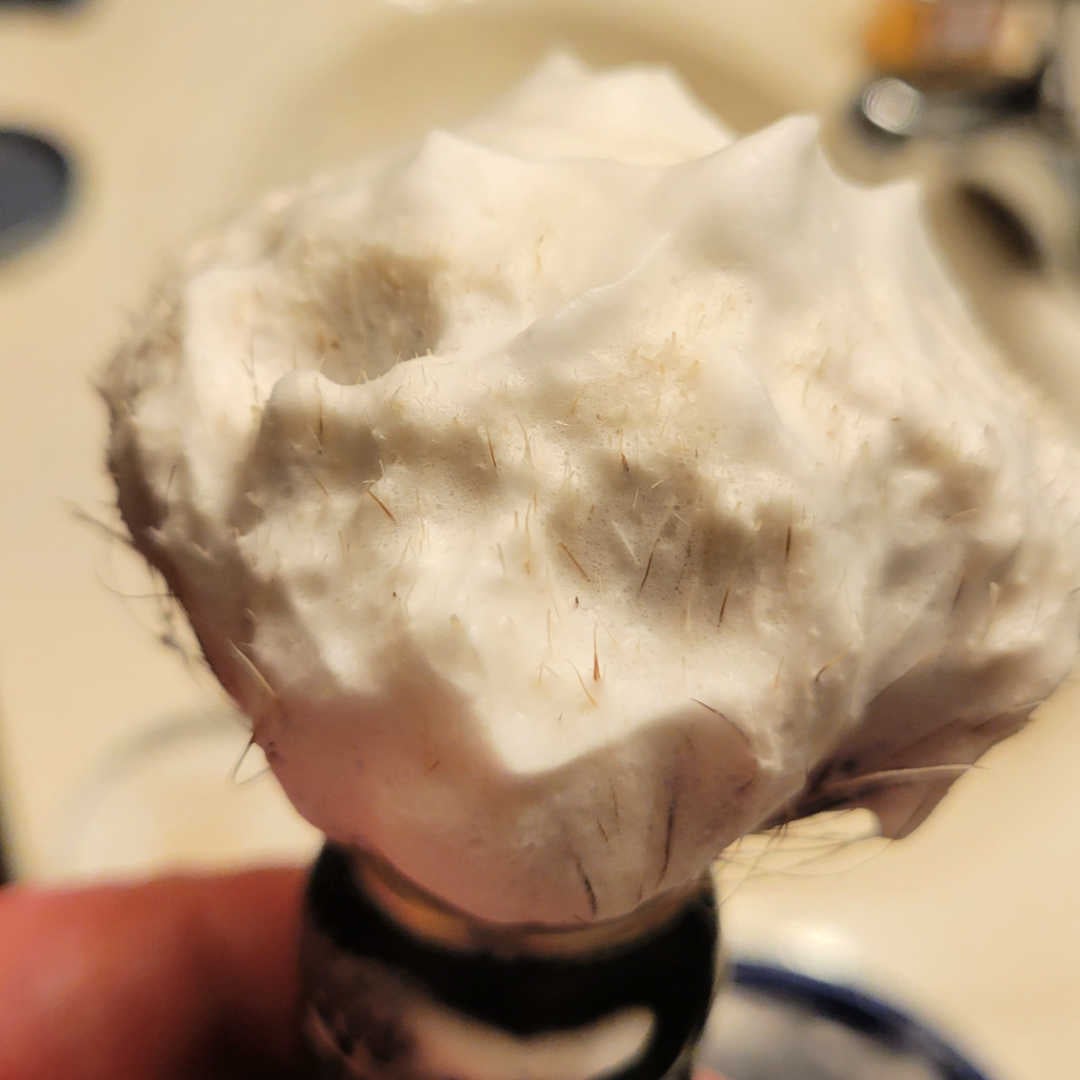
Shaving lather is often initially judged by its look. A dense layer, glossy surface, or lots of volume can make a lather look finished and protective.
But performance matters more than appearance.
A shaving lather has to keep working while the razor moves through beard growth, changes direction, and removes the visible layer of stubble from the skin. Some impressive-looking lathers resist the razor or dry before the shave is complete. Other lathers look comparatively light but provide excellent lubrication and predictable razor movement.
The main question is whether the lather is doing its three main jobs: maintaining hydration, reducing friction, and supporting controlled blade contact.
Quick Answer: What Does Shaving Lather Do?
Shaving lather works by keeping beard hair hydrated, reducing friction during razor movement, and creating a stable contact environment between the razor and skin. These functions make the hair easier to cut and help limit unnecessary drag, pressure, and repeated strokes.
Lather improves the conditions of the shave, but it can’t make excessive pressure, unstable angle control, or repeated blade contact harmless. Good lather supports sound technique rather than replacing it.
The Three Main Jobs Of Shaving Lather
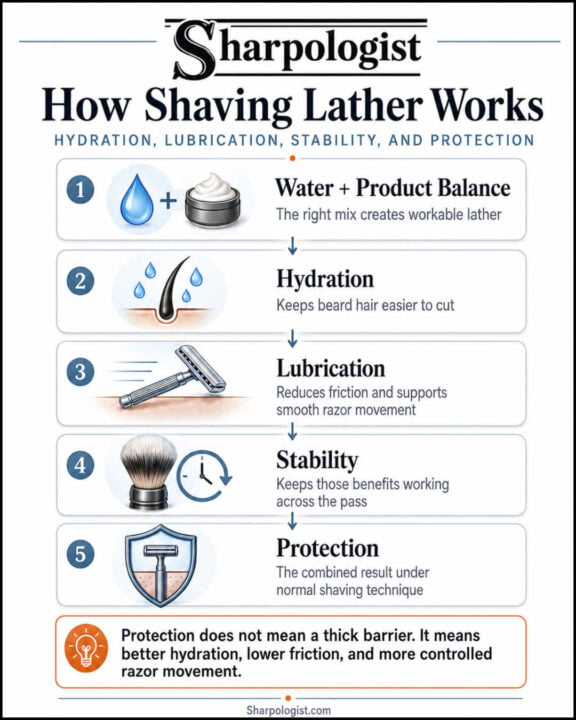
Hydration, lubrication, and protection are often discussed as separate product qualities. But during a shave, they depend on each other.
Hydration affects the beard hair and the behavior of the lather. Lubrication affects friction and razor movement. Protection describes the combined result when the lather keeps the hair hydrated, allows the razor to move consistently, and remains useful long enough to complete the pass.
| Lather Function | What It Changes | What Failure May Feel Like |
|---|---|---|
| Hydration | Beard cutting resistance and lather flexibility | Tugging, rapid drying, or paste-like lather |
| Lubrication | Friction and razor movement | Drag, skipping, or uneven strokes |
| Stability | Performance over time and across passes | Collapse, drying, or disappearing slickness |
| Protection | Skin exposure under normal shaving technique | Increasing warmth, tightness, or discomfort |
These symptoms aren’t exclusive to lather. Tugging may also involve blade condition or cutting angle. Drag may come from pressure, razor geometry, or an unsuitable blade. The table is a way to organize diagnosis, not a set of carved-in-stone rules.
Hydration Changes The Hair Before The Blade Cuts It
Beard hair is harder to cut when it is dry. Water penetrates the hair fiber and changes its mechanical behavior, reducing the force needed to cut it. The exact reduction depends on the hair, exposure time, temperature, and testing method, so dramatic numerical claims should be treated cautiously. The general relationship is well established: properly wetted hair is easier to cut than dry hair.
Preparation begins this process, but the lather has to help maintain it.
A wet face followed by a dry or overly concentrated lather can lose that advantage during the shave. Water evaporates, the product becomes more concentrated, and the lather begins to resist movement. This is one reason the first part of a pass may feel comfortable while later areas feel stickier or less cooperative.
Hydration doesn’t just mean that the lather contains visible water. A lather may appear wet on the surface while lacking enough water to remain flexible and lubricating. Another may contain so much water that it collapses before it can provide stable performance.
The useful balance is enough water to maintain the hair and lather in a workable condition, with enough product to hold that water and create a persistent lubricating layer.
Pre-shave preparation determines the starting condition of the beard. Lather determines whether that condition is supported while the shave is taking place.
Lubrication Controls Friction And Razor Movement
Lubrication reduces resistance as the razor moves across the shaving surface.
That doesn’t mean the razor should feel disconnected from the skin: you still need feedback about angle, growth direction, and cutting action. Effective lubrication allows that feedback to remain clear without forcing the razor through a sticky or uneven product.
Several familiar terms describe parts of this:
Lubrication is the reduction of friction.
Slickness is the practical low-friction quality the shaver experiences.
Glide describes how easily and consistently the razor moves.
These terms are related, but they aren’t necessarily interchangeable. Lubrication is the underlying function. Slickness is a performance quality. Glide is the behavior that becomes noticeable during the stroke.
Poor lubrication often changes technique before the shaver consciously identifies the problem. When the razor hesitates, the natural response is to add pressure, lengthen the stroke, or repeat the stroke over the same area. Those adjustments may get the razor moving, but they also increase blade contact and reduce the margin for error.
This is why a lather problem can become a pressure or repetition problem. The lather did not directly cause every part of the irritation. It created resistance, and the shaver compensated for that resistance in a way that increased exposure.
Lubrication then matters beyond comfort. It helps the shaver control movement and avoid corrective behavior that makes the shave less predictable.
Visible Lather And Residual Slickness Are Not The Same Thing

The razor removes most of the visible lather during a stroke. Some lubrication may remain behind.
That remaining lubrication is commonly called residual slickness. It can support a little overlap between strokes, minor directional adjustments, or careful work in areas where the visible coverage has thinned.
Residual slickness does not make bare-skin buffing harmless. It simply means the surface does not become completely unlubricated the moment the visible lather is removed.
That distinction helps explain why two lathers can appear equally substantial but behave very differently. One may leave a useful lubricating film after the razor passes. Another may feel abruptly dry once the visible layer is gone.
Residual slickness also affects the transition between passes. When the first pass rinses away cleanly and the skin immediately feels dry or resistant, the next application may have to restore more than visible coverage. A lather that retains some lubrication can make relathering and subsequent passes feel more consistent.
Experienced shavers often recognize this quality by touch, but it’s easy to misuse. The presence of some remaining slickness can encourage extra cleanup strokes because the surface still feels workable.
The limits of skin exposure have not disappeared. The visible lather is only one part of the equation, and lubrication does not erase the effect of repeated blade contact.
What Lather “Protection” Actually Means
Protection may be one of the most common and least precise words used to describe shaving lather.
It can sound as though the lather creates a physical cushion that keeps the blade away from the skin. That is not how wet shaving works. The razor still contacts the shaving surface, and the edge still has to reach the beard hair.
A protective lather:
- helps maintain beard hydration
- reduces friction
- supports stable razor movement
- limits the temptation to use compensating pressure
- remains useful across the time needed to complete the pass
- reduces the need for unnecessary corrective strokes
Protection is a combined performance result, not a separate wall of lather.
The distinction matters because a thick lather can create a strong sensation of separation without providing good lubrication. The razor may ride through a dense layer while the lather underneath becomes sticky or resistant. The shaver feels plenty of product but does not get the low-friction movement normally associated with protection.
The opposite can also happen: a relatively low-volume lather may provide excellent slickness, remain hydrated, and allow precise razor movement. It may not look heavily cushioned, but it can still manage normal blade contact effectively.
Good lather increases the operating margin of the shave but it can’t make the margin unlimited.
Excess pressure still increases force against the skin. An unstable angle can still expose the edge poorly. Additional passes and touch-ups still add cumulative contact. Lather can reduce friction during those actions, but it can’t cancel their mechanical effect. Lubricating products are commonly recommended to reduce shaving friction and abrasion, but technique and repeated contact remain important parts of irritation control.
Cushion Is Useful Language, But An Imprecise Measurement

Wet shavers use the word “cushion” because it describes a real sensation. Some lathers feel as though they provide more body or support between the razor and the skin.
The problem is not the word itself. The problem appears when cushion is treated as proof of protection.
Depending on the speaker, cushion may refer to:
- density
- volume
- resistance to collapse
- perceived separation
- structural body
- softened blade feel
Those qualities can be useful, but they don’t automatically indicate that the lather is well hydrated or highly lubricating.
A dense lather may provide excellent slickness. Another dense lather may be underhydrated and resistant. A thinner-looking lather may lack stability, or it may provide exceptional glide and residual slickness.
Cushion should therefore remain a descriptive term rather than a complete performance measurement.
Cushion can describe how a lather feels, but it does not prove that the lather is well hydrated, highly lubricating, or protective.
The most useful evaluation combines sensation with behavior. Does the razor move consistently? Does the lather remain flexible? Does it dry during the pass? Does it leave useful residual slickness? Does the shaver have to add pressure to overcome resistance?
Those questions reveal more than volume alone.
Why More Product Is Not Always More Protection

When a lather feels weak, adding more soap or cream seems like the obvious correction.
The logic is understandable. More product produces more density, stronger visible structure, and often a richer-looking lather. It may also improve stability when the original mixture contains too little product.
But more product does not automatically create better product.
When the product concentration becomes too high relative to the available water, the lather can become pasty. It may cling heavily to the skin, dry quickly, or resist the razor. The surface looks substantial, but the razor does not move freely.
This can create a misleading form of protection. The shaver sees a thick layer and assumes the skin is well buffered, then uses more pressure when the razor begins to drag.
The lather has plenty of body but it lacks the balance needed to perform.
Too little product creates a different problem. The lather may be bubbly, loose, or short-lived. It may initially feel wet and slick but collapse quickly or fail to maintain lubrication across the pass.
The goal is a product-and-water mixture that retains useful hydration, reduces friction, and remains stable during the time it takes to shave.
That balance varies among soaps, creams, brushes, water conditions, and lathering methods. A fixed recipe is less useful than learning how the lather behaves as water or product is added.
Stability Matters Across The Whole Shave
A lather that works well right after its applied may not continue to work well.
Time changes the mixture: water evaporates, dry air can accelerate moisture loss, a slowly completed pass gives the lather time to change character.
Later passes may also expose the skin to different conditions. Much of the beard has already been reduced, the visible lather is thinner in some areas, and the skin has already experienced blade contact.
That makes stability important.
A stable lather maintains enough hydration and lubrication to remain useful through the intended pass. It doesn’t need to look the same from beginning to end, but it shouldn’t suddenly become sticky, flaky, or resistant.
The lather in the brush or bowl matters as well. A mixture that gradually dries between passes may produce a noticeably worse second application, even though the shaver has not changed the razor or technique.
Refreshing the lather can be enough. A small amount of water and brief reworking can restore flexibility and glide. Rebuilding everything from the beginning usually isn’t necessary.
The practical lesson is to evaluate lather over time, not only when it first reaches the face.
Why Good-Looking Lather Can Still Shave Poorly
Lather appearance is useful because it can reveal obvious problems. Large dry bubbles may indicate instability. A dull, cracked surface may indicate drying. A mixture that immediately runs off the face may lack sufficient structure.
But visual clues become less reliable once the lather looks broadly acceptable.
A glossy lather can still be too dense.
A thick lather can still lack residual slickness.
An airy lather can look abundant but collapse under the razor.
A creamy lather can dry on the face before the pass is complete.
A wet-looking lather can contain enough surface water to shine without maintaining useful hydration through its full depth.
This is why photographs and visual demonstrations can only go so far. They show appearance at one moment. They don’t show how the razor moves, how quickly the lather dries, or what remains after the visible lather is removed.
Functional evaluation is more useful:
- Does the razor move without hesitation?
- Does the lather remain flexible?
- Does it support a controlled stroke without encouraging pressure?
- Does useful slickness remain after the visible layer is removed?
- Does performance remain consistent across the pass?
The related article What Good Lather Actually Feels Like goes into a deeper sensory evaluation. The principle here is simpler: appearance can support diagnosis, but it cannot substitute for performance.
How To Identify Which Lather Function Is Failing
Lather problems often produce similar symptoms to blade or technique problems. Diagnosis works better when the shaver treats the symptom as a clue rather than a verdict.
| What The Shaver Notices | Possible Lather Problem | Other Variables To Check |
|---|---|---|
| Tugging despite a fresh blade | Inadequate beard hydration or drying lather | Growth length, blade fit, or cutting angle |
| Razor drag or skipping | Low lubrication or overly dense lather | Pressure, blade condition, or razor geometry |
| Lather disappears quickly | Weak stability or excess water | Product load or brush behavior |
| Lather becomes sticky | Water loss or excessive product concentration | Shaving time or room conditions |
| Skin feels increasingly exposed | Loss of lubrication or excessive repetition | Pressure, pass count, or touch-ups |
| First pass feels good, later passes worsen | Drying or insufficient refreshing | Skin exposure or pass strategy |
The pattern matters more than a single stroke.
If the razor moves well at the beginning of each freshly lathered area but begins dragging after the lather sits for a minute, drying becomes a likely factor. If the same resistance appears immediately with multiple known-good lathers, the blade, angle, or razor deserves more attention.
A lather problem should follow the lather.
When the symptom remains unchanged despite correcting hydration and lubrication, continuing to add water or product may only complicate the diagnosis.
A Practical Order Of Operations For Lather Problems
When a lather is not performing correctly, change the smallest plausible variable first.
1. Check Whether The Lather Is Drying
Look for a change in texture, flexibility, or razor movement as time passes. Refreshing the lather or adding a small amount of water may restore performance.
2. Pay Attention To Razor Movement
The razor should move consistently without requiring extra force. If resistance is encouraging pressure, stop and correct the surface rather than pushing through it.
3. Check The Product-To-Water Balance
A paste-like lather often needs water. A mixture that collapses immediately may need additional product, more working time, or both.
4. Compare Against A Known-Good Lather
When drag, tugging, or irritation remains with a familiar and properly prepared lather, investigate blade condition, razor design, angle, pressure, or repetition.
5. Change One Variable At A Time
Changing the soap, brush, blade, water amount, and shaving technique together may produce a better shave, but it will not reveal what solved the problem.
Why Lather Problems Persist dives deeper into the troubleshooting path.
What Lather Cannot Fix
Lather can improve a large part of the shaving environment. It cannot compensate indefinitely for every problem within it.
Even excellent lather cannot fully correct:
- excessive pressure
- unstable shaving angle
- a damaged or unsuitable blade
- repeated strokes over the same area
- an unrealistic closeness target
- poorly prepared long or resistant growth
- a technique that depends on lather thickness to control the razor
This limit does not make lather less important: it clarifies its role.
Lather gives the razor better working conditions. It helps the shaver move with less resistance and maintain more consistent contact. It also increases the margin available for small variations in the shave.
Once pressure, repetition, or angle error exceeds that margin, more lather cannot restore the exposure that has already occurred.
This is why “protective” should never mean “mistake-proof.”
The Better Standard For Shaving Lather

Good shaving lather should perform consistently, not just look impressive. It should maintain useful hydration, allow controlled low-resistance movement, remain stable long enough to complete the shave, and provide some lubrication after the visible layer has been displaced.
It should also support technique without becoming a substitute for it.
The thickest lather is not automatically the most protective. The glossiest lather is not automatically the slickest. The largest volume is not automatically the most stable.
The better lather is the one that performs its functions throughout the actual shave:
- beard hair remains workable
- razor movement remains controlled
- friction stays manageable
- the lather does not dry prematurely
- normal blade contact does not require compensating pressure
- performance remains predictable across passes
Once those conditions are present, further pursuit of visual perfection may add little.
Shaving lather works best when it becomes part of a controlled process rather than the main event. It prepares the cutting environment, supports the razor, and helps the shaver preserve a reasonable margin.
That is what lubrication, hydration, and protection mean in practice.
