

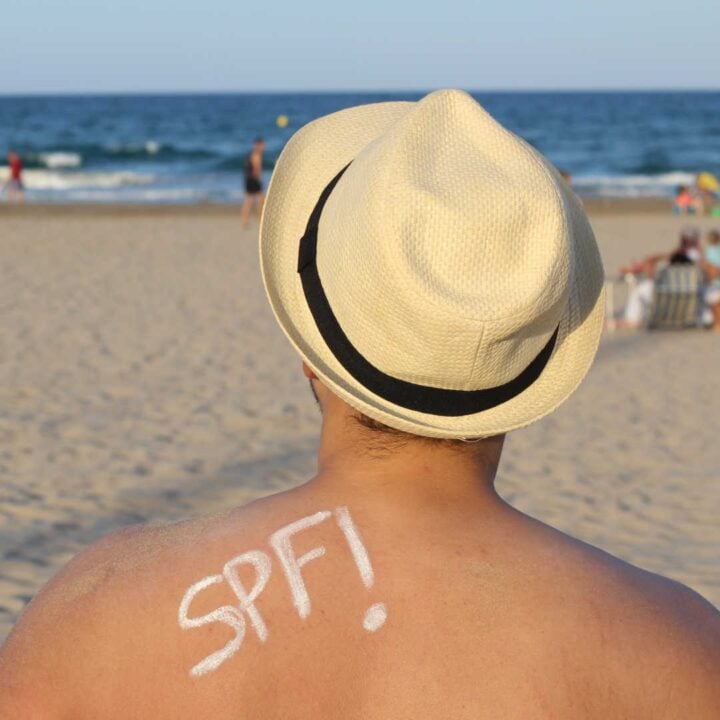
Welcome to summer! Here in the United States, we just celebrated Memorial Day – the unofficial start to summer. Given how early Memorial Day came this year, and how late Labor Day, the unofficial end to summer will be this coming September; we are in for an extra long summer! Summer time usually translates into more time spent outside. So now is a good time to learn or review good summer-time skin care practices – especially for one’s face and neck.
The Math and Science
The ugly truth: 20% of men, before the age of 70, will develop skin cancer, in one form or another; there are three. Furthermore, a significant majority of these skin cancers will develop on the face and neck – 85%! So learning how to care for one’s face and neck is of particular importance.
Before I delve into the mathematics, chemistry, and the FDA regulations surrounding sunscreens or sunblocks (don’t worry, there isn’t a quiz at the end, and I promise, this will all be very easy stuff), let’s first understand some of the gender differences in skin cancers and why men are more likely to develop skin cancer than women.
There are a number of key reasons for this difference:
- Biological: male skin is thicker and contains more collagen – why this matters, I don’t know, but that is what Google/Gemini informed me. Also, it is believed that women’s higher levels of estrogen offer better protection through an enhanced immune response to sun-related DNA damage.
- Behavioral: Men are outside an average of 10 hours more a week than women. They are also less likely to wear protective clothing and/or apply sunblocks. Finally, they are less likely to visit a dermatologist, even after spotting something suspicious on their skin.
- Commercial: Women’s cosmetic products are much more likely to contain sun-blocking ingredients than men’s aftershaves. An extensive search found only three aftershave balms that contained sun-blocking ingredients – all of which are mass-market products. More on this below.
So, for the shaving man, who doesn’t use one of the three sun-blocking aftershave balms, it is important to then later apply a separate sun-blocking product. I can’t speak for anyone besides myself, but this, for me, is a real bummer. As a minimalist, the fewer “product” I apply to any part of my body, especially my face and neck, the better. Sure, there are body and even face specific moisturizers that carry an SPF –more on that below– rating. However excellent these products might be, they are not formulated to provide any calming or healing benefits to one’s post shave face.
Sun-blocking ingredients are typically delivered in a few ways:
- Powder or stick: this mainly applies to women’s cosmetics, e.g. a brush on blush.
- Spray: There are excellent environmental reasons to avoid using any type of aerosol spray: they accumulate in landfills, the high alcohol contents of the propellant makes them flammable, etc. From a sun protection perspective, more than half the formula in these sprays are the propellant, so far less of the active sun-blocking ingredients reach one’s skin. Save the spray-ons for those overly anxious kids who can’t wait to jump into the pool or ocean, and hope that it is not too windy.
- Lotion: duh!
Time to read the label, so you know what you’re putting on your face (and arms and legs, and chest). Before we get to the active ingredient list, let’s decipher SPF: sun protection factor.
The SPF scale is logarithmic – don’t get nervous, this isn’t a test of your high school math. Just know that logarithms are the inverse (opposite) of exponents.
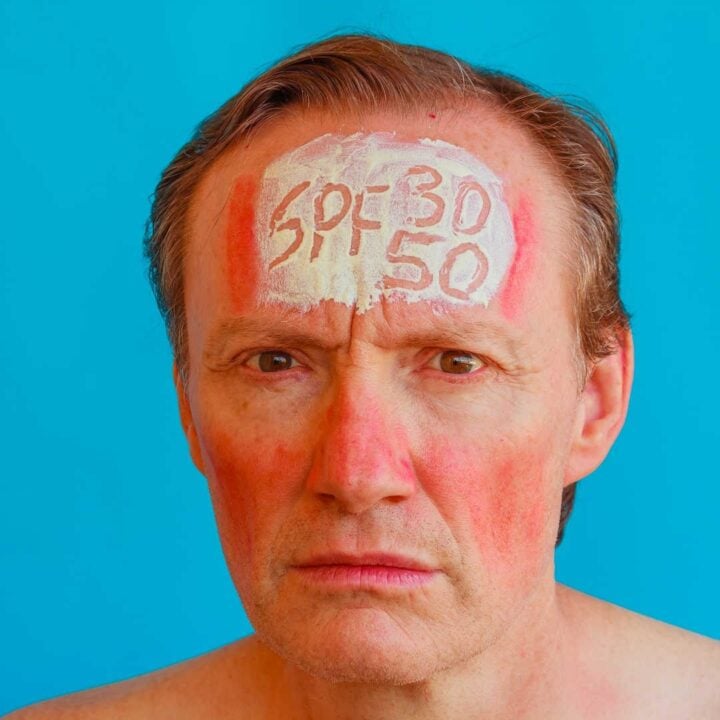
Things that grow exponentially get large very, very fast. (Simple get rich quick savings scheme: take a paper monthly calendar and on the the first day put down one penny, on day two, two pennies, doubling the number of pennies each day. So, four pennies on the third day and eight pennies the next day. See what I mean? You’ll need 1 billion pennies by the end of the month – unless it’s February.) While exponents grow very, very fast, logarithms grow just as slowly. So, a product with SPF 15 blocks 93% of the sun’s UVB rays. A product with SPF 30 does not block 185% of the suns’s UVB rays (something that is mathematically impossible), nor does it last twice as long before you need to reapply. It only raises the blocking factor to 97%. SPF 50: 98%. SPF 100: 99%
So, don’t waste your money; yes, the higher the SPF, the more the tube costs. SPF 30 should be all you need – provided you apply and reapply as needed. More on that later.
The SPF scale only measures protection against UVB rays. However, the sun emits, and our atmosphere doesn’t fully block, both UVA and UVB rays. UVB rays are the primary culprit behind sunburns and skin cancer, but UVA rays also contribute to skin cancer and are believed to cause premature aging. So, read the label and seek out products that say “broad spectrum” sunscreen – these products will block out both UVA and UVB rays.
In the United States, SPF products are regulated by the Food and Drug Administration (FDA) as an over the counter (OTC) drug. This is different from your standard aftershave, or shaving cream or soap, as they are regulated as cosmetic products. Products designated as cosmetic do not require pre-market approval by the FDA, while for OTC drugs, pre-approval is required.
To obtain FDA approval for an OTC drug and be allowed to label your product with an SPF rating, the manufacturer has to perform themselves, or more likely hire a UV product testing company (I found only three) to conduct somewhat extensive product testing. In the past, this involved the use of human test subjects, though as of 2011, that has been more or less phased out.
I will spare you the deep dive into how how an SPF rating used to be determined using human volunteers, but know that it only measured how long it took before the subject got sunburned – ouch! Also, it used to be that as long as a manufacturer included an ingredient/chemical that was known to provide some UVA protection, they could label their product “broad spectrum.”
These days, there is now an official FDA approved test for ingredients that block the critical UVA wavelengths. So, since, 2011, “broad spectrum” really does provide UVA protection. Though, unlike a product’s SPF rating, there is no way to compare the degree of protection between two products, since “broad spectrum” merely means the product exceeded the FDA minimums for UVA protection.
Hopefully, this provides some insight as to why the only three aftershave balms I could find that had an SPF rating were mass market products. It is not hard to imagine that the cost to bring an SPF-rated aftershave balm to market is well beyond the R&D budget of most small and medium boutique producers. To create such a product they would have to include one or more of the sixteen FDA approved chemicals/ingredients (Europe has 29 approved sunblock ingredients and regulates sunscreens as a cosmetic product), pay a third-party company to conduct the required FDA testing, and then wait for the FDA to approve your product.
Alternatives

There are alternatives to SPF products, primarily protective clothing. I spend a lot of time each summer cycling and really hate slathering my body in sunscreen. You start to sweat, and it starts to run/melt/whatever – yuck! So, yes, I am one of those silly people you see zipping along on their sleek racing bicycle wearing a long sleeve tee. Clothing, unlike sunscreens, are rated using a different scale, the UPF scale, for Ultraviolet Protection Factor.
Yes, all clothing blocks some UV rays, the amount does vary. A plain thin, white tee is about UPF 5 – meaning it allows 20% (or one fifth) of the sun’s ultraviolet rays to reach your skin. Unlike SPF, UPF is linear. So a shirt with UPF 10 is twice as good, only allowing 10% of the UV rays through. Doing the math: a shirt with UPF 50, translates to 98% of the sun’s UV rays being blocked.
Bottom line: UPF clothing is not a marketing scam, but you don’t need to buy specially labeled UPF clothing to get its benefits. For example, I purchase bamboo-based long-sleeve tees – a material, which feels soft like cotton, but unlike white cotton (UPF 5-7) has a natural UPF of 50. Finally, the great thing about protective clothing – you never need to apply/reapply as the day progresses!
While UPF clothing is great for one’s body, facial clothing is not really a thing. However, hats are an option. For sun protection, leave the baseball hats at home and get something with a full or wrap-around brim. While a baseball hat does protect your forehead and possibly even your nose, they leave your temples (one of the facial locations with the highest incidence of skin cancer), cheeks and the back of your neck, depending on hair length, exposed. I am not advocating for the return of the men’s mullet hairstyle –1980’s men’s styles should stay in the 1980s– but your neck and temples deserve protection. Get a hat and up your style quotient at the same time.
Another alternative for men’s faces and necks is to grow a beard. Yes, I recognize the irony of possibly recommending growing a beard on a web site dedicated to wet shaving. Sadly, beards are not all that protective; Their UPF rating is between 2 and 20, depending on the beard length and hair type. You need to go full ZZ-Top to hit that 20 mark.
Furthermore, beards complicate the diagnosis of face/neck skin cancers. For example, as someone with long-term skin cancer, my dermatologist forbids me from growing a beard. There are lots of reasons for facial hair, but sadly, preventing skin cancer is not one of them.
Ok, now that we’ve untangled the meaning of SPF (logarithmic scale) and UPF (linear scale) and the need for products labeled “Broad Spectrum” (can’t ignore those dangerous UVA rays), let’s turn to the active ingredients portion of your sunscreen.
Sun-blocking ingredients fall into two categories: chemical or mineral – yes, this is the chemistry lesson part of the blog, but don’t worry, it is even easier than the math portion.
- Mineral: These ingredients literally create a protective layer and reflect or scatter the sun’s UV rays. If the active ingredient label lists “Zinc Oxide” or “Titanium Dioxide” it’s a mineral-based sunscreen. Those white pastes on the noses of your local swimming pool life guards – zinc oxide. Modern mineral-based sunscreens are not so ugly. They use nano-particles so that after being rubbed in, they’re nearly invisible. Keyword to look for in a mineral-based sunscreen: oxide.
- Chemical: These ingredients literally absorb the UV rays and convert it to heat. If the active ingredient label says “Avobenzone”, “Oxybenzone”, or “Octinoxate” it’s a chemical-based sunscreen. Basically, if the active ingredient isn’t an “oxide” it’s a chemical-based sunscreen.
Some key differences between the two:
Chemical sunscreens can get used up: the process of converting UV rays into heat literally uses up the chemical molecules – hence the need to reapply chemical sunscreens more frequently. Furthermore, some of these chemicals are harmful to marine life, particularly coral reefs and are banned in some places around the world. The general rule of thumb is that for anyone going into an ocean or lake, stick to a mineral-based sunscreen – why risk it?
Chemical sunscreens, unlike mineral-based ones, also need time to be absorbed before being effective: usually 15-20 minutes. Since a mineral sunscreen is a protective/reflective layer, you’re good to go immediately after application, though they are harder than chemical sunscreens to fully rub in to the point of being, more or less, invisible.
Regardless of the chemical or mineral (or hybrid) approach, you need to reapply. Dermatologists, those people at the beach who sit there completely covered from head to toe, recommend reapplying every two hours. I joke with my dermatologist that they must be in the pay of the sunscreen lobby – every two hours!?!
Seriously, one does need to reapply. The frequency depends on the circumstances and the type of product being used. Both types of sunscreens will wash off in ocean/lake/pool water and/or sweat. Towel drying after a dip wipes off more than just water.
Finally, I would be derelict if I did not point out that one could reduce one’s sun exposure by relocating to a less sunny location, say Britain, or Cleveland, Ohio. It turns out that cloud coverage is no protection against UV exposure; a partly cloudy sky only blocks about 25% of the sun’s UV rays. Skin cancer rates in Britain match those in the USA. Also know that those with dark or black skin are not immune from skin cancer. Very dark skin is considered to provide a level of protection equivalent to SPF 12 (or so); not bad, but not the same level of protection as an SPF 30 sunscreen or appropriate clothing.
Summing Up
This concludes the chemistry, math, and regulatory lessons for the day. To summarize: the wet shaving industry we support has left us, the population most vulnerable to skin cancer, high and dry when it comes to sun protection – though given the regulatory landscape, it is understandable. This translates to us men having to take an extra step to protect our sensitive faces and necks. Hopefully, this article has informed you as to the alternatives and how to make effective use of them.
