
Some bad shaves don’t have a single obvious cause.
Nothing dramatic happens. You don’t cut yourself badly. The razor or blade doesn’t fail. The lather does not disappear.
Still, by the end, the shave doesn’t feel better than it should. It feels like something went wrong, even though no single mistake seems large enough to explain it.
That kind of shave is frustrating because it encourages the wrong question.
You start asking, Was it the blade? Was it the razor? Was my lather off? Did I use the wrong angle?
Sometimes one of those things is the main problem. But often, the shave went downhill another way.
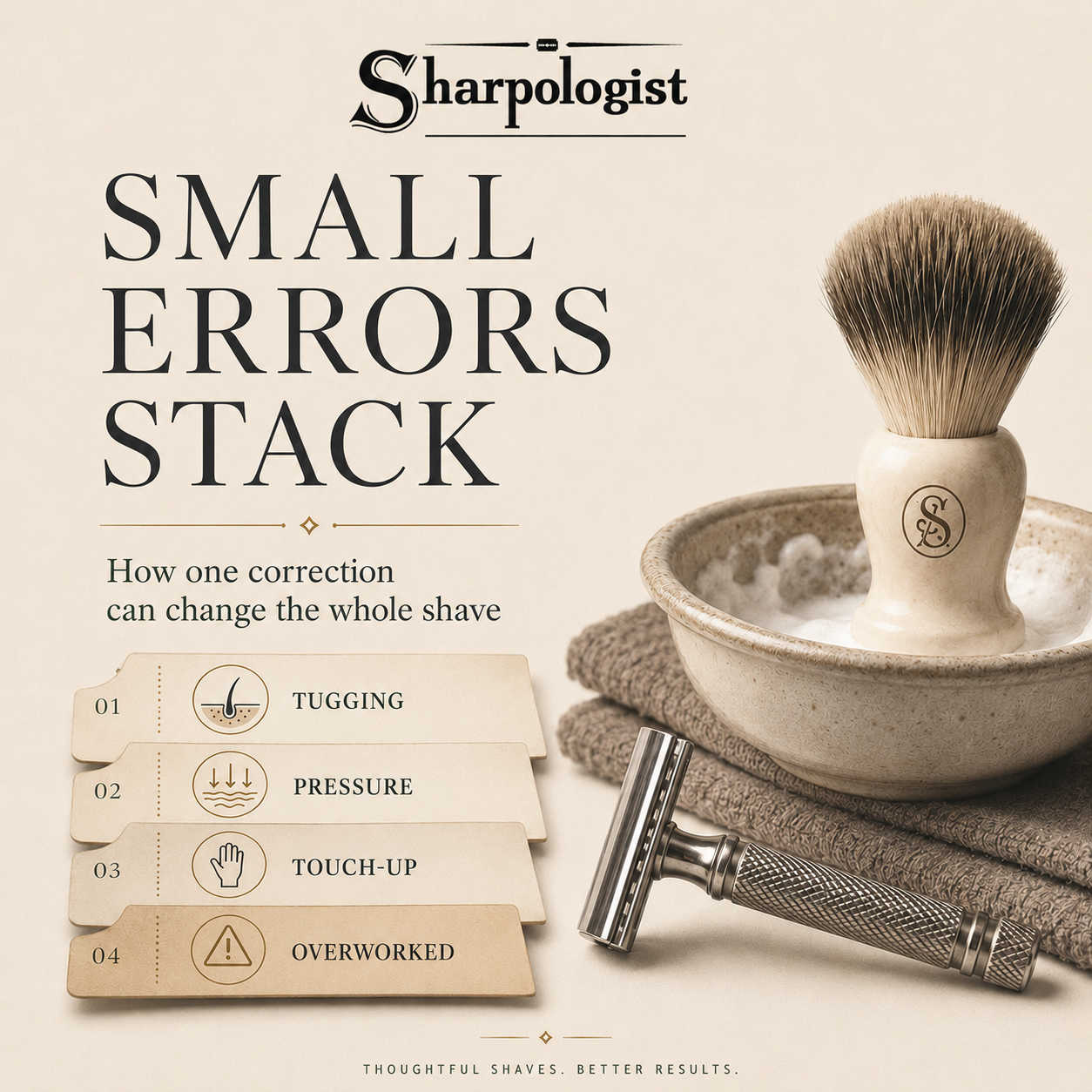
A small problem appeared. You corrected it. The correction added cost. Then the next correction added more.
That’s how small shaving errors stack into big results.
Quick Answer: Why Small Shaving Errors Stack Into Big Results
Small shaving errors stack when one small problem causes a correction that adds pressure, strokes, exposure, or loss of margin.
A little tugging, a slightly poor angle, weak lather, or one missed patch may not ruin the shave by itself. The result becomes larger when the shaver compensates by pressing harder, shaving the same area again, changing angle abruptly, or chasing a rough spot after the area has already been worked.
The question is not really what went wrong first but what did you do next?
This does not mean every minor mistake needs to be noticed or corrected. In fact, the point is often the opposite: many small imperfections are better left alone than chased.
Small Errors Matter Most When They Cause Compensation
A small shaving error becomes more important when it causes a compensation that adds pressure, strokes, exposure, or loss of margin.
Not every imperfection ruins a shave. One missed spot is not an emergency. A slightly less close result on the lower neck may be acceptable.
The problem begins when the correction is more costly than the original issue.
The razor tugs, so you press a little more. One patch feels rough, so you shave it again. The lather thins out, so you slow down and push through it. The angle feels uncertain, so you adjust mid-stroke and then clean up what remains.
The frustrating part is that these corrections feel reasonable in the moment. But together they can change the whole shave.
That’s different from saying the skin simply became irritated because the shave involved too much exposure. That broader mechanism matters, and it is covered more directly in Why Shaving Causes Irritation. This article is about one common way shavers accidentally build that exposure: by correcting small problems in ways that make the next part of the shave less forgiving.
How One Correction Leads To The Next
A shave rarely goes from good to bad all at once.
More often, it changes direction through a sequence:
- A small issue appears.
- The shaver corrects it.
- The correction adds cost.
- The next stroke becomes less forgiving.
- The final result feels larger than the original mistake.
That is the loop:
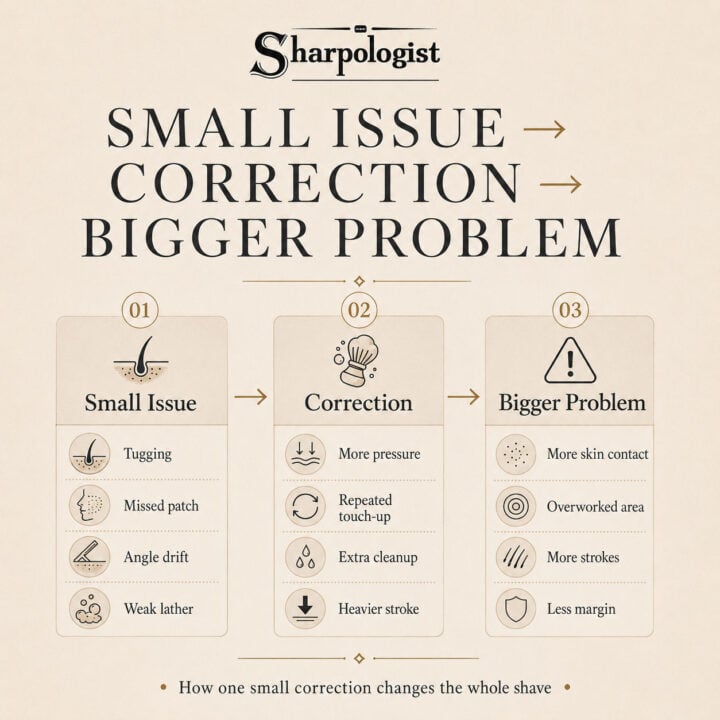
small issue → correction → added cost → bigger problem
The first issue may have been minor. The chain that followed was not.
Where The Compensation Loop Usually Starts
The compensation loop usually starts in ordinary places. Not dramatic shaving failures but small points where the shave asks for judgment.
Tugging Leads To Pressure
Tugging is one of the most common starting points.
When the razor does not cut as smoothly as expected, the natural response is to help it along. The hand adds a little pressure. The stroke slows down. The razor may be held more firmly against the skin.
That can make the tool feel more effective for a moment. But pressure changes the cost of everything that follows, often hiding other explanations. A shaver may blame the blade, razor, prep, or soap. Any of those may be involved. But the shave often gets worse when tugging causes a heavier correction.
The tugging was the first issue. The pressure was the more expensive response.
Missed Stubble Leads To Repeated Strokes
A missed patch is rarely left alone. That is understandable. The whole point of shaving is to reduce stubble. If one area still feels rough, the hand wants to fix it.
The problem is that missed stubble usually appears in places that are already less forgiving: the lower neck, under the jaw, around a grain change, near the chin, or anywhere the face shape makes the razor harder to control.
Those areas are also the places where repeated strokes add up fastest.
One touch-up may be harmless. Several touch-ups over the same small area can turn a minor imperfection into an overworked patch.
This is especially common when the rest of the shave is good. The contrast makes the rough area feel more important than it really is. The cheeks feel smooth, so the neck becomes the project. The shaver keeps returning to it, trying to make one difficult area match the easiest parts of the face.
The missed stubble was the first issue. Repeated correction made it larger.
Angle Drift Leads To Cleanup
Angle drift is deceptive because the razor can still cut.
A stroke doesn’t need to be ideal to remove hair. A slightly inefficient angle can still produce reasonable results. That makes the mistake easy to miss during the shave.
The cost shows up in what happens next.
If the angle isn’t stable, the reduction may be uneven. That unevenness invites cleanup. Cleanup adds strokes. The extra strokes may happen over skin that has already been shaved once or twice.
The shaver may not experience this as an angle problem. He may think of it as a rough patch problem.
But the rough patch may be the result of the earlier angle drift.
This is why angle mistakes often lead to more shaving rather than better shaving. The razor still works, but it leaves behind enough imperfection to invite correction.
Weak Lather Leads To Heavier Shaving
Lather does not need to collapse completely to affect the shave.
Sometimes it’s only a little dry, a little thinner, or less slick near the end than it was at the beginning. It may still look usable and may still allow the razor to move.
But weak lather offers less room to correct.
A light, clean stroke may still be fine. A heavier correction over fading lather is different. So is repeated cleanup over an area where the lather has thinned. The same action that would have been tolerable earlier in the shave becomes less forgiving later.
Weak lather is often not the whole failure. It is part of the environment in which the compensation loop happens.
Why The Final Result Feels Larger Than The First Mistake
The final result can feel disproportionate because the shaver remembers the original mistake, not the whole sequence.
You remember that the razor tugged a little.
You remember that one patch needed attention.
You remember that the lather was only slightly off.
You remember that you used only a little more pressure.
Each memory may be accurate. But none of them describes the whole shave.
The shave changed after each correction.
A little pressure made the next stroke less forgiving. A repeated touch-up worked the same area again. A drifting angle left more cleanup. Thin lather made the final strokes less comfortable.
The final result reflects the sequence, not just the first mistake.
That is why it can feel unfair. No single decision seems serious enough to explain the outcome. But the outcome was not built from a single decision.
It was built from corrections.
The Compensation Pattern: Small Issue, Correction, Bigger Problem
The pattern is easier to see when you separate the first issue from the correction.
| Small Issue | Common Correction | Bigger Problem |
| Tugging | More pressure | More skin contact |
| Missed patch | Repeated touch-ups | Overworked area |
| Weak lather | Slower or heavier strokes | Less margin |
| Angle drift | Extra cleanup | More strokes |
| Mild setup feels ineffective | More passes | More total shaving |
This table is not meant to diagnose every shave. It is meant to change the question.
Instead of asking only, “What caused the bad shave?” ask:
What correction did I make, and what did that correction cost?
That question is often more useful.
The first issue may point to the right adjustment. The correction tells you why the shave became worse than expected.
How To Tell If A Shave Is Getting Worse Through Compensation
A compensation loop often leaves clues.
The shave may feel acceptable during the first pass but deteriorate during cleanup. The roughest area may also be the area that received the most attention. The neck or jawline may become the problem after several small touch-ups. The result may be close but feel overworked.
One rough patch may start deciding the whole shave.
That last sign matters. A difficult area can pull the entire routine out of balance. Instead of shaving the face as a whole, the shaver starts chasing one spot. The shave becomes less about controlled reduction and more about correction.
Another clue is repetition. If the same area keeps causing problems after the same type of correction, the issue may not be random.
For example, if your lower neck feels worse only after cleanup, the first pass may not be the main problem. The problem may be what happens after the first pass. If changing razors helps briefly but the same overworked area returns, the compensation pattern may still be there.
A single rough shave does not prove much. A repeated sequence does.
Look for the moment when the shave started asking you to fix something. Then look at what you did next.
How To Interrupt The Loop Without Changing Everything
The answer is usually not to rebuild the entire routine.
If the problem is a compensation loop, changing everything can make the shave harder to understand. A new razor, new blade, new soap, new brush, new pass pattern, and new prep may produce a different result, but it won’t tell you where the loop began.
Start by reducing the most expensive correction.
If tugging makes you press harder, lighten the stroke before changing several pieces of gear. If one patch keeps getting touched up, stop one touch-up earlier. If lather fades late in the shave, refresh it before cleanup instead of shaving through it. If the neck behaves differently from the cheeks, treat it differently instead of forcing it to meet the same standard.
Do not fix the whole shave at once. Fix the point where the shave starts going downhill.
That usually means asking practical questions:
Where did I first notice trouble?
What did I do in response?
Did that response add pressure, strokes, or repeated contact?
Would doing less have produced a better result?
This is not passive shaving. It is controlled shaving.
Restraint is not the same as ignoring a problem. It is recognizing when the correction is likely to cost more than the imperfection.
What This Does Not Mean
This does not mean every shave requires perfect technique.
Perfect technique is not the goal. A good shave can include small imperfections. The goal is to avoid turning each imperfection into a bigger correction.
This also does not mean tools are irrelevant.
Razors, blades, brushes, soaps, creams, and prep can all make compensation more or less likely. A blade that tugs may encourage pressure. A razor that feels too mild may encourage extra passes. Lather that dries too quickly may make late cleanup less forgiving.
But product changes are most useful when they match the actual pattern.
The point is not “never change tools” but “know what problem the tool change is supposed to reduce.”
Big Shaving Problems Are Often Built Small
A better shave is not one where nothing imperfect happens. It’s one where small imperfections do not force bigger corrections.
That’s a more useful standard because it gives you something to control. You may not be able to make every area reduce equally. You may not be able to make the lower neck respond like the cheek. But you can reduce the number of times you escalate the shave.
Fewer repeated strokes. Less pressure correction. Less cleanup chasing. Better stopping judgment. More margin left at the end.
Sometimes the better shave comes from accepting a small imperfection before the correction becomes more expensive than the stubble.
A shave can fail without one obvious mistake because the shave changes after each correction. The first problem may be minor. The response may seem reasonable. But if that response adds pressure, strokes, exposure, or loss of margin, the next part of the shave becomes less forgiving.
So when a shave goes bad, do not only ask what failed.
Ask where the correction loop began.
Big shaving problems are often built from small corrections that seemed harmless at the time.

The point about compensation being the real problem is the most useful part of this article. A little tugging on its own rarely ruins a shave, but the instinctive response of pressing harder turns a minor blade-angle issue into irritation across the whole pass. Treating that first sign of drag as information, and pausing to check lather hydration or re-find the angle rather than pushing through, seems like a much better habit than blaming the blade straight away.
I also like the framing that the key question is what you did next rather than what went wrong first. Re-shaving the same patch several times is probably the most common way small errors stack up: each extra stroke removes a little more protection and margin, so by the time a rough spot finally feels smooth, the skin around it has already paid the price. Accepting a slightly less than perfect result on one area, or saving it for a light, well-lathered touch-up at the end, is usually the better trade.
For anyone trying to diagnose inconsistent shaves, this suggests keeping changes small and one at a time. If you adjust pressure, angle and number of passes all at once after a bad shave, it becomes impossible to tell which correction helped. Watching how you react mid-shave may reveal more than swapping gear does.