


You’re listening to Wet Shaving Talk powered by Sharpologist.com where we’re dedicated to preserving the art and skill of classic shaving. I’m your host Joe Borrelli and today is August 5th, 2026.
Today On The Show:
Straight Razor Month
How to Store Your Straight Razor
The Shave : How to Shave
The 1700’s Shave
Fully Cased Canadian Toggle Set Found
Next Month: Dedication to Gillette I Need Your Help!!
___________________________________________________________________________
How To Store Your Straight Razor
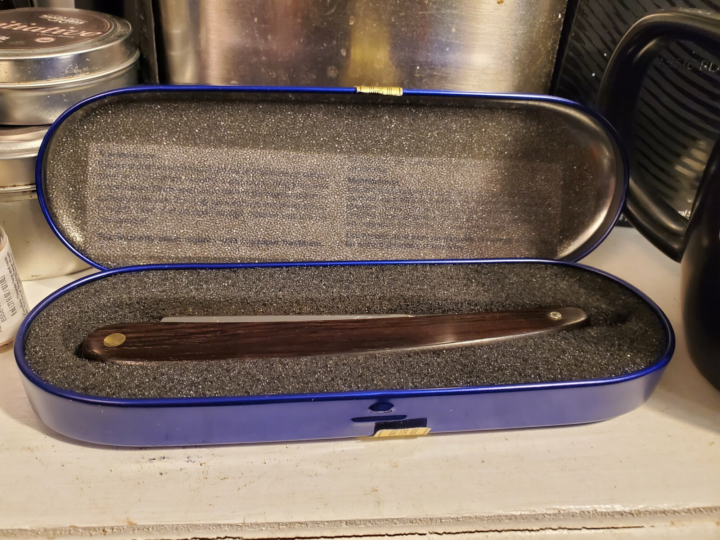
Daily Storage (Between Shaves)
- Rinse and wipe: Rinse the blade with hot water, keeping the pivot pin and handle (scales) completely dry. Carefully wipe the blade with a towel or tissue, moving away from the sharp edge.
- Air dry open: Leave the razor unfolded and open on a clean towel for at least an hour. Closing the razor while the inside of the handle is damp will trap moisture and rust the blade.
- Evacuate the bathroom: Move your dried razor out of the bathroom. The high humidity from showers will corrode the metal even if you aren’t using the blade. Store it in a bedroom drawer or a dedicated cabinet instead.
- Use a breathable case: Slip the dried razor into a wooden box or a breathable fabric sheath (like merino wool or a clean sock). You can also use silica packets in a plastic or wooden box. I use a reverse humidor
For long term storage add a coat of mineral oil to the blade to prevent oxidation. ___________________________________________________________________________
The Shave: How to Shave with a Straight Razor

We talked about prep now it’s time to shave : Here is a video on How I Do it: It’s old but still relevant.
- Keep Your Fingers Dry
- I think this is more of a rule than a step. Keep your fingers dry, especially the fingers you use to stretch your skin. I like to rub my fingers against a alum block in between passes.
- Skin Stretching is Key
- Pull your skin tight but not too tight. You want the whiskers on your face to be at a 90 degree angle.
- Keep the Blade at a 30 degree Angle:
- I find this to be best. It gives you the right cutting edge and is the safest.
- Do Not Use Any Pressure: Let the blade do the work.
- Take your time!
___________________________________________________________________________
Canadian Cased Toggle Found
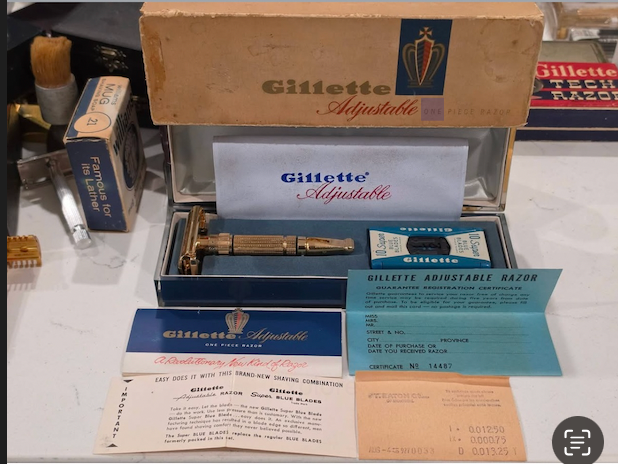
Recently a member from the Gillette Safety Razor Forum found a fully cased Canadian Gillette Toggle F4. I personally have never seen one before. All the bells and whistles on this set. Incredible find!
____________________________________________________________________________
The 1700’s Shave
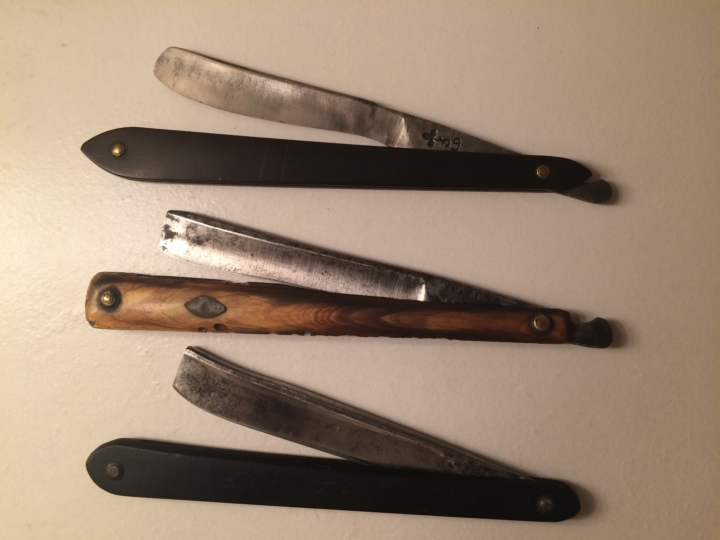
An article I wrote some years ago, the 1700’s played a huge part in the history of wet shaving.
Listen to learn more: You might be surprised on what you learn!
____________________________________________________________________________
Dedication to Gillette Month
What better time to end the summer than with a month dedicated to Gillette. One of my favorite things to talk about. I’m a huge fan of Gillette the company in general and will discuss the rare models, how to start your Gillette Collection and will share my experiences. 3 episode series coming up!
Do you have a special Gillette “Barn Find”? Please share with me and I will feature it on the show.
__________________________________________________________________________
Our show is powered by Sharpologist.com, “What Your Father Didn’t Teach You about Shaving”
Special Thanks to:
Mark aka Mantic 59
Most of All……….YOU!!!!
Don’t forget to check out my blog site www.shavestraightandsafe.com for the tips and interesting wet shaving stories!
Please feel free to contact me at joe.wetshavingnews@gmail.com
Subscribe to my You Tube Chanel for videos regarding some interesting wet shaving content.
Don’t forget to check out my book “The Modern Guide to Straight Razor Shaving” available on Amazon, Barnes and Noble and at Pasteur’s Pharmacy in NYC.
If you’re a vendor and would like to be featured on the show please contact me!!
Transcript (Generated using Transcript LOL)
You’re listening to Wet Shaving Talk powered by Sharpologist.com where we’re dedicated to preserving the art and skill of classic shaving. I’m your host Joe Borelli and today is August 5th, 2026. Hey guys, welcome back to the podcast on the finale of Straight Razor Month. That’s right.
If you haven’t been listening, if you just tuned in for the first time in a little bit, we’ve been doing several episodes on the dedication to my favorite piece of hardware, the Straight Razor. So for this week, we’re going to discuss how to properly store your Straight Razor between uses for both long-term and short-term storage. And finally, how to shave with your straight razor. That’s right, shaving with the straight razor is the most fun and probably the most important part of the whole hobby, right?
If you consider what shaving hobby is actually having to use it, right? That’s the best part. It’s a hobby you can do every day. It’s something you can do quite often and have a good time with.
So, we’re going to talk about some tips and tricks, how to actually shave with a straight razor. In addition, a little bonus content for today, guys, I wanted to talk about one of my favorite parts of the actual straight razor journey is the 1700 shave. I did an article about this about 10 years ago, still pretty relative. Well, mainly because 1700s really aren’t going to change.
It’s about 250 years ago now we’re talking. And it’s not going to change it in that sense, so it’s still a very relevant article. So, looking forward to talking about that. I also put a link to a couple of articles on that and some good stuff to read on the actual 1700 shave.
Out of the straight razor area, to kick off our next month, I wanted to start off with a fully cased Canadian toggle set that was found and purchased over the last couple of weeks by a collector. First one seen, first one that I’ve seen and that’s in a actual new old stock condition with all the paperwork. the shipper, the box, everything. Really incredible to see that case come in and see that’s pretty much the same thing, but a little different for the Canadian market back in the 1958 to 1960 time span.
So that will be kicking off our next month, which will be dedication to Gillette. And you know what, you guys, the listeners, I’m going to need your help with this one. So at the end of the show, don’t click off too early. I’m going to ask for each and every one of you or any of you out there, if you have anything, a certain piece of, I guess you could say news or content that I’m looking for, I’d like to feature it on the show in the next couple of
weeks. So without further ado, let’s get on with the show. So how to properly store your straight razor is definitely something that I think a lot of new straight razor users probably need to work on, right? We get all excited, we buy the razor, we buy all the stuff, we buy the strop, we buy a brush, soap, everything.
We’re ready to shave, we’re using it on an everyday basis. And then we figure out what we see one day. that we missed something and the thing that we missed is storing our razor properly and we might see you know those pesky little black spots that form on the blade or on the edge and then we’re like oh boy my beautiful polished straight razor now is ruined I have to get it redone I have to take care of it all because I left it out and didn’t properly store it so To better inform our new straight razor users and existing straight razor users out there alike We’re going to talk about how to actually store The
straight razor in between shaves and for long-term storage not a lot of work needed and definitely not a lot of money Required for this just a little bit of extra time and it will go and it’s worth its weight in gold long term so First off, when you use your straight razor, there are a couple ways of actually shaving with it that can prevent oxidation and those pesky black spots. Now, before I get into that, I just wanted to explain what those spots are. It is oxidation of the metal.
It’s a chemical reaction with metal and water. Now, most straight razors, I’d say 75 to 85, maybe 90% produced today are made of carbon steel, which is untreated steel that can corrode. Yes, it’s true. If you live in a humid area like I do, where it’s almost 100% humidity most of the year, A piece of bare steel, if you leave it outside overnight, will have rust on it by the next morning.
You can take a look, if you look at your car, your front car, if you can see the front wheels on your car, if you have disc brakes and you have like holes in your rims and you can see through it, you’ll notice that if you live in Florida, if you leave your car to sit for a day, you’ll see the next morning there’ll be rust on those, on those surface rust on those rotors and they come right off as soon as you hit your brakes a few times. That is the same thing, same type of steel that you’re looking at with a straight razor. So, in order to prevent that, there are a few things you want to make sure you do.
First, when you shave, you want to make sure you’re rinsing your razor completely and drying it completely. You can prevent this step or be preventative and not use water to rinse your blade, which is, there’s two, I guess you could say two benefits to that. One, By not rinsing your blade in between and just wiping it on a towel, I like to use a paper towel sometimes so it’s disposable. I throw it out so I don’t get my towel dirty or I use a dedicated shaving towel which I have several of them.
I use like a white washcloth barber’s towels that I have. I got them from West Coast Shaving with an order I did. I think it was a free giveaway. I got like 10 of them.
I use those and I put them in with my white shirts when I do my laundry. One of those will last you a couple days if you want to do that or I like to use a paper towel and then I just throw it right in the garbage when I’m finished. So when you shave, scrape, and then you’re going to go wipe it off clean, you can either use a towel and or paper towel. A lot of people like to rinse it.
Now when you’re using the paper towel, you’re not getting water on it. You’re just the water that’s on your face and you’re giving it a little bit extra so water won’t get into the crevices of the straight razor where the pivot pin is and where the scales meet the blade which is really where the rust can start and it usually is the most, I would say the most neglected part of the straight razor. I like to do that, if not, and also prevents the ability, the number two reason is, prevents the accidental ding against the faucet or the sink.
When you’re rinsing it, sometimes you turn it, if you hit that microfin on your blade against the faucet, you’re gonna have to re-hone the razor. You can chip it, it’s very, very fragile, very thin, and that’s why it’s so sharp. So just being careful in that area when you do that. So first, rinse, wipe, make sure that blade is completely dry when you’re finished with it.
Now a lot of people like to… air dry it, which would be the next thing, where you would leave the blade open and let it dry out for an hour or so on the countertop or in your shave den area, right, or in your closet. I would recommend keeping it out of the bathroom or wherever you shave because of the humidity in the bathroom is usually pretty high. There’s a lot of hot water in there, especially after you just took a shower.
You want to keep it out of there, get as less, the least amount of humidity possible to that blade. So, if you’re going to air dry it open, make sure that you leave it outside of the bathroom and or restroom, whatever you call it, shave den, your area where you shave and leave it out on like a countertop, a dresser or something like that. Now, in my area, I can’t do that because I have a little kid around the house and I really, the last thing I want to do is have to deal with an injury because of my negligence. So, what I do is I take the blade out, I make sure it’s completely dry, and I put a little bit of mineral oil on it every time.
We’ll talk a little bit about that as well. So air dry, make sure it’s completely dry. And then when you go to store it, you want to make sure it’s stored outside of the bathroom, outside of the restroom, outside of the area where all the humidity is, and in an area where it’s dry. So I leave mine in my closet, where I keep all my shaving stuff, and it’s out of the bathroom.
I don’t put any razors in my shave bathroom, right? Even my safety razors, because I don’t want any rust. I don’t want any oxidation in there. I keep them out.
I put them away in an area where it’s nice and dry. And then if you’re using for storage, you know, a lot of people, if you look in the show notes, I put a picture of a Dovo Straight Razor 10. And sitting in there, that’s a great way to store your razor. It’s safe, it’s soft, it’s not going to get ding damage.
And really, it’s not that easy to open up. So you don’t have to worry about it falling. But using a breathable case to where you can get some air out of it. And it’s not just sealed up, right.
So some people like to use, I guess you could say like cigar boxes or humidors. And that’s actually what I use for long term storage. And we’ll get into that in a minute. And just keeping it really dry where it can actually have some air going in and out of it so it doesn’t get stagnant and it won’t, if there is any moisture in there, it can come out naturally, right?
Even if the blade is a little warm or if there’s any moisture inside, you want it to be able to basically exit the area and not be pent up in there so it would get those really where the oxidation would start to form. Now, both for short and long-term storage, it’s great to use a breathable case, as mentioned. You can use a couple of things that are sold in certain wet shaving sites, such as the, I guess, a fabric sheath, like socks for them. Some of these socks are breathable, they’re cotton, and some of them, if you go on, I think, the Superior Shave, based out of Jacksonville, Florida, he sells them, and they’re pre-charged with a little oil, mineral oil, so they actually, We’ll keep the razor nice and dry, have enough
air come into it so it’s breathable, and then we’ll oil it up so then it really prevents all the oxidation. And they’re not expensive. They’re under $10 each. I highly recommend them.
If you feel that you are just not disciplined enough to do it, or if you’re really in a rush, you put it right in there. And for long and short term storage, your razor is nice and safe. Or the method that I use is I actually use a humidor and I reversed it. So I took a humidor box that would hold cigars that fits straight razors perfect and I put silica packs in there in order to get the moisture out instead of giving and leaving the moisture in.
So cigars you want a little bit more humidity, right? razors, you don’t want any humidity. So living in a very humid, I guess climate for myself, anything under 70% humidity is good, right? So I try to keep it around that I keep the humidity around that level under 70% 50% probably being ample.
I leave my razors in there and I haven’t had any issues with that kind of a storage box. Also, I like to take a little mineral oil or olive oil as well can work in a pinch and just lightly coat the blade. You will never get oxidation, it’ll be great. One thing I will mention, if you do coat the blade with oil and there’s water spots on it, or little water drops, you will get oxidation.
It will not help. So just make sure it’s completely dry, a little layer of oil on it. You can use like a cotton swab or you can use a cotton ball or your hand, finger if you’re very careful. And your razor will last for years and years and years with no issues.
So, that’s really if you think about it with storage in a nutshell. I didn’t want to get too detailed into it just for the, I guess, for the respect of time and also there’s really no reason to complicate it. You know, a lot of people do their own storage ways. A lot of people like using test tube racks.
I use those for my safety razors. For me, I have to keep the straight razors out of I guess out of reach for little kids because I really, I have a seven year old son as you guys know. The last thing I want is to see him walking around with a straight razor or worse get hurt from one. So be very careful.
I actually treat straight razor storage and straight razor use kind of like the same I would do with gun safety. I keep them away, I keep them out of reach for little kids and with safeties on it so I have the little box and I put a lock in it. So, nobody can touch them. I don’t want him getting to it and just being very disciplined in that area.
And it will definitely prevent any injuries or issues or just situations you don’t want to be in, in general. So, highly recommend getting a lockable case and keeping it nice and dry. So, that’s it for stray user storage. And if you guys have any other methods that you use and stuff, I’m always open to hear about it.
I’d love to hear it. And just sending it off, you can send me an email or show me some pictures of what you’re using. I would love to get more involved in that and find other methods. I’m always looking at different ways to store mine.
There used to be a straight razor case that somebody made that had those silica packs and it was made out of plastic. I want to say it was called the Amblea or something like that case back in the day and I have not seen any of those. I’m pretty sure they’re not making them anymore, but it was cool. It was like foam.
It took out the humidity, foam based, kept the razors nice and safe and it was lockable too. It was really cool. Moving along, so now’s the best part of straight razor shaving, how to shave with one. So, we’ve talked about the prep, we’ve talked about storage, we’ve talked about collecting, we’ve talked about what to look for.
Now, it’s the most important part, it is finally time to shave. Now, when you guys start your straight razor journey, if you haven’t already, Make sure you take a lot of time in the morning to do this. Do not rush. If you have to be to work at 8 a.m., you have a 30-minute commute, and you’re trying to shave at 7, I wouldn’t do it, right?
I would make sure you get up early. Get up early or do it at night when you have nothing, no distractions, nothing rushing you, nothing going on like that, no people around, right? I did an article several years ago called The Five Rules destroy razor safety. It’s very easy.
Just google it You’ll find it and look that up and just make sure you have no distractions, right? So be ready. All your attention needs to go into the straight razor shave for this because you’re learning, you’re trying it out, and you need your full attention. Even myself, who’ve been straight razor shaving for 15 years, I still make sure I am not bothered.
If my wife needs to use the room for a minute, if my son’s coming in, I kind of just put it away, right? I try to do it by myself. Usually I do it in the morning, I wake up very early in the morning. If you guys don’t know me, I’m usually up anywhere between 3.30 and 4am.
And I do my share, I do most of my work that time I set my my this podcast is usually done. Most of my writing is done, then our content is done, then all my studying for my class for my wine. Certifications are done then and some work too. I do some of my work, but it’s a time where everybody’s sleeping It’s nice and quiet and I can get a good shave and so usually I’ll come wake up early.
I Will do some of my work when I’m getting some time I set some time aside for about 15 to 20 minutes to get a good shave in with no distractions I enjoy that time because it’s very slow paced and it is dedicated to myself. So set them set Set the mood, right? Make sure you’re right. A lot of people like using candles to set the mood, right?
They like to relax when they come home from a long day at work, go on vacation, whatever. Do that for your shave. Think of it as a 20-minute vacation you can do every single day. But enough of all that now.
Now that you’ve got the room set, you’re ready to go, you’re left alone, it’s time to shave. And a couple of tricks and tips to do for this, and I’ll show you a couple things. You might have to buy a couple things, but it’s definitely worth its weight in gold. I also guys I put in a link of a straight razor shave that I did probably about eight or nine years ago on YouTube.
There’s a link to it in the show notes, you can watch it. It is me much younger me, I can definitely say, and I could say that much more inexperienced but I think The shave is still pretty good and I watched the video a few times just to make sure it was very relevant for today and it still is. I’m very proud of that video. I did it on an old iPhone way back in the day so probably not the greatest quality but definitely good content and I think you guys will enjoy using it and a good representation of a basic straight razor shave.
So check it out when you get a chance. So number one, you want to make sure that when you’re doing your shaving that your fingers are dry, both hands. Wet fingers equals slip, slipping, right? You don’t want to slip.
You don’t want to slip by accident. And you certainly don’t want to slip on your face and cut yourself or cut your hand or finger. So make sure your hands are dry. Always keep a dry towel next to you and then purchase an alum or a loom block.
Some people say alum, some people say loom. I don’t care which way you say it. All I’m saying is you need to have one in your straight razor. journeys.
These blocks not only work well on their face, they were and they’re very good at clearing up acne. If you have a zit or pimple on your face, and it’s like you want to rub it on there when before you go to bed, get a little wet, rub it on your face, it will dry it up in a couple days and it will go away naturally without using squeezing it without having to use any chemicals or anything like that. It works great.
but also it’s great for keeping your hands dry. What I like to do is I like to lightly coat it with water, right? Just keep it with water, wring it out a little bit, like drop, like I guess shake it out and then put my fingers on there. Rub my fingers on and it gets it like a really, really dry feeling so your hands will not slip and just do it every pass.
So then when you’re, and the reason for that is you want to keep it on your opposite hand because you’re going to skin stretch. Skin stretching is key with straight razor shaving, not so much with safety razors, but it does work very well if you do do it with a safety razor. So I recommend it any way of shaving. I know some guys are not about it.
They don’t think you need to do it. And that’s fine too, as long as they get a good shave. But I know every straight razor shaver will say the same thing. You do have to stretch because you need that ample angle.
The angle of your whiskers, you want to make it stretchy. You don’t want to do too tight. I’m actually doing it right now. You want to do it just enough so you can get those whiskers to stand at a 90 degree angle.
So that means when you put your blade on it, it will cut them very, very evenly and cut it to the point where it’s nice and clean so you don’t get any ingrown hairs. If you go too high of an angle, like a 75 degree angle or low, you will get the blade, the actual hair will not cut straight up, it will cut to an angle and it can, if it’s underneath the skin, it can grow to the side and can give you an ingrown. That’s why a lot of people get ingrown hairs with cartridge razors, because it will cut it to an angle.
And then the hair goes underneath the skin, the skin level, right? This level of the skin where it’s poking out and then will grow sideways into your skin and give you an ingrown hair. And that is a very painful process. And if you could avoid it, I highly recommend doing that.
So skin stretching does help even with a cartridge razor or safety razor when doing that and preventing the ingrowns. Next, well, you want that own block to pull that you want to make sure you pull your skin a little straight. When you take your other hand, you want to set your safety or excuse me straight razor at a 30 degree angle. In my opinion, the 30 degree angle is the ample cutting edge and cuts it nice and straight and gives you a nice safe cut without having to worry about cutting your hand your your face or anything in that sense.
A 90 degree angle cutting it, you’re going to cut your face. If you go anything under a 30, like a 15 degree angle, you’re not going to cut anything and you can cut your hand. You’re just going to slide. So you want to make sure that 30 degree angle, which is pretty much I’d say perfect.
Some guys like to go up to 45, which I’d say would probably be okay as well. By doing that, you’ll get a nice even cut and that hair that you have on there, that whisker will stay straight, as straight as possible naturally. Now also, when you’re using your straight razor, do not use any, and I mean this, and I cannot emphasize this enough, do not use any pressure with that blade at all. Pressure on the blade will cut you and hurt you, right?
No pressure any time. So make sure you’re not using any pressure on the blade, let the blade do the work, and of course, take your time when doing so. Make sure you’re taking your time when shaving, make sure that you are Again, no distractions, you’re ready to go and that you have plenty of time to do it and do your pass and take your time. And remember, it’s not all about perfect shaves, it’s all about hair removal, not about baby butt smooth right off the bat.
You want to make sure that you’re going, it’s a progressive thing with straight razor shaving. You’re not going to get the perfect shave on the first one, but when you start getting really good, do your second, third passes, you’re going to end up saying, wow, my face is perfect. And that’s all it is for shaving in a nutshell. Anybody, if you ever have questions, I’ve done numerous things on this.
If you guys have any issues or anything like that, let me know and I’ll do my best to answer your questions. So recently, a member from the Gillette Safety Razor Forum on Facebook found a fully cased Canadian toggle with the original receipt, warranty card, instructions, shipper, everything. The first that I’ve ever seen in general, right? This razor was obviously purchased in the Canadian market.
It has everything, it does say Canada on it. Of course the razor is still made here. I believe they never made the toggle outside the United States. But it’s all, it was shipped for the Canadian market and the best part is this is a fully case set and he even has a receipt which is incredible.
The actual receipt when he purchased it. And I thought it was really cool to see a set like that. Definitely a collector’s piece. And I want to keep that all together for years and years to come.
But what an incredible find. If you guys are members of Facebook and you like Gillette razors, that Gillette safety razor forum is pretty good resource. A lot of very big collectors are there. Most of the guys that have, um, I guess the most collectible razors out there, like the prototypes and stuff are on there and are willing to always answer questions.
You just got to kind of get in there a little bit. I know Greg McCoy from Procter & Gamble, the archives guy, he’s on there. I know you have Matt Pisarczyk on there. I’m on there.
I love going to that group. And I’ve actually been posting some of my vintage stuff lately. I haven’t posted in social media in a very long time, but I started this week just because I want to start kicking off some fun and I want to start talking wet shaving a little bit more. I have a little bit more time than I have and I just want to have some fun with it.
So, that’s that. So, the 1700 shave is an incredible thing, I think, of wet shaving. It was a really big part of my wet shaving journey in the beginning. In the show notes is a picture of my three razors that I do own that are confirmed 1700 shavers.
They were built in the 1700s, made then, and I have a little bit of information, especially on the EVAT one in the middle. That guy went out of business in 1805. So he’s, I was able to find a lot of information, did an article on that one as well. But 1700s, it plays a huge part of wet shaving because that’s when the shaving brush was invented.
That’s when, you know, the straight razors started to get gold. They started to do a hollow grind on straight razors and get them a little bit sharper and better. They went from more of a crude steel to carbon steel and were able to get a harder steel that would last longer instead of some of those older razors that would crumble after a few honings and stuff. This is when you can really see the straight razor develop.
And I think you will definitely be excited to know that this is where it all started for us straight razor users. And I think they perfected the design and the actual sheet blades and the tempering process when it comes to the steel in the 1800s, because there’s not much change from probably the 1860s to now, except maybe hollow grinding a little bit in the early 20th century. But these razors are actually really good shavers. The bottom two in the picture shave well.
The top one I haven’t honed yet. I’ve left it alone. It’s kind of got a weird blade on it. I wasn’t really going to mess with it.
But the bottom two do shave very well. And they both took me a very long time to hone. But they’re awesome shavers. They’re full wedges and they just go, they plow through.
your whiskers like nothing and they make no noise. There’s no noise when you shave like you don’t get that. It’s just like quiet and they’re really good quality razors and I really enjoy using them. But I wanted to keep this part of it with straight razor month, mainly because of the importance it has to it.
1700s is when, again, steel became better, everything started getting launched, and really, more and more people started to shave themselves other than barbershops. Now, I’m still saying you’ve got a lot of people shaving in a barbershop at this point. At that point, if you’re going to shave, you went to the barber and they took care of it. But a lot of people started purchasing straight razors at this time and shaving themselves due to time constraints, right?
And just being able to not have to go to the barber all the time and that. So, this is when it started, kicked it off. And if you haven’t seen this article that I wrote, it is… One of my favorite ones that I’ve written, and I think you’d really enjoy just taking a look at it and seeing how stuff has progressed and what started, and that there are actually still several companies out there still making soap and stuff, and even straight razors themselves, since
then. There’s still companies in business, with recently one of them, Rooney Brushes, actually no longer being produced, but they were in business since the late 1700s. And just knowing that they’re still there and still being made, and that these companies have stood the test of time, really is interesting to me. And it’s just a really fun part of the wet shaving world.
So I think check it out, guys. I’m a little bit tied up for time, which is why I can’t get in too much into it. But it’s definitely a big part of the wet shaving journey. And I think you guys will really enjoy some of the content if you haven’t seen it before.
So next month is going to be dedicated to Gillette month. What better way to do it than to finish off the summer with a dedication to Gillette. I think, you know, King C. Gillette is the most, probably the most influential person in wet shaving.
He’s the one that created this double edge safety razor and the disposable blade, which every single one of us have been encountered with in our lives, right? if it wasn’t for him making that blade who knows what the world would have been but he made it disposable he made it easy and he made this a lot of the reason why we’re collecting today and that’s why there’s so many double-edged razors out there there’s so many produced and so innovative it was just a great company so We’re gonna do a three-episode series coming up, so it’s gonna be a whole month. As you guys know, I’m a huge fan of Gillette and Gillette Company and the history of the company.
Out of all the brands in the world, I have several brands that I’m really a fan of that I really like. Gillette is on the top of the list. I think Gillette’s a great brand. I think what they’ve done is incredible.
And we’re gonna talk a little bit about the history of Gillette. We’re gonna talk about some notable models and some cool, fun facts. But I need your guys’ help, and I’m gonna tell you what I need. I am looking for, and I’ve done this before, a barn find Gillette razor.
I’m not looking to purchase it, unless somebody wants to offer it to me, and I’ll definitely consider it. But I’m looking for somebody that went around, found a Gillette razor, whether it be in somebody’s relative or found it in a flea market or antique store that is really nice and perfect shape and that they feel would be great for the show. Example, some guys find like vintage Corvettes. A guy found a split window Corvette in a barn.
That would be a great barnyard story. Like, hey, I found one in a barn, I purchased it, I’m restoring it. There are out there, I know a couple of people you found toggles, found adjustables and stuff like that. But I’m looking for anything, anything that you found that you think is really cool, that you were like, wow, this is a barnyard find, this is a perfect razor for me, doesn’t matter the condition.
I want to just all I need from you is a couple pictures, bullet points on what you found in the story. And I will definitely share it on one of the shows coming up. Three shows, so I want to have at least three or four stories to share, including my own. So, I’m looking forward to hearing from you guys if you’ve got any good stories and letting me know what you found and what you have and sharing it with our listeners and having a great time doing it too.
So, looking forward to Gillette Month coming up, the next three episodes dedicated to the history and fun facts about the Gillette Razor Company. All right, guys, longer show this week. Yes, I talked a lot about straight razors. You know, I’m passionate about it.
Love them. And I think I hope all of you appreciate them as well. So I remember our show is powered by sharpologist.com what your father didn’t teach you about shaving. I wanted to ship special thanks to Mark Mantic 59 for everything that he does in the what shaving community and you guys the listeners.
So don’t forget to check out my blog site, ShaveStraightAndSafe.com, and feel free to contact me at any time at Joe.WetShavingNews at gmail.com. Don’t forget to check out my book, The Modern Guide to Straight Razor Shaving, available at Barnes & Noble, Pasteur’s Pharmacy, and Amazon. So guys, next show will be the start of that special series. Until then, shave straight and shave safe.
Bye-bye now.
