
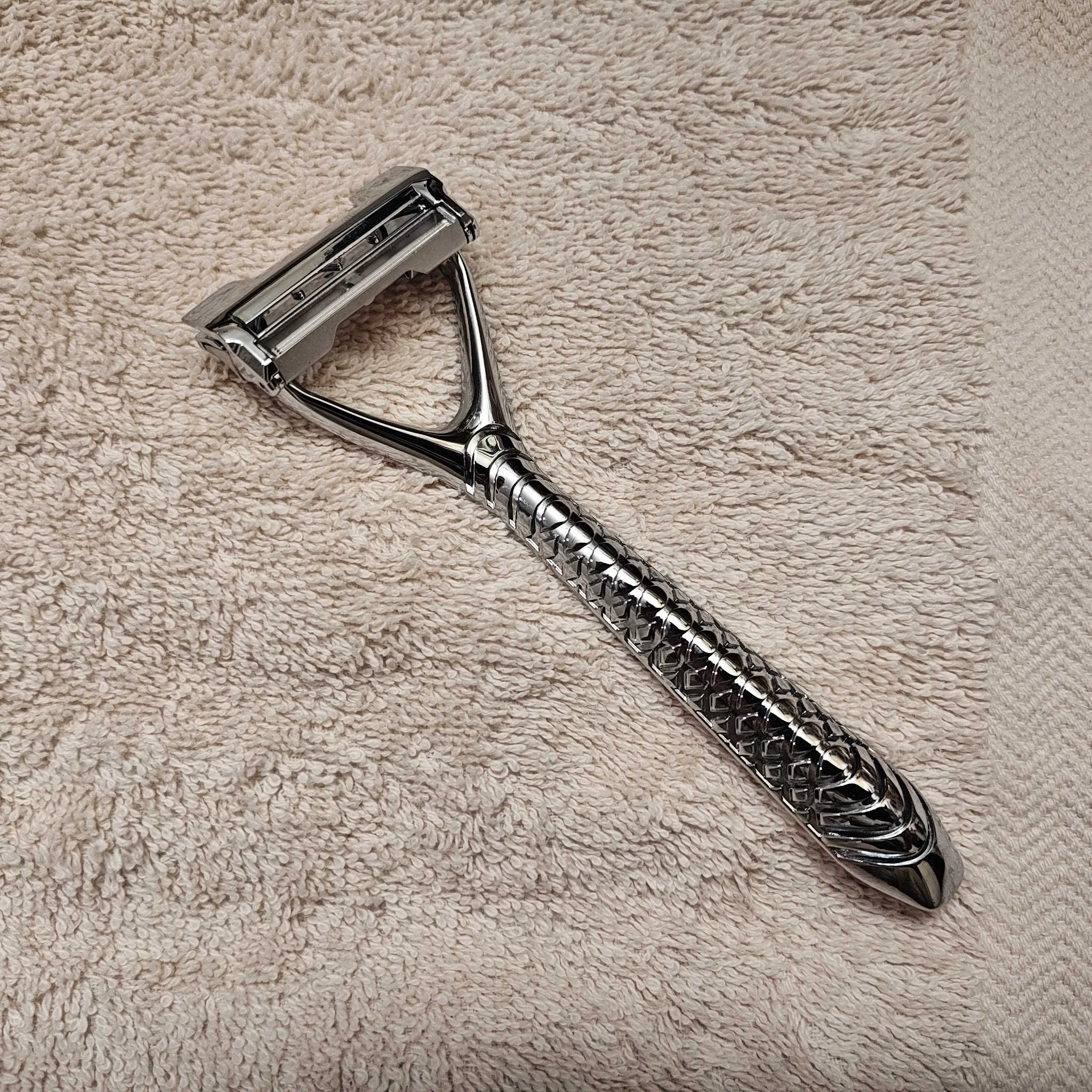
The Leaf Two, sometimes referred to as the Leaf 2 Razor, is one of those razors that’s easier to describe mechanically than categorize. It’s a two-blade, pivoting-head safety razor that uses safety razor blades, but it does not behave like a traditional double-edge razor. It also borrows some familiar ideas from cartridge shaving without becoming a cartridge razor.
That makes the Leaf Two interesting, but it also makes expectations important. If you come to it expecting a traditional DE experience with a pivot, you may be disappointed. If you come to it expecting a cartridge razor that magically fixes irritation, you may also be disappointed. The Leaf Two is as a hybrid: a safety-blade razor with a pivoting head that reduces some angle-management demands while preserving several shaving problems the user still has to manage.
Quick Answer
The Leaf Two Razor is best suited for shavers who want a pivoting safety razor that feels more familiar than a traditional fixed-head DE razor. It’s most appealing for cartridge-transition users, body shavers, and shavers who like the idea of safety razor blades but don’t want to manage angle as actively on every stroke.
Its main tradeoff is that the pivoting head makes the razor more forgiving around angle, but the large head and hybrid design make it less ideal for detailed face shaving. In Sharpologist testing, the Leaf Two performed better as a body-shaving razor than as a face or detail razor.
Traditional DE users who want direct blade feedback, compact head control, and precise under-nose maneuverability may not find the Leaf Two especially satisfying. It is not a bad razor, but it is a fit-dependent razor.
Bottom Line
[Note: I received a Leaf Two razor from Leaf Shave for evaluation. However the opinions expressed here are mine and have not been reviewed or approved by Leaf. Leaf links (tidd.ly) are affiliate. Geni.us links may be affiliate.]
The Leaf Two is a capable hybrid safety razor, but its strongest use case is not necessarily the one every wet shaver will expect.
Across my test shaves, the Leaf Two felt most convincing as a body-shaving razor. The pivoting head does help maintain cutting angle once the correct hand position is found, and the relatively loose pivot makes the razor less pressure-sensitive than many fixed-head safety razors. But the large head makes precision work more difficult, especially around the nose and other tight areas, and the relatively loose pivot action tended to “skip” over my hard, grey stubble.
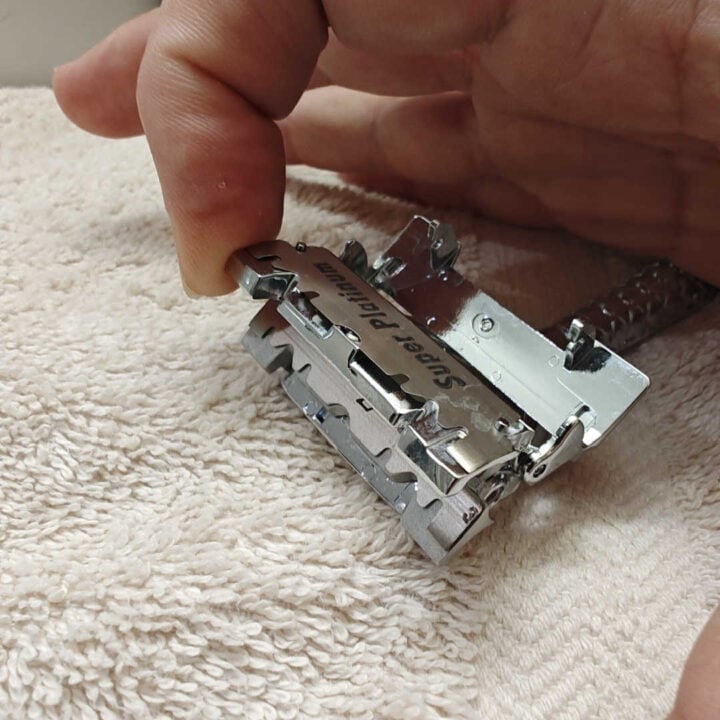
The best version of the Leaf Two shave for me came with two blade positions loaded. One-blade loading was just as easy, but the shave quality dropped noticeably. Surprisingly, irritation from repeated passes was more of a problem with one blade loaded than with two.
That is my take: the Leaf Two is not simply “safer because it pivots” or “more irritating because it has two blades.” Its behavior depends on how the pivot, blade count, head size, grip, and user pressure interact.
What The Leaf Two Razor Is
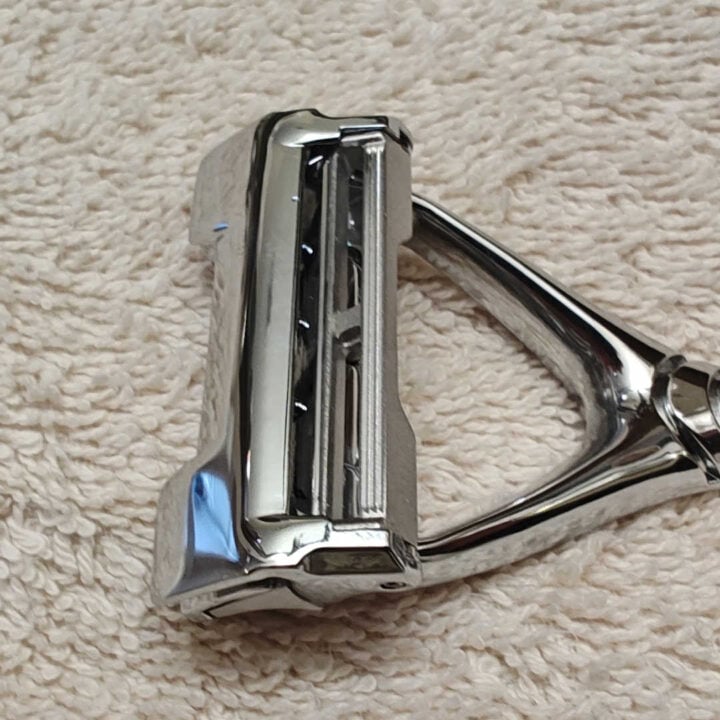
The Leaf Two is a two-blade pivoting safety razor from Leaf. Leaf positions it as a solid metal razor that uses replaceable safety razor blades rather than disposable cartridge heads. The design is intended to offer some of the convenience and contour-following behavior of a pivoting razor while using safety razor blades.
That puts the Leaf Two in an unusual category. It’s not a conventional double-edge safety razor. It’s not a cartridge razor. It’s not the same thing as Leaf’s Twig or Thorn, which are closer to fixed-head single-edge safety razors. It’s also not quite the original Leaf razor, which is commonly associated with the larger multi-blade pivoting Leaf format.
I think the Leaf Two is best thought of as a hybrid shaving tool. The relevant question is not whether it is a “real” safety razor, but what the hybrid design actually does for the shave.
In my testing, the answer was mixed. The pivot helped with angle maintenance once the right hand position was found. The two-blade configuration worked better than using one blade. The large head and wet grip were the biggest practical limitations.
How The Leaf Two Shaves
To me, the Leaf Two does not shave like a traditional DE razor with a pivot added to it. It feels more like a middle ground between a cartridge razor and a safety razor.
The pivot is a major part of that feel. It’s relatively loose, which means the head follows contours without demanding the same constant angle correction required by a fixed-head DE razor. That can make the razor easier to use across broader surfaces.
But the user still has to find the right hand-holding angle first. Once that hand position is found, the pivoting head does a good job of maintaining the cutting angle. Before that point, however, the razor can feel less intuitive than the idea of a pivoting safety razor might suggest.
The shave quality was clearly better with two blades loaded than with one for me. One-blade loading was just as easy mechanically, but the shave itself was not as good. That matters because some users may assume that loading one blade would make the Leaf Two milder, simpler, or less irritating. In my testing, that was not the case.
The rinse behavior was good. Clogging was not a major issue. That’s important for a razor with a larger pivoting head and two blade positions because poor rinsing could have made the design feel more cumbersome.
The grip was a larger concern. Without the silicone handle grip, the handle was poor when wet for me. With the silicone grip, my experience improved markedly, but that grip is an extra-cost accessory. For a razor that may appeal to head and body shavers, wet grip is not a small detail. It directly affects confidence and control.
Pivoting Head vs Traditional Safety Razor Angle Control
The Leaf Two changes the angle problem, but it doesn’t eliminate technique.
A traditional safety razor asks the user to manage the relationship between handle angle, blade angle, pressure, and stroke direction. That’s one reason DE razors can feel awkward at first. A fixed head gives strong feedback, but it also makes the user responsible for maintaining a consistent cutting angle.
The Leaf Two reduces some of that burden. Once the user finds a workable hand position, the pivot helps the head follow the skin. This can be especially useful over larger curved areas where a fixed-head razor requires more conscious adjustment.
But that does not mean the razor shaves automatically. The user still has to manage pressure, pass count, and shaving direction. The pivot may make the Leaf Two easier to move across the skin, but it does not turn poor shaving habits into good ones.
This distinction matters because many shavers misunderstand what a pivot can do. A pivot can help maintain contact and reduce some angle errors. It cannot prevent over-shaving or fix poor lather.
The Leaf Two is easier around angle than many fixed-head razors, but it still rewards restraint.
Efficiency vs Blade Feel
With two blades loaded, the Leaf Two produced a better overall shave for me than it did with one blade loaded. The difference was noticeable enough that one-blade use does not appear to be the best default configuration for this razor.
The Leaf Two’s blade feel is also shaped by the pivot and head design. It does not deliver the same direct blade feedback as a traditional DE razor. Experienced DE users may read that as a loss of precision. Cartridge users may read it as familiarity.
Both reactions are understandable. The Leaf Two is not trying to be a highly communicative fixed-head razor. I think it’s trying to make safety-blade shaving feel more approachable across larger surfaces.
How Forgiving Is It?
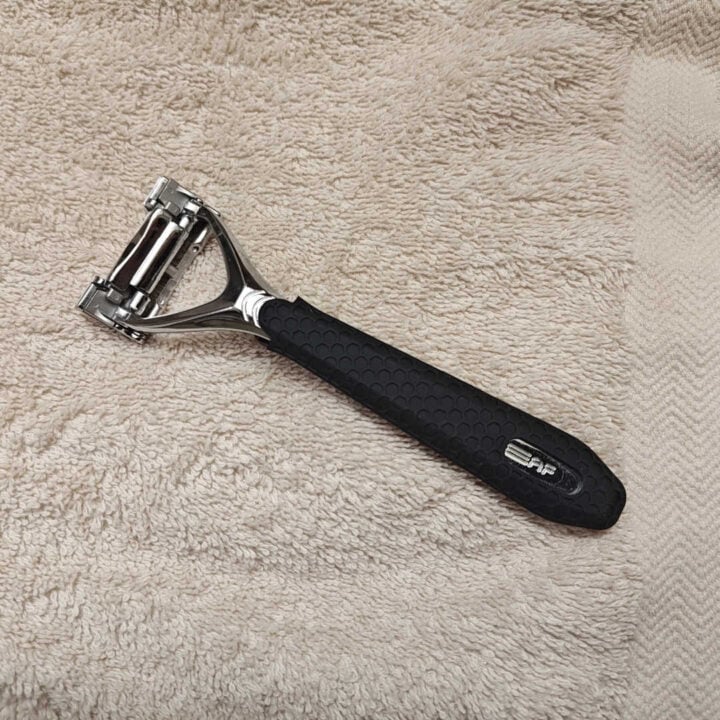
The Leaf Two is forgiving in some ways and less forgiving in others.
It’s forgiving around angle once the user finds the correct hand position. The pivot helps maintain the blade relationship to the skin, so the user doesn’t have to micromanage angle as aggressively during the stroke.
It’s also somewhat forgiving around pressure because of the loose pivot. The head movement lessens some pressure sensitivity compared with fixed-head razors, where excess pressure often translates immediately into harshness.
But the Leaf Two is not universally forgiving. The large head makes detailed shaving more difficult. Under-nose work and tight facial areas are not where this razor feels strongest. A razor can be forgiving on broad surfaces and still awkward in detail zones.
The loose pivot strength can also cause a skipping sensation over coarser hair–in my case grey hair in the chin area.
The grip also affects forgiveness. A razor with a wet handle that feels insecure can make the user compensate unconsciously. The silicone grip improves that problem, but if the grip is an extra accessory, it should be considered part of the practical cost of getting the best version of the Leaf Two experience.
Face Shaving, Head Shaving, And Body Shaving
I think the Leaf Two makes the most sense when the shaving surface is broad enough to take advantage of the pivot.
In my testing, it was not as good for face shaving or detail shaving. The large head made precision work challenging, and the razor did not feel as naturally suited to facial detail areas as a narrower fixed-head safety razor or single-edge razor.
The Leaf Two was better for body shaving. That use case fits the design more naturally. A pivoting head, broader head structure, and less active angle management all make more sense when the razor is working across larger surfaces rather than tight contours around the nose or mouth.
Although I do not shave my head, head shavers I have talked to have generally described the Leaf Two as a good fit for head shaving. That makes sense to me, because the pivoting head and broader shaving surface seem better suited to larger curved areas than to facial detail work.
That use case fits the design more naturally. A pivoting head, broader head structure, and less active angle management all make more sense when the razor is working across larger surfaces rather than tight contours around the nose or mouth.
This does not mean the Leaf Two cannot shave the face–it can. But “can shave the face” and “best suited for face shaving” are different conclusions.
For a daily face shaver who values detail control, a Twig, Thorn, or traditional DE razor may make more sense depending on the user’s preferences. For a body shaver or a cartridge-transition shaver who wants something more durable and safety-blade based, the Leaf Two’s design becomes more compelling.
Leaf Two vs Original Leaf Razor
The most natural comparison is the original Leaf razor, because both designs occupy the modern pivoting safety razor category.
The Leaf Two should not be treated simply as “less original Leaf” or “newer original Leaf.” Its two-blade format, head feel, and use case need to be judged on their own. The original Leaf has often been discussed as a head and body shaving tool, and the Leaf Two appears to live in a related but more focused lane.
The likely buyer question is whether the Leaf Two simplifies the Leaf idea. The answer depends on what the user wants simplified. If the user wants fewer blades than the original Leaf format and likes the idea of a pivoting razor, the Leaf Two may be attractive. If the user wants better detail control, the two-blade pivoting format does not automatically solve that.
The Leaf Two feels more like a hybrid shaving tool than a replacement for every Leaf family razor.
Leaf Two vs Twig And Thorn
The Twig and Thorn are important comparisons because they represent a different answer to the same broad problem: how to make safety-blade shaving more approachable.
The Twig and Thorn are closer to traditional single-edge safety razors. They use a more familiar fixed-head logic, and they are better aligned with shavers who want more direct blade feedback, cleaner lines, and a narrower shaving head.
The Leaf Two goes in the other direction. It uses the pivot to reduce some active angle management, but it gives up some of the detail-friendly behavior many experienced safety razor users value.
That makes the choice less about which razor is “better” and more about which problem the user is trying to solve.
Choose the Leaf Two if you want a pivoting safety-blade razor for larger shaving areas or cartridge transition. Consider the Twig or Thorn if you want something that feels closer to traditional wet shaving while still using a modern Leaf-style format.
Leaf Two vs A Traditional DE Safety Razor
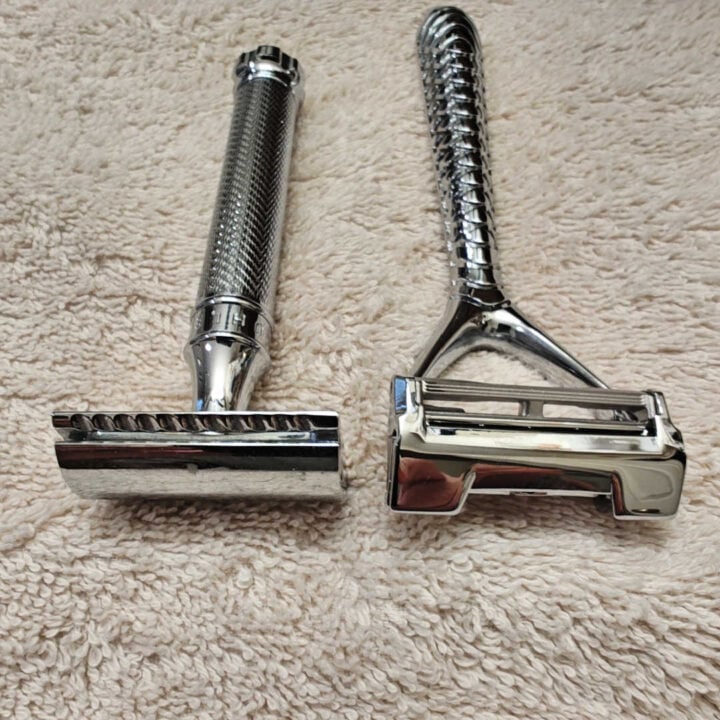
The Leaf Two is not a direct replacement for a traditional DE safety razor.
A DE razor gives the user more direct control over angle, blade feel, pressure feedback, and detail work. That control is the point for many experienced wet shavers. It is also the reason some beginners struggle with DE shaving at first.
The Leaf Two reduces some of that learning burden. The pivot can make the razor easier to use once the hand position is established. But the result is a less traditional shaving experience.
For a committed DE shaver, the Leaf Two may feel less precise. For a cartridge user, it may feel more familiar. For a head or body shaver, it may feel more practical. For a face shaver who wants clean detail work, it may feel bulky.
That’s the tradeoff.
Who The Leaf Two Is Best For
I think the Leaf Two may be best for shavers who want some of the familiarity of a pivoting razor while moving away from disposable cartridge systems.
It is especially worth considering for:
- Body shavers who want a pivoting metal razor with safety razor blades
- Cartridge-transition users who are not ready for a fixed-head DE razor
- Shavers who struggle with angle management on broad surfaces
- Existing Leaf users who want to try the two-blade version
- Shavers who value rinse behavior and a less fussy blade-loading experience
The Leaf Two is also a reasonable candidate for someone who understands that it is a hybrid tool. It’s not the purest traditional wet shaving experience, but that’s not necessarily a flaw. It depends on what the reader wants the razor to do.
Who Should Skip The Leaf Two
The Leaf Two is probably not the best choice for shavers who want a compact, detail-friendly face razor.
You may want to skip it if:
- You mostly shave the face and care about under-nose precision
- You want the direct blade feedback of a traditional DE razor
- You dislike large razor heads
- You dislike multi-blade contact
- You expect the pivot to fix pressure problems
- You want the lowest upfront cost
- You do not want to buy or use the silicone grip to improve wet handling
That last point is important. If the handle feels poor when wet without the added grip, the real-world experience may depend on an accessory that is not part of the base feel of the razor.
What The Leaf Two Teaches About Shaving
The Leaf Two shows that razor design can reduce some shaving demands while leaving others in place.
The pivot helps with angle maintenance. Once the user finds the right hand position, the head can maintain a usable angle across the skin more easily than many fixed-head razors.
But the pivot does not make pressure irrelevant. The broader lesson is having comfort does not come from one feature. It comes from the interaction between razor design, blade exposure, pressure, angle, lather, surface being shaved, and the user’s expectations.
The Leaf Two is a good case study because it changes the feel of the shave without removing the need for judgment.
What The Leaf Two Will Not Fix
The Leaf Two will not fix excess pressure.
It will not fix rushed shaving. It will not fix poor lather. It will not fix repeated cleanup strokes over skin that has already had enough. It will not turn a face razor into a detail tool if the head is too large for the area being shaved.
It also will not automatically reduce irritation just because it has a pivot. In testing, the pivot did not particularly improve comfort, but it also did not mask feedback. That’s actually useful. A razor that hides bad feedback can encourage the user to keep shaving past the point where the skin is tolerating the shave.
The Leaf Two gives the user a different kind of control. It does not remove the need for control.
Internal Next Step
If you are deciding whether the Leaf Two makes sense, the next question is not just “Is this a good razor?” The better question is “Which part of shaving am I trying to make easier?”
If you struggle with angle management on broad surfaces, the Leaf Two may be worth considering. If your main problem is pressure, repeated passes, or irritation after chasing closeness, a different razor may not solve the underlying problem. If you struggle with repeated passes or irritation after chasing closeness, a different razor may not solve the underlying problem.
Readers who are still sorting out razor fit should start with Sharpologist’s razor decision or diagnostic resources, then compare the Leaf Two against the kind of shaving problem they are actually trying to solve.
Conclusion
The Leaf Two is a hybrid safety razor with a clear point of view. It’s not trying to be a classic DE razor, and it should not be judged only by classic DE standards. It’s also not simply a cartridge razor with cheaper blades.
Its strongest argument is convenience across larger shaving areas, a pivoting head, and a safety-blade format that feels more approachable than a fixed-head DE razor. Its weaknesses are face-detail control, wet grip without the added sleeve, and the fact that the pivot changes angle behavior more than it changes the fundamentals of shaving pressure and pass discipline.
For body shaving or cartridge transition, the Leaf Two has a real use case. For traditional face shaving, especially detail work, it is more conditional. That does not make it a bad razor. It makes it a razor whose value depends heavily on what the user expects it to solve.
