

Quick Answer: You can compare multiple razors without owning many by stabilizing your technique, keeping a consistent baseline, and giving differences time to reveal themselves. Buying more razors usually makes comparisons noisier, not clearer.
Why Razor Comparison Gets Out Of Hand So Fast
Most shavers don’t set out to buy a pile of razors. They set out to understand them.
The intent is usually reasonable. You want to know how different razors feel, which ones are more forgiving, and why certain designs seem easier or harder to use. Somewhere along the way, curiosity turns into accumulation.
That happens because of an unspoken assumption:
Good comparisons require ownership.
Once that idea takes hold, buying feels like progress. In practice, it often makes clarity harder to reach.
What You Are Actually Trying To Learn When You Compare Razors
When people say they want to compare razors, they’re rarely asking about metal dimensions or manufacturing tolerances.
They’re trying to learn how a razor behaves in use. Questions like:
- How forgiving is this razor when my angle is slightly off?
- How much attention does it demand?
- How does my skin feel the next day?
Those are questions about interaction, not hardware.
Once you see comparison this way, it becomes clear why owning more objects does not automatically produce better answers.
Why Many Razors Make Comparisons Worse, Not Better
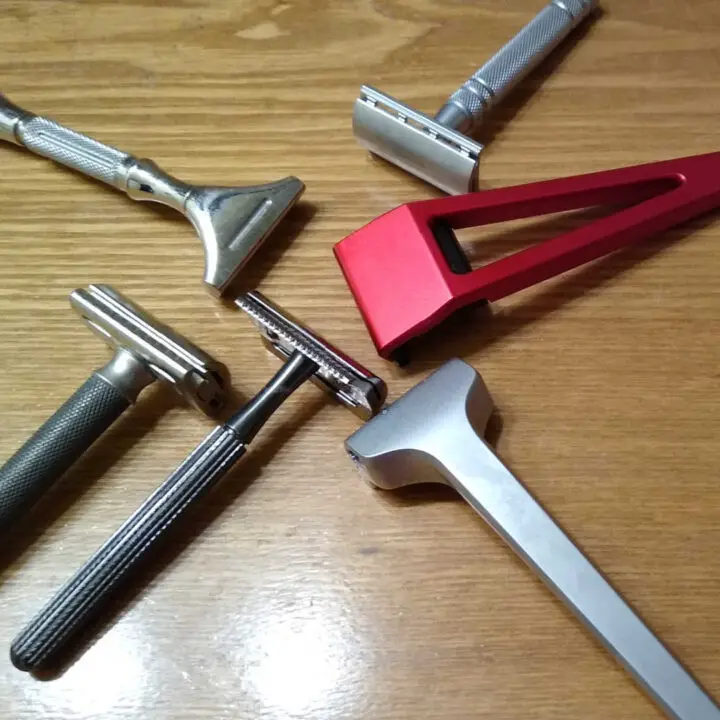
Adding razors usually increases noise before it increases insight.
Each new razor introduces:
- novelty bias
- a short testing window
- shifting expectations
- fewer reference points
Without a stable anchor, everything blurs together. Differences feel inconsistent or disappear altogether. The common conclusion becomes, “They all shave the same,” which is rarely true in the long run.
Why Everything Feels The Same At First
This is one of the most common frustrations in shaving forums, and it’s completely normal.
Early on, perceptual detail is low. Your hands, face, and expectations are still calibrating. Small differences exist, but you don’t yet have the experience to detect differences reliably.
That doesn’t mean the razors are identical. It means perception hasn’t stabilized yet.
Buying more razors at this stage more often than not delays that stabilization.
The Baseline Razor Concept
Meaningful comparisons require a reference.
A baseline razor is one you know well enough that its behavior feels predictable. Returning to it regularly anchors perception. Without that anchor, every shave becomes a first impression.
Differences only become visible when something stays the same.
This is not about choosing the “best” razor. It is about having a stable reference point so other experiences can be interpreted accurately.
Technique Normalization (The Silent Comparison Killer)
One reason razor comparisons fail is that technique adapts automatically.
As you shave, your hands tend to adjust pressure, angle, and stroke length without conscious intent. The razor feels usable because you are making it usable.
That adaptation is useful for shaving, but it’s terrible for comparison.
You are often adapting faster than you are observing. By the time you try to evaluate the razor, you have already normalized its behavior.
One Variable At A Time (Without Turning This Into A Lab)
When people struggle to compare razors, blades are often the hidden complication during comparisons.
Blades dominate feel. Changing them mid comparison may invalidate conclusions, even when everything else feels controlled.
This doesn’t mean testing needs to become rigid or scientific. It means recognizing that comparison collapses when too many variables move at once.
Clarity comes from stability, not precision.
Time Is The Hidden Comparison Tool
Most razor differences do not reveal themselves during the first shave.
They appear across days:
- when fatigue sets in
- when concentration slips
- when skin recovery matters
- when consistency is tested
First impressions are loud but unreliable. Week two is quieter and more honest.
Time turns noise into signal.
What To Pay Attention To Instead Of Closeness
Closeness is a tempting metric because it is immediate and easy to feel. It’s also a poor comparison tool.
More useful signals include:
- how forgiving the razor is when conditions are not perfect
- how much effort it takes to maintain control
- how your skin feels the next day
- how repeatable the shave feels over time
These traits matter more than peak smoothness, especially when evaluating tools.
Collecting Vs Learning (And Why People Confuse Them)
Collecting razors is a valid hobby. Learning how to shave better is a different goal.
Problems arise when those goals are mixed.
Ownership does not equal understanding. Accumulation does not guarantee insight. Advice meant for collectors often fails learners because the objectives are different.
Recognizing which goal you are pursuing prevents a lot of frustration.
The Psychology Behind Over Buying For Comparison
Waiting feels passive. Buying often feels like action.
When results are unclear, it is easy to assume the missing piece is another razor. Forum posts often reinforce that idea. Justifying purchases becomes part of the process.
In reality, clarity usually comes from restraint.
Noticing this pattern makes it easier to step out of it.
Conclusion: Fewer Razors, Clearer Answers
Comparing razors is not about owning more tools. It is about creating the conditions where differences can actually be seen. Stable technique, consistent references, and time do more for understanding than accumulation ever will.
You do not need to own everything to understand anything.

This is a thoughtful article with solid advice. I don’t disagree with any of it, but I am not sure how practicing this advice removes the need to actually use a new razor. These suggestions will certainly slow down the impulse to try a new razor by creating a baseline and revealing what it is you are looking for in a new razor, but you still have to acquire it and use it to evaluate it. So instead of buying 13 new razors in a year it may take 2 or 3 years to find those that meet you requirements for a close comfortable shave.
ah, ah, ah,.